How it works · Math of money
The Rule of 72 Explained: How Fast Money Doubles
Divide 72 by the yearly rate to estimate how long money takes to double. The formula, worked examples, a calculator, an accuracy table and why 72.
Checked against 14 sources (13 textbook, course or government) · By Ambient Math editors
The short answer. Divide 72 by the yearly interest rate, in percent, to estimate the years it takes money to double1. At a 9% rate that is 72 ÷ 9 = 8 years1. The shortcut assumes compound interest and a rate that stays the same, and it is accurate for rates from 6% to 10%79.
- Years to double
- About 72 ÷ the yearly rate in percent1
- Rate you need
- Double in 15 years: 72 ÷ 15 = 4.8%7
- Best range
- 6% to 10%; the error is 2.4% to 14.0% outside it9
- Exact version
- t = ln(2) ÷ ln(1 + r)11
- Debt
- A $1,000 balance at 18%, unpaid, doubles in 4 years10
On this page
- What the Rule of 72 says
- The formula, step by step
- Worked examples with savings
- How long does it take $100,000 to double?
- Does the Rule of 72 actually work?
- Why 72? The derivation
- Continuous compounding and the rule of 69.3
- Debt, inflation and fees
- A real-world check: savings bonds
- Working backwards: what rate do I need?
- Where the rule comes from
- Limits of the shortcut
- Next steps
Money that earns interest on its own interest grows in jumps of equal length, and the Rule of 721 turns those jumps into one division you can do in your head. Below you get the formula and how to run it forwards and backwards, a calculator, worked examples for savings, debt, inflation and fees, a table of how far off the shortcut drifts, the reason the number is 72, and where the idea comes from. It is arithmetic, not advice: it says what a rate implies, not what any investment will earn. The money section has the formulas around it.
What the Rule of 72 says
To estimate how long an investment takes to double, divide 72 by its expected rate of return; the result is the number of years1. At a 9% rate of return an investment doubles about every 8 years, because 72 divided by 9 equals 81. The rule works on compound interest, which is the interest you earn on interest1. These rules apply to exponential growth, so they fit compound interest and not simple interest11.
Here is what compounding looks like with small numbers. Start with $100 earning 5% a year: $105 after the first year and $110.25 after the second, because the second year’s interest is paid on the first year’s interest too1. In 10 years that account holds more than $162, and in 25 years almost $340 (our arithmetic)1. The doubling time does not depend on how much money you start with, only on the rate8. So $1,000 and $1,000,000 take the same number of years to double at the same rate.
The same one-line division answers several questions:
| You know | You want | Rule | Example |
|---|---|---|---|
| The yearly rate | Years to double | 72 ÷ rate | 8% gives 72 ÷ 8 = 9 years6 |
| Years to double | The rate you would need | 72 ÷ years | 15 years needs 72 ÷ 15 = 4.8%7 |
| An inflation rate | Years until buying power halves | 72 ÷ inflation rate | 5% a year gives 72 ÷ 5 = 14.4 years7 |
| A debt’s interest rate | Years until an unpaid balance doubles | 72 ÷ rate | 18% gives 72 ÷ 18 = 4 years10 |
| A yearly fee | Years until the fee takes half | 72 ÷ fee | 3% gives 72 ÷ 3 = 24 years11 |
The rule estimates either the interest rate or the time period needed for a sum of money, of any amount, to double6. It is useful for mental calculations or when only a basic calculator is available11.
The formula, step by step
- Write the rate as a whole number of percent. The formula is 72 divided by the annual interest rate in percent, so 9% goes in as 910.
- Divide 72 by the rate. The result is the number of periods needed to double, in years when the rate is yearly11.
- Read the answer in the same unit as the rate. A monthly rate gives months, a yearly rate gives years11.
- Repeat for each further doubling. At 6% the money doubles in 12 years, and after another 12 years it doubles again10.
- To go backwards, divide 72 by the years you have. That gives the rate the money would have to earn6.
Try your own numbers
Doubling-time calculator
Yearly compounding, one steady rate. Nothing you type leaves this page.
- The shortcut gives
- –
- Exact doubling time
- –
- Rule is off by
- –
- Value after the years held
- –
The default inputs reproduce the Rutgers example below, so you can see the shortcut and the exact answer agree to within a quarter of a percent.
Worked examples with savings
Start with a $1,000 gift in an account that earns 6% a year. Seventy-two divided by 6 is 12, so the $1,000 becomes $2,000 in 12 years10. Leave it alone for another 12 years and it doubles again, to $4,00010.
A longer example shows why starting early matters. Rutgers Cooperative Extension follows a $2,000 investment that earns an average of 8%, with 9 years per doubling6. One investor starts at age 22 and another at age 31.
| Age | Started at 22 | Started at 31 |
|---|---|---|
| 31 | $4,0006 | – |
| 40 | $8,0006 | $4,0006 |
| 49 | $16,0006 | $8,0006 |
| 58 | $32,0006 | $16,0006 |
| 67 | $64,0006 | $32,0006 |
The investor who waited lost the last doubling period, where the real payoff occurs6. The two accounts differ by exactly one doubling.
Worked example (our arithmetic). Inputs6: $2,000 at 8% a year. Shortcut1 against exact growth11.
| Check | Calculation | Result |
|---|---|---|
| Rule, age 22 to 67 | 45 years ÷ 9 years = 5 doublings; 2,000 × 2^5 | $64,0006 |
| Exact, 45 years | 2,000 × 1.08^45 | $63,840.9011 |
| Rule, age 31 to 67 | 36 years ÷ 9 years = 4 doublings; 2,000 × 2^4 | $32,0006 |
| Exact, 36 years | 2,000 × 1.08^36 | $31,936.3411 |
| Shortcut error | 64,000 against 63,840.90 | about 0.25% too high11 |
An average return is an assumption and not a promise, and in the Rutgers example the 8% is an assumed figure6.
How long does it take $100,000 to double?
The answer depends on the rate and not on the amount8. At 8%, 72 ÷ 8 = 9 years, so $100,000 becomes $200,000 in 9 years, $400,000 in 18 and $800,000 in 27 (our arithmetic)6. At 3% the same doubling takes 72 ÷ 3 = 24 years (our arithmetic)11.
Worked example (our arithmetic). Inputs: a $100,000 start and the rates in the first column. Shortcut1 against the exact time t = ln(2) ÷ ln(1 + r)11.
| Yearly rate | Rule of 72 | Exact time | Value after 27 years, exact |
|---|---|---|---|
| 3% | 24.0 years | 23.45 years | $222,12911 |
| 5% | 14.4 years | 14.21 years | $373,34611 |
| 7% | 10.3 years | 10.24 years | $621,38711 |
| 8% | 9.0 years | 9.01 years | $798,80611 |
| 10% | 7.2 years | 7.27 years | $1,310,99911 |
The last column is the amount after 27 years of yearly compounding (our arithmetic), 100,000 × (1 + r)^2711.
Does the Rule of 72 actually work?
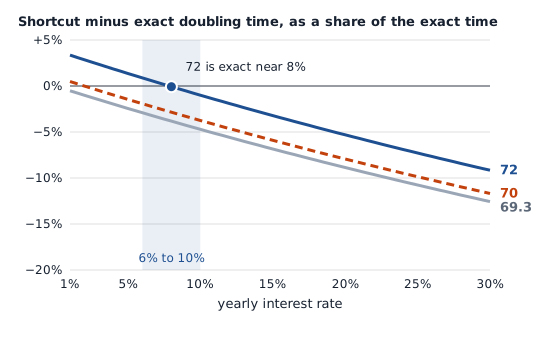
It works well in a band. The rule is only an approximation that is accurate for interest rates from 6% to 10%, and outside that range the error varies from 2.4% to 14.0%9. The 72 is most accurate for periodically compounded interest around 8%11. A band of rates of about 20% and below also covers commonplace investment earnings6.
The table is Wikipedia’s comparison of exact doubling times with three shortcuts11. The last column is our arithmetic: how far the rule of 72 sits from the exact time11.
| Yearly rate | Exact years | Rule of 72 | Rule of 70 | Rule of 69.3 | 72 off by |
|---|---|---|---|---|---|
| 1% | 69.661 | 72.000 | 70.000 | 69.300 | +3.4%11 |
| 2% | 35.003 | 36.000 | 35.000 | 34.650 | +2.8%11 |
| 4% | 17.673 | 18.000 | 17.500 | 17.325 | +1.9%11 |
| 6% | 11.896 | 12.000 | 11.667 | 11.550 | +0.9%11 |
| 8% | 9.006 | 9.000 | 8.750 | 8.663 | −0.1%11 |
| 10% | 7.273 | 7.200 | 7.000 | 6.930 | −1.0%11 |
| 12% | 6.116 | 6.000 | 5.833 | 5.775 | −1.9%11 |
| 20% | 3.802 | 3.600 | 3.500 | 3.465 | −5.3%11 |
| 30% | 2.642 | 2.400 | 2.333 | 2.310 | −9.2%11 |
| 50% | 1.710 | 1.440 | 1.400 | 1.386 | −15.8%11 |
The figure draws the same error as curves. The rule of 72 crosses zero near 8% and drifts away on both sides, the rule of 70 crosses near 2%, and the rule of 69.3 never rises above the exact time11.
At 8% the check is clean. The exact answer for a $100 investment at 9% is 8.0432 years and the rule gives 72/9 = 8, which is close9. A rate that high or low pulls the answer away. At 20%, the exact time is 3.802 years and the rule gives 3.60011.
Adjusting for high or low rates
Two fixes exist. For every three percentage points away from 8%, the value 72 can be adjusted by 19. And the choice of number is mostly preference: 69 is more accurate for continuous compounding, while 72 works well in common interest situations and is more easily divisible11. For higher annual rates, 78 is more accurate11. The ideal numerator is just rate times exact years; Wikipedia’s table lists it as 72.052 at 8%, 76.036 at 20% and 85.476 at 50%11.
Why 72? The derivation
Money doubles when the future value is twice the present value9. For yearly compounding that condition is (1 + r)^t = 2, and taking the natural log of both sides solves it: t = ln(2) ÷ ln(1 + r)11. Scientific calculators and spreadsheets have functions for this exact time11. The same algebra gives the doubling time of any exponential model: set the quantity equal to twice its start, take the natural logarithm, and divide by the growth coefficient5.
The rule comes from replacing ln(1 + r) with r. If r is small, ln(1 + r) approximately equals r, and with the approximation ln 2 ≈ 0.693147 the doubling time becomes about 0.693 ÷ r, or 69.3 ÷ the rate in percent9. So for very small rates, 69.3 would be more accurate than 729.
Then why not use 69.3? Because 72 is a convenient choice: it has so many small divisors, 2, 3, 4, 6, 8, 9 and 129. Try dividing 69.3 by 8 in your head and then 72 by 8. At typical rates, ln(1 + r) runs a little below r, and the difference pushes the best numerator up from 69.3 toward 72 near 8%11.
Continuous compounding and the rule of 69.3
Compounding more often lifts the final amount, but only up to a ceiling. For $1 at 5% over 10 years the growth factors are 1.63 compounded yearly, 1.64 quarterly, 1.65 monthly and 1.65 daily, and they never rise above 1.64878. That limit is continuous compounding.
With continuous compounding the time to double is .69/r, because the natural log of 2 is .698. The rule of 72 is left over from days when compounding was infrequent8. Daily compounding is close enough to continuous that 69.3 or 70 should be used instead of 729.
Worked example (our arithmetic). Inputs8: doubling at 4% and 12%. Continuous row: 69.3147 ÷ rate9.
| Compounding | Doubling at 4% | Doubling at 12% |
|---|---|---|
| Yearly | 18 years8 | 7 years8 |
| Quarterly | 17.5 years8 | 6 years8 |
| Monthly | 17.33 years8 | 5.83 years8 |
| Daily | 17.27 years8 | 5.76 years8 |
| Continuous | 17.33 years9 | 5.78 years9 |
The yearly row is rounded up to whole years, because the source uses the lowest time consistent with a whole number of years, quarters, months or days8.
Debt, inflation and fees
Every use above has a mirror image. The rule gives the same number whether money is working for you or against you.
Debt
A credit card balance is the clearest case. With an 18% annual rate and nothing paid, a $1,000 balance doubles in 72 ÷ 18 = 4 years10. That leaves out late fees and penalties for non-payment10. The Federal Reserve’s consumer credit release of October 7, 2026 lists 22.36% for credit card accounts assessed interest in the latest column, August 20263.
Worked example (our arithmetic). Input3: 22.36% a year. Shortcut1 against the exact time11.
| Rate | Rule of 72 | Exact (yearly compounding) |
|---|---|---|
| 22.36% | 72 ÷ 22.36 = 3.22 years | 3.43 years11 |
At this high a rate the shortcut runs about 6% fast on the low side, as the accuracy table predicts9. A balance doubles in that time only if no payments are made10. The loan payoff page shows what regular payments do to the same balance.
Inflation
Inflation halves buying power the way interest doubles money. Financiers divide the rule number by the inflation rate11. At 5% a year, money is worth half its original value in 72 ÷ 5 = 14.4 years7. With 3.5% inflation and the rule of 70, a unit of currency halves in about 70/3.5 = 20 years11. The Federal Reserve’s longer-run goal is 2% inflation, measured by the price index for personal consumption expenditures4. Worked example (our arithmetic): at 2%, 72 ÷ 2 = 36 years for prices to double, against an exact 35.0 years411. The formula assumes the rate stays the same through the period7.
Fees
Fees are a rate too. A 3% annual fee over and above the cost of the underlying fund cuts the account to 50% in 72 / 3 = 24 years and to 25% in 48 years, compared with holding the same investment outside the policy11. Even small differences in fees can translate into large differences in returns over time, and a high-cost fund must perform better than a low-cost one to generate the same returns13.
Worked example (our arithmetic). Inputs: a 7% return, with and without a 1% fee. Shortcut1.
| Net rate | Rule of 72 | Exact |
|---|---|---|
| 7% | 72 ÷ 7 = 10.3 years | 10.24 years11 |
| 6% (7% less a 1% fee) | 72 ÷ 6 = 12 years | 11.90 years11 |
| Difference per doubling | 12 − 10.3 = 1.7 years | 1.66 years11 |
A real-world check: savings bonds
The U.S. Treasury publishes a doubling promise you can test. For EE bonds bought now, Treasury guarantees the bond will double in value in 20 years, even if it has to add money at 20 years to make that happen2. Run the rule backwards: 72 ÷ 20 = 3.6% a year, and the exact rate is about 3.53%211.
The current rate is 2.40% for EE bonds issued May 1, 2026 to October 31, 2026, fixed for the first 20 years2. Interest is compounded semiannually, and a bond can earn interest for up to 30 years2. At 2.40% the shortcut gives 72 ÷ 2.4 = 30 years to double2.
Worked example (our arithmetic). Inputs2: 2.40% a year, compounded semiannually, 20 years. Each half-year adds 1.20%.
| Step | Calculation | Result |
|---|---|---|
| Half-years in 20 years | 20 × 2 | 402 |
| Growth factor | 1.012^40 | 1.612 |
| Value of $1,000 at year 20 | 1,000 × 1.61 | $1,6112 |
| Guaranteed value | 1,000 × 2 | $2,0002 |
| Top-up Treasury adds | 2,000 − 1,611 | about $3892 |
At today’s rate the guarantee does real work: 20 years of 2.40% would give only 1.61 times the purchase price (our arithmetic), so Treasury makes up the rest at year 202. The rate is dated October 2026 and changes for each new issue window.
Working backwards: what rate do I need?
To double money in a set number of years, divide 72 by the years. Texas A&M’s example wants to double in 15 years, which takes a product with an interest rate of 4.8%: 72 divided by 15 = 4.87. Compare with a $2,000 start in the Rutgers example, which doubles every 9 years at 8%6.
Worked example (our arithmetic). Inputs: the years in the first column. Shortcut7 against the exact rate 2^(1/t) − 111.
| Years to double | Rate by the rule | Exact rate needed |
|---|---|---|
| 5 | 14.4% | 14.87%11 |
| 10 | 7.2% | 7.18%11 |
| 15 | 4.8% | 4.73%11 |
| 20 | 3.6% | 3.53%11 |
| 30 | 2.4% | 2.34%11 |
Tripling and other targets
To find a tripling time, replace the constant 2 in the numerator with 311. To find how long it takes the initial value to rise by 35%, replace the constant 2 with 1.3511. Worked example (our arithmetic): 100 × ln 3 is about 110, so tripling takes roughly 110 ÷ rate years. At 8% that is 13.75 years against an exact 14.27, and at 5% it is 22 years against an exact 22.5211.
Where the rule comes from
An early reference to the rule is in the Summa de arithmetica of Luca Pacioli (1445–1514), printed in Venice in 149411. Pacioli was an Italian mathematician whose Summa summarized the mathematics known at that time12. His worked example translates as: when the interest is 6 percent per year, divide 72 by 6; 12 results, and in 12 years the capital will be doubled11. He did not derive or explain the rule, so it is assumed to predate him by some time11.
Limits of the shortcut
- A steady rate. The formula assumes the interest or inflation rate remains the same throughout the period7. A rate can be known, like the stated rate on a bond or certificate of deposit, or assumed, like average annual stock returns6.
- Compound, not simple, interest. The rule is for exponential growth11.
- Rates far outside 6% to 10%. The error runs from 2.4% to 14.0% beyond that band9.
- Extra costs. Late fees and penalties on a debt come on top of the interest10, and fund fees reduce what you keep13.
- Mixed periods. Use a rate and a period that match: the rule divides by the interest percentage per period11. The FDIC’s lesson applies 3 percent per month, so the rule gives 72 ÷ 3 = 24 months to double, not 24 years14.
Next steps
Take one rate from a statement, a bond or a loan, divide 72 by it, then check the answer in the calculator above. For the full formula behind the compounding, including APY and monthly periods, see the compound interest formula. To see how steady payments change a loan’s finish line, use the loan payoff page and the loan payment formula. The FDIC’s savings lesson applies 3 percent to each month’s balance, so $100 becomes $103, then $106.09, and reaches $119.41 in December14. The SEC’s compound interest explainer and the Treasury’s EE bond page are the primary sources used here.
Common questions
Does the Rule of 72 actually work?
Yes, as a mental estimate for compound growth at steady rates. At 8% the exact doubling time is 9.006 years against the rule's 911. The 6% to 10% band keeps the error small9. Simple interest and rates that swing from year to year break the assumptions711.
Read next
Compound Interest Formula: Examples and Calculator
The compound interest formula A = P(1 + r/n)^(nt) with a calculator, worked examples, solving for rate and time, APY and the Rule of 72.
Math of moneyHow Long to Pay Off a Loan: Formula and Calculator
Work out how many months a loan takes to pay off with the loan-term formula, a calculator, worked examples and what extra payments change.
Math of moneyLoan payment formula, step by step
The fixed monthly loan payment formula, a calculator, where it comes from, worked examples and common mistakes.
Sources
- What is compound interest? (Rule of 72) · Investor.gov, U.S. Securities and Exchange Commission · investor.gov · checked October 21, 2026
- EE bonds · TreasuryDirect, U.S. Department of the Treasury · treasurydirect.gov · checked October 21, 2026
- Consumer Credit - G.19, release of October 7, 2026 · Board of Governors of the Federal Reserve System · federalreserve.gov · checked October 21, 2026
- Why does the Federal Reserve aim for inflation of 2 percent over the longer run? · Board of Governors of the Federal Reserve System · federalreserve.gov · checked October 21, 2026
- 4.7 Exponential and Logarithmic Models, Precalculus · OpenStax (Rice University) · openstax.org · checked October 21, 2026
- The Rule of 72: A Tool to Measure Small Steps to Wealth · Rutgers Cooperative Extension (NJAES) · njaes.rutgers.edu · checked October 21, 2026
- Compound interest rule · Texas A&M University System News (1993), hosted by Texas A&M Mathematics · people.it.tamu.edu · checked October 21, 2026
- Continuous compounding and the rule of 72 · University of Northern Iowa, Department of Mathematics · math.uni.edu · checked October 21, 2026
- The Rule of 72, EE204 · Stanford University, Department of Electrical Engineering · web.stanford.edu · checked October 21, 2026
- How the Rule of 72 Can Help You Build Wealth, Or Sink Deeper Into Debt · University of Illinois System, Student Money Management Center · blogs.uofi.uillinois.edu · checked October 21, 2026
- Rule of 72 · Wikipedia · en.wikipedia.org · checked October 21, 2026
- Luca Pacioli, MacTutor biography · MacTutor History of Mathematics, University of St Andrews · mathshistory.st-andrews.ac.uk · checked October 21, 2026
- Mutual Fund and ETF Fees and Expenses · Investor.gov, U.S. Securities and Exchange Commission · investor.gov · checked October 21, 2026
- Chapter 5: Compound Interest · Federal Deposit Insurance Corporation · fdic.gov · checked October 21, 2026
Published . Every source shows the day it was read. Diagrams: original, by the editors. How we check facts · Report an error.