How it works · Math of money
Loan payment formula: how to calculate a monthly payment, step by step
The fixed monthly loan payment formula, a calculator, where it comes from, worked examples and common mistakes.
Checked against 7 sources (5 textbook, course or government) · By Ambient Math editors
The short answer. A fixed monthly loan payment is the loan amount times the monthly rate, divided by one minus (1 plus the monthly rate) raised to the negative number of payments5. For $100,000 over 30 years at four percent, that comes to $477 a month1.
- You need
- Loan amount, yearly rate, number of years
- Convert
- Yearly rate divided by months in a year; years times months in a year
- Works for
- Fixed-rate loans paid monthly, in equal installments
- Not included
- Taxes, insurance and fees1
On this page
- The formula in one line
- Worked example 1: a 30-year mortgage
- Try your own numbers
- How to calculate the monthly loan payment, step by step
- Where the formula comes from
- The interest rate: turning an APR into a monthly rate
- The fixed amount of the monthly payment, and what the term does
- Worked example 2: a five-year truck loan
- Worked example 3: eight years, a smaller rate
- How much interest will I pay in total?
- How do I find the loan amount from a monthly payment, in Excel or by hand?
- What the payment actually pays
- How much do I still owe after some payments?
- Mistakes that spoil the answer
- Loans where the simple formula does not finish the job
- Run it yourself
Your lender did not invent your payment. One formula produced it, from three inputs: how much you borrowed, how many months you will take, and the interest rate charged each month1. Once you know the formula you can check a quote, compare two loans, or see why stretching a loan lowers the payment and raises the total cost3.
Below you get the formula, a worked loan, a calculator for your own numbers, where the formula comes from, two more loans worked by hand, and the slips that most often spoil the answer. The examples come from a Consumer Financial Protection Bureau page and two open textbooks. The arithmetic is the point. It does not tell you whether to borrow. For that, read the money section for the neighboring formulas and talk to a licensed counselor about your own case.
The formula in one line
For a loan repaid in equal monthly installments, the payment is:
payment = P × i / (1 − (1 + i)^(−n))The pieces are:
| Symbol | Meaning | How to get it |
|---|---|---|
| P | Amount borrowed (the principal) | Read it off the loan offer |
| i | Interest rate per month | Yearly rate divided by months in a year |
| n | Number of monthly payments | Years times months in a year |
A negative exponent just means “one over”: (1 + i)^(−n) is 1 divided by (1 + i)^n. The same formula appears in textbooks as the rearranged present-value formula, with PMT for the payment, PV for the loan amount and N for the number of payments: PMT = PV × i / (1 − (1 + i)^−N)5. An encyclopedia entry on amortization calculators writes it with an A for the payment: A = P × i / (1 − (1 + i)^−n), where n is the total number of payments6. Different letters, same formula.
Lenders use this standard calculation so that the payment leaves exactly the right share for interest and principal, and the balance reaches zero at the end of the term2. That is why a fixed-rate loan can use one payment every month for the whole term1.
Worked example 1: a 30-year mortgage
The Consumer Financial Protection Bureau uses a loan of $100,000 for 30 years at an interest rate of four percent and reports a monthly principal and interest payment of $4771. Here is the arithmetic that gets there.
i = 0.04 / 12      = 0.00333333
n = 30 × 12        = 360
(1 + i)^360        = 3.313498
(1 + i)^(−360)     = 0.301796
1 − 0.301796       = 0.698204
payment = 100,000 × 0.00333333 / 0.698204 = 477.42
Rounded to the dollar, that is the $477 in the federal example1. Multiply the unrounded payment by the number of payments and subtract the loan to see what the time cost:
360 × 477.4153 = 171,869.51
171,869.51 − 100,000 = 71,869.51, about $71,870 of interest over thirty years
Rounding the payment to the cent first shifts the total by a dollar or two, so treat the interest figure above as approximate. The borrower returns well over one and a half times the amount borrowed. Time is what the interest rate charges for.
Try your own numbers
Loan payment calculator
Fixed rate, equal monthly payments, no fees, taxes or insurance. It runs in your browser and sends nothing anywhere.
- Monthly payment
- –
- Total repaid
- –
- Total interest
- –
The calculator opens with the numbers from the first example, so you can see it match. Change the rate or the term and watch how little the payment moves compared with the total interest.
How to calculate the monthly loan payment, step by step
- Write down the three inputs. Loan amount P, yearly rate, and term in years.
- Convert the rate. Divide the yearly rate by 12 to get i. When the rate is stated as an APR, dividing by 12 is the appropriate way to find the monthly rate6.
- Convert the term. Multiply years by 12 to get n. A textbook example makes the same step: 60 months is the same as 5 years4.
- Raise (1 + i) to the power n. Take the reciprocal to get (1 + i)^(−n). A calculator's power key does this in one step5.
- Subtract from 1 and divide: P × i divided by that number is the payment5.
- Check the sign of the result. The payment must be larger than P × i, the first month's interest. If it is not, a step went wrong6.
Where the formula comes from
You do not have to take the formula on faith. One idea produces it: a loan is worth what its future payments are worth today.
The present value of an annuity is the amount of money you would need now to make a series of payments in the future4. Put simply, the present value is the value now of a future stream of payments4. A loan fits this picture exactly. The bank hands you the present value, and you hand back the stream of payments.
Each payment is discounted by the interest it has not yet earned. Write v for the discount factor for one month. A payment due after k months is worth pmt × vᵏ today, so the loan amount is the sum of all of them:
v = 1 / (1 + i)
P = pmt × (v + v² + v³ + … + vⁿ)
That is a geometric series, and it has a closed form. The three lines below add it up, then solve for the payment:
v + v² + … + vⁿ = v(1 − vⁿ) / (1 − v)
1 − v = i / (1 + i), so v / (1 − v) = 1 / i
P = pmt × (1 − vⁿ) / i
pmt = P × i / (1 − vⁿ) = P × i / (1 − (1 + i)^(−n))
The amortization entry reaches the same result a second way, by tracking the balance after each payment, multiplying by (1 + i) for the interest and subtracting the payment6. The present-value formula, rearranged to solve for the payment, is the one the textbook prints5.
One consequence: the payment has to beat the interest. If it is smaller than i times the balance, the balance grows instead of shrinking6.
The interest rate: turning an APR into a monthly rate
The quoted yearly figure is not the number the formula wants. The payment depends on the loan amount, the loan term and the interest rate1, and the rate has to match the payment period. For monthly payments that means a monthly rate. A rate quoted as an APR becomes a monthly rate by dividing by 126. A rate quoted as an annual percentage yield does not convert that simply, because converting an annual percentage yield to the monthly rate is not as simple as dividing by 126. Compounding matters too: the textbook loans below are compounded monthly, so each month’s interest is added before the next month’s is figured4.
The fixed amount of the monthly payment, and what the term does
Make every payment on schedule and a fixed-rate loan lands on zero at the end of the term1. The combined principal and interest payment never changes along the way2.
The term is the lever you can pull. Stretch it and the payment per month falls, but the longer the loan term, the more you pay in interest over the life of the loan3. The two loans worked on this page show the size of the effect: the five-year truck loan below costs about a quarter of its price in interest, while the thirty-year mortgage costs well over two thirds of the amount borrowed.
Worked example 2: a five-year truck loan
A finite-mathematics textbook prices a truck costing $45,000 on a 60-month loan at an interest rate of 9%, compounded monthly4.
i = 0.09 / 12      = 0.0075
n = 60
(1 + i)^(−60)      = 0.63870
payment = 45,000 × 0.0075 / (1 − 0.63870) = 934.13
The textbook arrives at $934.13 a month for five years4. It then multiplies the payment by the number of payments: over the loan she would pay $934.13 every month for 60 months4. The interest is found the same way every time: take the total repaid and subtract the purchase price4.
60 × 934.13 = 56,047.80
56,047.80 − 45,000 = 11,047.80 of interest
One thing to know if you check this against the book: its printed interest line does not match its own subtraction4. That last line is a typo. The payment and the total repaid in the book are right.
book prints:      56,047.80 − 45,000 = 16,047.80   (wrong)
correct result:   56,047.80 − 45,000 = 11,047.80   (about 11,048)
unrounded payment gives 11,047.56
Worked example 3: eight years, a smaller rate
Another open textbook asks what payment is required at the end of each month for 8 years to repay a $32,000 loan if the interest charged is 3.8% compounded monthly5. Here n is 12 × 8 = 96 and i is 0.038 / 12. Because the loan amount is known, the book uses the present-value version of the formula5.
i = 0.038 / 12     = 0.0031667
n = 96
(1 + i)^(−96)      = 0.73822
payment = 32,000 × 0.0031667 / (1 − 0.73822) = 387.09
The answer is $387.09 a month5. A lower rate and a longer term than example 2 give a smaller payment on a smaller loan, which is what you would expect.
How much interest will I pay in total?
Total interest is the total repaid minus the amount borrowed, and the total repaid is the payment times the number of payments4. In symbols:
total interest = n × payment − PThat one subtraction is how the interest lines in the worked examples were found. It is also the number to compare when you weigh two loans with the same amount and different terms. Carry the unrounded payment through the multiplication, or say “about” in front of the answer: a payment rounded to the cent shifts the total by up to a few dollars over a long loan.
How do I find the loan amount from a monthly payment, in Excel or by hand?
Reverse the formula: the loan amount equals the payment times (1 − (1 + i)^−n) divided by i5. The textbook writes this as the present value of an annuity, PV = PMT × [(1 − (1 + i)^−N) / i], and the payment formula is that equation rearranged to solve for PMT5. The same family of formulas serves retirement plans, loans and savings schemes, depending on which quantity is unknown5.
loan amount = 477.4153 × 0.698204 / 0.00333333 = 100,000A spreadsheet does the payment side for you: the financial function PMT returns the monthly payment7. Feed it the rate per month and the count of months, not the yearly rate and the years, for the reason given in the rate section above.
What the payment actually pays
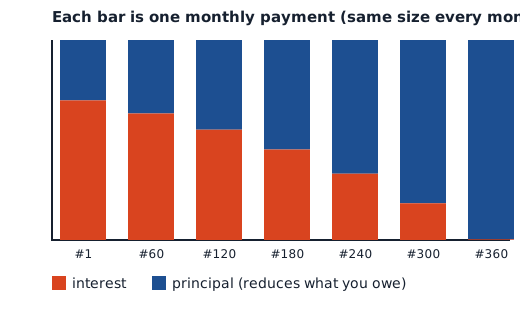
The payment stays the same. What is inside it moves. Each month it splits between principal and interest2. Early on the balance is high, so most of the payment is interest2. As the balance falls, the interest falls with it, and more of each payment pays down the loan2.
The figures below follow the 30-year example1. Each payment is the same total.
payment #1    interest 333.33   principal 144.08   balance left 99,855.92
payment #60   interest 302.08   principal 175.34   balance left 90,447.51
payment #180  interest 216.01   principal 261.40   balance left 64,542.80
payment #360  interest   1.59   principal 475.83   balance left      0.00
The first line is a quick check on the formula: interest in month one is the loan amount times i, which is 100,000 × 0.0033333 = 333.33 (our arithmetic). The rest of the payment reduces what you owe. A federal auto-loan explainer makes the same point: at the beginning of the loan term more of your payment is generally applied toward the interest rather than the principal3. The chart that lists the split is called an amortization schedule3, and the schedule is a table that lays these figures out across the loan in chronological order6.
The principal balance therefore decreases slowly at first, then more quickly closer to the end of the loan term3. In the example above, the balance after 60 payments is about $90,448 (our arithmetic), which is the balance the federal example reports after five years of payments1.
One more number matters: interest paid does not build equity. The part of the payment that goes to interest does not reduce your balance or build your equity2.
How much do I still owe after some payments?
Sell a house or pay off a car early and the question becomes the remaining balance. One of the most common problems deals with finding the balance owed at a given time during the life of a loan4. Because most long-term loans are paid off prematurely, the question comes up often4.
The method is the present-value idea again. You owe the present value of the payments that have not been made yet. A textbook example takes a 30-year loan at 7.8% with a monthly payment of $1260, and asks for the balance when ten years remain4. Ten years left means 120 payments still remain to be paid4. The original loan amount is not needed for this calculation, because the remaining payments alone fix the balance4. The remaining term is the original term minus the time already passed, and it has to be computed first4. Here is the working:
i = 0.078 / 12         = 0.0065
n = 12 × 10            = 120 payments left
(1 + i)^(−120)         = 0.45956
1 − 0.45956            = 0.54044
0.54044 / 0.0065       = 83.144
balance = 1,260 × 83.144 = 104,761
The balance with ten years to go is the last line above, rounded to the dollar. The textbook’s own working ends at $104,761.484, a few cents higher because it rounds in the middle steps. Paying off today also saves the interest still to come:
carrying more decimals:   104,761.34
120 payments × 1,260    = 151,200
151,200 − 104,761.34    = 46,438.66 of future interest saved
Mistakes that spoil the answer
- Using the yearly rate as the monthly rate. On the $100,000 loan, plugging 0.04 in for i gives a payment of 4,000 a month (our arithmetic), a long way from $4771. Divide by 12 first.
- Mixing years and months. If i is monthly, n must count months. Convert both or neither.
- Treating APR and APY as the same. Converting an annual percentage yield to the monthly rate is not as simple as dividing by 12; for a rate stated as APR, dividing by 12 is appropriate6. Check which one your offer states.
- Forgetting the first payment’s timing. The formula assumes the first payment is not due on the first day of the loan, but one full payment period into the loan6.
- Zero interest. The formula needs i above zero. At zero interest the payment is simply P divided by n6.
- Reading the payment as the whole bill. The total monthly payment you send to your mortgage company is often higher than the principal and interest payment explained here, because it often includes homeowners’ insurance and taxes1.
Loans where the simple formula does not finish the job
- Balloon loans. A balloon loan has a payment sized as if it ran much longer than it does. Because the monthly payments are not high enough to pay off the full loan, the remaining balance comes due as one large final payment1.
- Adjustable-rate loans. Initial payments are calculated assuming the initial interest rate stays the same for the entire loan term1. When the rate adjusts, the payment is typically recalculated on the new rate and the remaining term1.
- Loans that add interest faster than you pay it. If the payment is below the first month’s interest, the balance grows. The minimum payment that makes any progress is the one that exceeds the interest added6.
Run it yourself
Pick any loan offer and test it in five minutes, with the calculator above or by hand. Compute i and n, apply the formula, and compare with the quoted payment. If your figure and the quote differ by more than a few cents, look for fees rolled into the loan amount, a different compounding rule, or an insurance and tax line added on top1. A difference is a question worth asking, not proof of an error. Interest is a rate acting on a balance, the same idea as the cooling coffee in calculus in everyday life, and the rules for differentiating such rates are on the derivative rules cheat sheet.
Read next
APR vs APY: The Difference, With the Math and Examples
APR is the yearly rate before compounding; APY is the rate after it. See the formula, 5% and 24% examples, a calculator and how loan fees change APR.
Math of moneyCompound Interest Formula: Examples and Calculator
The compound interest formula A = P(1 + r/n)^(nt) with a calculator, worked examples, solving for rate and time, APY and the Rule of 72.
Math of moneyHow Much Do You Need to Retire? The Math, Step by Step
A retirement number is one division: yearly spending minus Social Security, over a withdrawal rate. Worked examples, 2026 limits and a calculator.
Sources
- How do mortgage lenders calculate monthly payments? · Consumer Financial Protection Bureau · consumerfinance.gov · checked October 21, 2026
- How does paying down a mortgage work? · Consumer Financial Protection Bureau · consumerfinance.gov · checked October 21, 2026
- What is amortization and how could it affect my auto loan? · Consumer Financial Protection Bureau · consumerfinance.gov · checked October 21, 2026
- 6.4: Present Value of Annuities and Installment Payment · LibreTexts, Community College of Denver (Sekhon and Bloom, De Anza College) · math.libretexts.org · checked October 21, 2026
- 3.9 PMT of Annuities: Formula Approach · eCampusOntario, Finance Math open textbook · ecampusontario.pressbooks.pub · checked October 21, 2026
- Mortgage calculator · Wikipedia · en.wikipedia.org · checked October 21, 2026
- Amortization calculator · Wikipedia · en.wikipedia.org · checked October 21, 2026
Published . Every source shows the day it was read. Diagrams: original, by the editors. How we check facts · Report an error.