Reference · Core ideas
Derivative rules cheat sheet: the full first-course list, in words, with worked examples
Derivative rules of a first calculus course on one page: all six trig functions, a^x, logs, inverse trig, with examples.
Rev. · 12 refs · 11 textbook or government · Ambient Math editors
Seven rules do most of the work in first-year calculus: constant, constant multiple, sum and difference, power, product, quotient and chain123. Add the derivatives of the six trig functions, the exponential and logarithm families and the inverse trig functions, and almost every function in a first course can be differentiated4512.
- Angles
- Radians only for the trig rules4
- Power rule
- Needs a variable base and a number exponent1
- Chain rule
- Outside function first, inside left alone3
On this page
- A cheat sheet for derivatives: the rules at a glance
- The seven core rules, one at a time
- Worked examples
- Trig derivatives
- Exponential and logarithmic function derivatives
- Inverse trig derivatives
- What are the 7 (or 9) rules of derivatives?
- How to memorize the derivative rules
- Which rule do I use first?
- Common mistakes
- Beyond a first course: hyperbolic and inverse (arc) hyperbolic derivatives
Finding a derivative from the limit definition is slow, and for some functions it is a rather challenging process6. That is why the rules exist. Learn them once and you will seldom go back to the definition1. Each rule below gets its formula, a plain-words version and a worked example. The Lamar University notes2 carry the full proofs.
A cheat sheet for derivatives: the rules at a glance
| Rule | Formula | In words |
|---|---|---|
| Constant | d/dx (c) = 0 | The derivative of a constant is zero1 |
| Constant multiple | (c·f)′ = c·f′ | A constant factors out of the derivative1 |
| Sum and difference | (f ± g)′ = f′ ± g′ | Differentiate term by term, keep the signs1 |
| Power | d/dx (xⁿ) = n·xⁿ⁻¹ | Bring the exponent down, subtract one from it1 |
| Product | (f·g)′ = f′·g + f·g′ | Derivative of the first times the second, plus the first times the derivative of the second2 |
| Quotient | (f/g)′ = (f′·g − f·g′) / g² | Like the product rule, with a minus sign and a squared denominator2 |
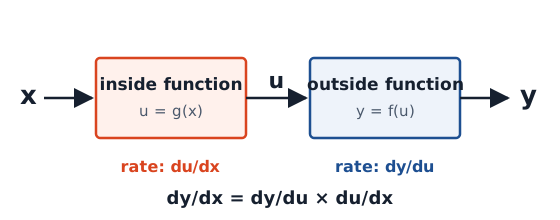
| Chain | d/dx f(g(x)) = f′(g(x))·g′(x) | Outside derivative, inside left alone, times the inside derivative3 |
| Sine and cosine | (sin x)′ = cos x, (cos x)′ = −sin x | The sine’s derivative is the cosine; the cosine’s is the negative sine8 |
| Tangent and cotangent | (tan x)′ = sec² x, (cot x)′ = −csc² x | Both follow from the quotient rule8 |
| Secant and cosecant | (sec x)′ = sec x · tan x, (csc x)′ = −csc x · cot x | Same pattern: the function times the other one, with a minus sign for the “co” version8 |
| Natural exponential | (eˣ)′ = eˣ | The natural exponential is its own derivative5 |
| General exponential | (aˣ)′ = aˣ · ln a | The natural exponential’s rule with one extra factor, ln a11 |
The logarithm and inverse trig rules follow in a block of their own, because their formulas are fractions. The natural logarithm comes from the exponential5, the general logarithm from the natural one11, and the six inverse trig functions from the inverse function theorem12:
(ln x)′        = 1/x
(logₐ x)′      = 1 / (x · ln a)
(arcsin x)′    = 1/√(1 − x²)            (arccos x)′ = −1/√(1 − x²)
(arctan x)′    = 1/(1 + x²)             (arccot x)′ = −1/(1 + x²)
(arcsec x)′    = 1/(|x|·√(x² − 1))      (arccsc x)′ = −1/(|x|·√(x² − 1))
Hyperbolic functions (sinh, cosh and relatives) sit at the end of the page under beyond a first course. Three notes apply to every row above and below. Trig formulas assume radians4. The power rule needs a variable base and a number exponent1. And the derivative of a product or quotient is never the product or quotient of the derivatives1.
The seven core rules, one at a time
Constant rule
The derivative of a constant is zero1. A constant function is a horizontal line, and the slope, or rate of change, of a horizontal line is zero6. A tangent line to the graph of a constant is level, so the slope is flat everywhere9.
Constant multiple rule
You can factor a multiplicative constant out of a derivative if you need to1. In practice you leave the constant where it is and differentiate the rest. The derivative of 5x is 5, because the 5 stays and x becomes 11.
Sum and difference rule
To differentiate a sum or a difference, differentiate each term and put the pieces back together with the same signs1. The rule is not limited to two functions1. Combined with the power and constant multiple rules, it gives the derivative of any polynomial9.
Power rule
Bring the original exponent down in front, multiply, and subtract one from the original exponent1. The rule requires a variable raised to a number, and the term must be in the numerator1. Rewrite roots as fractional exponents and move denominators up before you start: when you see radicals, convert them to fractional exponents and simplify the exponents as much as possible1.
The power rule does not apply to a constant raised to a variable power6. For example, 3ˣ needs the exponential rules below, not the power rule5.
Product rule
Take the derivative of the first function times the second, then add the first function times the derivative of the second2. The derivative of a product is not the product of the derivatives2. Early textbook examples can often be done by multiplying out first, so there are few reasons to use the product rule at that stage, but as the functions grow more complicated the product rule becomes more useful and in many cases required2.
Quotient rule
The numerator looks like the product rule with a minus sign, over the denominator squared. Be careful not to mix the two numerators up2. When the denominator is a plain constant or a single power, rewrite the quotient as a power and skip the quotient rule2.
Chain rule
Identify the “inside function” and the “outside function”3. Differentiate the outside function leaving the inside function alone, then multiply by the derivative of the inside function3. The outside function is the last operation you would perform in an evaluation3. When applying the chain rule to a composition, work from the outside function in7.
Worked examples
The functions come from the open course notes; the arithmetic is worked here.
Sums, differences and the power rule. A polynomial is handled term by term with the sum rule and the power rule1:
f(x) = 15x^100 − 3x^12 + 5x − 46
f′(x) = 15·100·x^99 − 3·12·x^11 + 5·1·x^0 − 0
      = 1500x^99 − 36x^11 + 5
Negative exponents. It is an easy mistake to go the other way when subtracting one from a negative exponent1. The correct step moves the exponent more negative, from −6 to −7:
g(t) = 2t^6 + 7t^(−6)
g′(t) = 12t^5 + 7·(−6)·t^(−7) = 12t^5 − 42t^(−7)
Product rule. For y = x^(2/3)·(2x − x²), the product rule gives a result that can be simplified to match the answer from multiplying first, which is the standard check2:
y′ = (2/3)x^(−1/3)(2x − x²) + x^(2/3)(2 − 2x)
   = (10/3)x^(2/3) − (8/3)x^(5/3)
Quotient rule. For W(z) = (3z + 9)/(2 − z) there is little to do but apply the quotient rule2:
W′(z) = [3(2 − z) − (3z + 9)(−1)] / (2 − z)²
      = 15 / (2 − z)²
Chain rule. For sin(3x² + x) the outside function is the sine and the inside function is 3x² + x3:
d/dx sin(3x² + x) = cos(3x² + x) · (6x + 1)A chain rule problem often hides a second rule. There can be two terms that each need a different application of the chain rule, so do not expect a single chain rule in a problem3.
Trig derivatives
The derivative of the sine function is the cosine, and the derivative of the cosine function is the negative sine8. These formulas depend on two limits, and the proof of the sine formula requires angles in radians4. If the angles are in degrees, the limit involving sine is not 1 and the formulas would pick up an extra constant4. So always use radians in a calculus class4.
The other four need no new memory work. Tangent, cotangent, secant and cosecant are all quotients involving sine, cosine or both, so the quotient rule produces their derivatives8. The full set of six is in the table above4. Worked from a textbook function:
f(x) = 2 tan x − 3 cot x
f′(x) = 2 sec² x − 3·(−csc² x) = 2 sec² x + 3 csc² x
Why do these matter outside a classroom? Sine and cosine describe simple harmonic motion, which is associated with systems such as an object with mass oscillating on a spring8.
Exponential and logarithmic function derivatives
The power rule does not work on an exponential function, because it required the exponent to be a fixed number and the base to be a variable, and the exponential function is exactly the opposite5. The natural exponential function is the simple case: eˣ is its own derivative5. The natural exponential and natural logarithm are inverses of each other, and that is how the derivative of the logarithm is found from the derivative of the exponential5.
For any other base a, with a positive and not equal to one, the same two rules pick up a factor of ln a11:
(aˣ)′ = aˣ · ln a (logₐ x)′ = 1 / (x · ln a)Check it with a equal to e: ln e is one, so the extra factor disappears and you are back at the two natural rules. Two quick examples, one with the chain rule:
d/dx 3ˣ         = 3ˣ · ln 3
d/dx log₁₀ x    = 1 / (x · ln 10)
d/dx 2^(5x)     = 2^(5x) · ln 2 · 5
Textbooks state the general case the same way, including the chain-rule version where the exponent or the log argument is itself a function11.
These functions matter because exponential functions play an important role in modeling population growth and the decay of radioactive materials11. When a function is a messy product or quotient with exponents, logarithmic differentiation can determine its derivative: logarithms remove exponents, turn products into sums and division into subtraction119.
Inverse trig derivatives
The derivatives of the inverse trig functions are surprising: they are algebraic functions, with no trig left in them12. Arcsine, arccosine, arctangent, arccotangent, arcsecant and arccosecant are all in the table above, and the textbook finds the remaining ones from the inverse function theorem12. Written with a calculator-style name, arcsin x is the same function as sin⁻¹ x, and it is not the reciprocal of sin x. A worked example with the chain rule, from the textbook:
h(x) = arcsin(2x³)
h′(x) = 1/√(1 − (2x³)²) · 6x² = 6x² / √(1 − 4x⁶)
What are the 7 (or 9) rules of derivatives?
The count depends on who is counting. Constant, constant multiple, sum, difference, power, product and quotient make seven; the chain rule makes eight67; the trig family and the exponential and logarithm family push a list to nine or more. This page counts seven core rules, with sum and difference as one, and then two families of special functions, so that each group fits in your head.
How to memorize the derivative rules
Memorize the rules in words first and symbols second, because the words carry the logic.
- Linear rules. Constant, constant multiple, sum and difference. Differentiate each term, keep constants out front1.
- Building rules. Power, product, quotient and chain. They handle everything built from simple pieces9.
- Special functions. Sine and cosine, the natural exponential, the natural logarithm. These you simply recall85.
Then test yourself on one function per rule until you stop reaching for the page. The reciprocal rule need not be memorized separately, because it can be derived from the quotient rule or from the power and chain rules9.
Which rule do I use first?
Look at the outermost operation, the last thing you would do when evaluating the function3.
- Last operation is adding or subtracting: sum and difference rule.
- Last operation is multiplying two functions: product rule.
- Last operation is dividing: quotient rule.
- Last operation is applying a function to an inside expression: chain rule3.
The rules combine, and most real problems use two or three together6. In a product of an inverse tangent and a root, for instance, the first step is the product rule, and each derivative then needs a chain rule3. In the reverse case, a chain rule on the outside needs a product rule for the inside3.
Common mistakes
- Wrong direction on a negative exponent. From −6 you subtract one to reach −7, not −51.
- Pulling a constant up with the variable. Only the term immediately to the left of the exponent takes it1.
- Applying the power rule to a constant base. It does not apply to a constant raised to a variable power6.
- Differentiating a product piece by piece. The derivative of a product is not the product of the derivatives2.
- Mixing up the two numerators. The quotient rule’s numerator looks like the product rule’s, so check the minus sign2.
- Differentiating the inside too early. Differentiate the outside function and leave the inside alone until the final multiplication3.
- Degrees instead of radians. The trig derivatives change if angles are in degrees4.
- Logs and products. If a function is a messy product or quotient with exponents, logarithmic differentiation can simplify it first: logarithms remove exponents, turn products into sums and division into subtraction9.
Beyond a first course: hyperbolic and inverse (arc) hyperbolic derivatives
You can skip this section until a course asks for it. Hyperbolic functions are built from the exponential. The hyperbolic sine and hyperbolic cosine are defined from the exponential10, and the other four come from those two10:
sinh x = (eˣ − e⁻ˣ) / 2        cosh x = (eˣ + e⁻ˣ) / 2
tanh x = sinh x / cosh x        coth x = cosh x / sinh x
sech x = 1 / cosh x             csch x = 1 / sinh x
Their derivatives look like the trig table with different signs10:
| Function | Derivative |
|---|---|
| sinh x | cosh x10 |
| cosh x | sinh x10 |
| tanh x | sech² x10 |
| coth x | −csch² x10 |
| sech x | −sech x tanh x10 |
| csch x | −csch x coth x10 |
The inverse hyperbolic functions follow the same implicit-differentiation route as the inverse trig ones10, and the textbook tabulates the results, with the range each one needs10:
(sinh⁻¹ x)′ = 1/√(x² + 1)             all x
(cosh⁻¹ x)′ = 1/√(x² − 1)             x above one
(tanh⁻¹ x)′ = 1/(1 − x²)              x between −1 and 1
(coth⁻¹ x)′ = 1/(1 − x²)              x beyond ±1
(sech⁻¹ x)′ = −1/(x·√(1 − x²))        x between 0 and 1
(csch⁻¹ x)′ = −1/(|x|·√(1 + x²))      x not zero
The tanh and coth rows match, which is why integrating that fraction needs the domain to pick the right antiderivative10. Combine any of them with the chain rule when the argument is an expression instead of a bare x7.
See the rules at work in a normal morning, or in the exponential behind a loan payment. The rest of the core ideas section grows from this sheet.
RelatedWhat Is a Derivative in Calculus? Simple ExplanationWhat Is a Limit in Calculus? Plain Meaning, ExamplesWhat Is an Integral in Calculus? Area, Sums, Examples
Sources
- Calculus I: Differentiation Formulas · Paul's Online Math Notes, Lamar University · tutorial.math.lamar.edu · checked October 21, 2026
- Calculus I: Product Rule and Quotient Rule · Paul's Online Math Notes, Lamar University · tutorial.math.lamar.edu · checked October 21, 2026
- Calculus I: Chain Rule · Paul's Online Math Notes, Lamar University · tutorial.math.lamar.edu · checked October 21, 2026
- Calculus I: Derivatives of Trig Functions · Paul's Online Math Notes, Lamar University · tutorial.math.lamar.edu · checked October 21, 2026
- Calculus I: Derivatives of Exponential and Logarithm Functions · Paul's Online Math Notes, Lamar University · tutorial.math.lamar.edu · checked October 21, 2026
- 3.3 Differentiation Rules, Calculus Volume 1 · OpenStax (Rice University) · openstax.org · checked October 21, 2026
- 3.6 The Chain Rule, Calculus Volume 1 · OpenStax (Rice University) · openstax.org · checked October 21, 2026
- 3.5 Derivatives of Trigonometric Functions, Calculus Volume 1 · OpenStax (Rice University) · openstax.org · checked October 21, 2026
- Differentiation rules · Wikipedia · en.wikipedia.org · checked October 21, 2026
- 6.9 Calculus of the Hyperbolic Functions, Calculus Volume 1 · OpenStax (Rice University) · openstax.org · checked October 21, 2026
- 3.9 Derivatives of Exponential and Logarithmic Functions, Calculus Volume 1 · OpenStax (Rice University) · openstax.org · checked October 21, 2026
- 3.7 Derivatives of Inverse Functions, Calculus Volume 1 · OpenStax (Rice University) · openstax.org · checked October 21, 2026
Published . Every source shows the day it was read. Diagrams: original, by the editors. How we check facts · Report an error.