How it works · Core ideas
What Is a Derivative in Calculus? Simple Explanation
A derivative is the instantaneous rate of change of a function: the slope of its tangent line. Plain meaning, worked examples, notation and when it fails.
Checked against 7 sources (6 textbook, course or government) · By Ambient Math editors
The short answer. A derivative is the instantaneous rate of change of a function at a point, which is the same thing as the slope of the tangent line to its graph there17. You find it as a limit: the slope of a secant line through two points, as the second point closes in on the first4.
- In one line
- The slope of the tangent line at a point7
- Computed as
- The limit of secant slopes as the second point closes in4
- Same idea as
- Instantaneous rate of change, instantaneous velocity1
- Fails at
- Sharp corners, jumps and vertical tangents3
On this page
- Derivatives in simple terms
- What do derivatives mean in calculus?
- Worked example (our arithmetic): x² at x = 3
- The derivative as a function
- The derivative of 2x, step by step
- Reading a derivative off a graph
- A real rate: the thermostat
- When a function has no derivative
- Notation: one idea, four spellings
- Where to go next
Your house cools overnight. In the evening the thermostat lets the temperature begin to drop, and at midnight you want one number: how fast is it falling right now? Not the average since dinner. Right now. The derivative is the tool built for that question1.
Derivatives in simple terms
A derivative tells you how fast something is changing at one exact moment, and in which direction. If the derivative is positive, the quantity is rising. If it is negative, the quantity is falling2. A rate is negative when the quantity is decreasing and positive when it is increasing2. Where the derivative is zero, the curve is momentarily level, like the top of a hill3.
The speedometer is the everyday case. Your position changes, and the derivative of position is your velocity3. The thermostat works the same way: temperature is the quantity, and the derivative is how many degrees per hour it is gaining or losing.
A derivative is a speedometer for any quantity that changes.
What do derivatives mean in calculus?
In calculus, the derivative of a function at a point is the slope of the tangent line to its graph at that point, and it measures the instantaneous rate of change of the function there17. Two pictures, one number.
The tangent line needs care. It is not simply a line that meets the graph at one point4. It is the limit of the secant line, a line drawn between two points on the graph, as the distance between the two points goes to zero, as the MIT OpenCourseWare lecture puts it4. So the recipe has three steps. Fix a point. Pick a second point on the curve and draw the secant line through both. Slide the second point toward the first and watch the secant lines approach the tangent line1.
Slopes of secant lines are average rates of change, and the slope of the tangent line is the instantaneous rate1. When the function is the position of a moving object, the secant slope is average velocity and the tangent slope is instantaneous velocity1. Written as a formula, the secant slope is the difference quotient, and the derivative is its limit as the step h goes to zero4:
Secant slope = ( f(a + h) − f(a) ) / h4
Derivative f′(a) = the limit of that slope as h → 04
The limit is doing the one thing algebra cannot: it lets h get as close to zero as you like without ever dividing by zero. Direct substitution of h = 0 always produces zero over zero, so some cancellation must happen first45. Plugging in h = 0 gives a division by zero error5, which is why the Lamar University course notes cancel h before taking the limit.
Worked example (our arithmetic): x² at x = 3
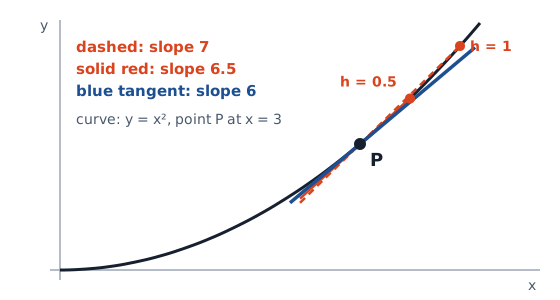
Take f(x) = x². OpenStax uses this same function and point to introduce the tangent slope and to show that a table of values gives a good estimate1. The arithmetic below is ours, with the method from that textbook. The secant slope from x = 3 to x = 3 + h for smaller and smaller h:
| Step h | Secant slope from x = 3 to x = 3 + h | Result |
|---|---|---|
| 1 | (16 − 9) / 1 | 71 |
| 0.5 | (12.25 − 9) / 0.5 | 6.51 |
| 0.1 | (9.61 − 9) / 0.1 | 6.11 |
| 0.01 | (9.0601 − 9) / 0.01 | 6.011 |
| 0.001 | (9.006001 − 9) / 0.001 | 6.0011 |
The slopes slide toward 6, the estimate the table method gives1. Algebra confirms it without a table: expand (3 + h)² and subtract 9, then divide by h5:
| Algebra step | Expression |
|---|---|
| Expand and subtract | ((3 + h)² − 9) / h = (9 + 6h + h² − 9) / h = (6h + h²) / h5 |
| Cancel h (h is never exactly 0) | 6 + h5 |
| Take the limit as h → 0 | 6, so f′(3) = 65 |
Each cancellation of h is legal because h is never exactly zero inside the limit5. The tangent line at that point passes through the point (3, 9) with slope 6, so its equation is y = 6x − 91. The diagram above shows the first two secants and the tangent for exactly this curve.
The derivative as a function
Do the same algebra at any x instead of x = 3, and the answer becomes a formula. The derivative of f(x) with respect to x is the function f′(x), defined by the limit of (f(x + h) − f(x)) / h5. The function f′ is read “f prime of x”5.
Worked example (our arithmetic), the derivative of f(x) = x² at any x:
| Step | Expression |
|---|---|
| Difference quotient | ((x + h)² − x²) / h = (2xh + h²) / h = 2x + h5 |
| Limit as h → 0 | f′(x) = 2x5 |
| Check at x = 3 | f′(3) = 2 × 3 = 6, matching the table above1 |
The derivative function gives the derivative of a function at each point in the domain of the original function for which the derivative is defined3. That makes it one more function you can plot, and even differentiate again. The derivative of a function is itself a function, so we can find the derivative of a derivative3. The new function is called the second derivative3. In motion, the first derivative of position is velocity and the derivative of velocity is acceleration3.
The derivative of 2x, step by step
The definition settles it with no rule at all, and the constant multiple rule agrees6:
Worked example (our arithmetic), f(x) = 2x6:
This is the cleanest picture of a derivative. The graph of y = 2x is a straight line, a straight line has the same slope everywhere, and that slope is 2. The first time a calculus student feels the idea click is often right here: the derivative of a line is its slope. For curves the slope changes from point to point, and the derivative is the function that tracks it. Once you have a feel for the definition, the rules for powers, sums, products and chains let you skip the limit; the derivative rules cheat sheet lists them all6.
Reading a derivative off a graph
You do not need a formula to read a derivative. Where a function is decreasing, its derivative is negative. Where it is increasing, the derivative is positive. Where the graph has a horizontal tangent, the derivative is zero3.
This gives a habit worth building early. Sketch the curve, then ask three questions at each spot. Is it going up or down? Is it level for an instant? How steeply? A steep climb is a large positive derivative. A gentle slide is a small negative one. The sign of the derivative gives the direction of the change2.
A real rate: the thermostat
Back to the cooling house. OpenStax models the evening with T(t) = 0.4t² − 4t + 70, where t counts hours after 9 p.m., and asks for the instantaneous rate of change of the temperature at midnight1. Midnight is t = 31. Worked example (our arithmetic). The definition is a limit that factors and cancels, and the rules give the same result in one line:
| Step | Arithmetic |
|---|---|
| Model | T(t) = 0.4t² − 4t + 70, t in hours after 9 p.m.1 |
| Derivative by the rules | T′(t) = 0.8t − 46 |
| At midnight, t = 3 | T′(3) = 0.8 × 3 − 4 = −1.6 degrees Fahrenheit per hour1 |
At midnight the house is cooling at 1.6 degrees per hour1. The negative sign is the direction, and the size is the speed2. Find where the derivative is zero and you find the coldest moment of the night:
| Step | Arithmetic |
|---|---|
| Set the rate to zero | 0.8t − 4 = 0, so t = 5, which is 2 a.m.1 |
| Temperature then | T(5) = 0.4 × 25 − 4 × 5 + 70 = 10 − 20 + 70 = 60 degrees1 |
The temperature bottoms out at 60 degrees, which matches the textbook’s description of the night, a low of 60 degrees before the temperature rises back1. A derivative that crosses from negative to positive marks a minimum. That one move, finding where the rate hits zero, is the engine of optimization.
The same limit appears in other fields. OpenStax lists velocity and acceleration in physics, marginal profit functions in business, and growth rates in biology1.
When a function has no derivative
Derivatives do not always exist5. The limit has to exist, and for some functions it does not. A function can fail at a point in three common ways3.
- A jump. If a function is not continuous, it cannot be differentiable, since every differentiable function must be continuous3.
- A sharp corner. The absolute value function is continuous but fails to be differentiable at x = 0, because the tangent slopes do not approach the same value from the left as they do from the right7. Visually, the limit of slopes on the left and on the right are not the same, which leaves a sharp corner on the graph3.
- A vertical tangent. A function fails to be differentiable at a point where there is a vertical tangent line3.
The two ideas are not twins. If a function is differentiable at a point, it must be continuous there, but a function that is continuous at a point need not be differentiable at that point3. From this we conclude that to be differentiable at a point, a function must be “smooth” at that point3. Failure at one point says nothing about the rest of the curve: the absolute value function has a derivative at every point except the corner5. Most functions that occur in practice have derivatives at all points or almost every point7.
Notation: one idea, four spellings
You will meet the derivative written in several ways, and they all mean the same thing. We use a variety of different notations to express the derivative of a function3.
| Name | How it looks | Where you see it |
|---|---|---|
| Prime (Lagrange) | f′(x) or y′, read “f prime” | Most textbooks and algebra-style work7 |
| Leibniz | dy/dx | Introduced by Gottfried Wilhelm Leibniz in 1675, and common in engineering and physics73 |
| Newton’s dot | ẏ | A dot over a symbol, for derivatives with respect to time7 |
| Operator | d/dx (f(x)) | Same as Leibniz, with the “differentiate this” step made explicit5 |
The split in names follows the split in credit. Newton and Leibniz are credited with developing calculus because they were the first to understand the relationship between the derivative and the integral1. Newton probably arrived at the ideas first, but we are indebted to Leibniz for the notation that we commonly use today1.
Where to go next
The derivative sits between two other ideas. Skill with the rules is practice, and the definition is worth keeping in the back of your mind56. Before it comes the limit, which makes sense of “closer and closer”4. After it comes the derivative’s mirror image, the integral, which is the second half of calculus. The two are connected: Newton and Leibniz are credited for the link between derivative and integral1. The rest of the core ideas section grows from this page. For derivatives in action, see how a normal morning is full of rates, and keep the derivative rules cheat sheet open when you start differentiating real functions.
Common questions
What is the derivative of 2x?
The derivative of 2x is 2. A constant multiple factors out of a derivative, and the derivative of x is 16. The graph of y = 2x is a straight line with slope 2, which is the same answer read off a picture.
Read next
Derivative rules cheat sheet
Derivative rules of a first calculus course on one page: all six trig functions, a^x, logs, inverse trig, with examples.
Core ideasWhat Is a Limit in Calculus? Plain Meaning, Examples
A limit is the value a function approaches as its input nears a point. Plain meaning, worked examples, when limits fail to exist, and the formal definition.
Core ideasWhat Is an Integral in Calculus? Area, Sums, Examples
An integral adds up a changing quantity: for a positive function it is the area under the curve. Plain meaning, worked examples, the Fundamental Theorem.
Sources
- 3.1 Defining the Derivative, Calculus Volume 1 · OpenStax (Rice University) · openstax.org · checked October 21, 2026
- Calculus I: Rates of Change · Paul's Online Math Notes, Lamar University · tutorial.math.lamar.edu · checked October 21, 2026
- 3.2 The Derivative as a Function, Calculus Volume 1 · OpenStax (Rice University) · openstax.org · checked October 21, 2026
- 18.01 Single Variable Calculus, Lecture 1: Derivatives, Slope, Velocity, and Rate of Change · MIT OpenCourseWare · ocw.mit.edu · checked October 21, 2026
- Calculus I: The Definition of the Derivative · Paul's Online Math Notes, Lamar University · tutorial.math.lamar.edu · checked October 21, 2026
- Calculus I: Differentiation Formulas · Paul's Online Math Notes, Lamar University · tutorial.math.lamar.edu · checked October 21, 2026
- Derivative · Wikipedia · en.wikipedia.org · checked October 21, 2026
Published . Every source shows the day it was read. Diagrams: original, by the editors. How we check facts · Report an error.