How it works · Core ideas
What Is a Limit in Calculus? Plain Meaning, Examples
A limit is the value a function approaches as its input nears a point. Plain meaning, worked examples, when limits fail to exist, and the formal definition.
Checked against 7 sources (6 textbook, course or government) · By Ambient Math editors
The short answer. A limit is the one value a function's outputs approach as its inputs approach a chosen point, whether or not the function ever takes that value there26. Limits matter because continuity, derivatives and integrals are all defined with them6.
- Plain meaning
- The value the outputs head toward2
- Cares about
- What happens around the point, not at it3
- Fails when
- The two sides disagree or the values never settle2
- Formal version
- Epsilon-delta, begun by Bolzano in 18176
On this page
- What do limits mean in calculus?
- Worked example (our arithmetic): a hole in the graph
- Why the limit ignores the point itself
- When does a limit exist, and when does it not?
- How to find a limit, step by step
- The precise definition, in one worked case
- Where limits show up outside the classroom
- Common mistakes
- Where to go next
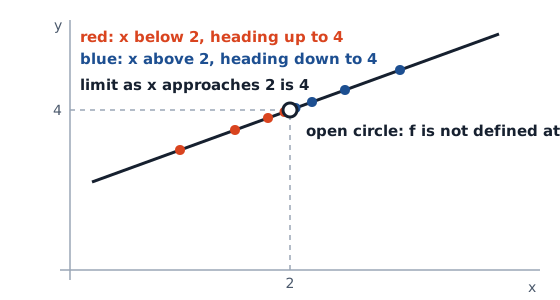
Put x = 2 into (x² − 4) / (x − 2) and you get 0/0, which is not a number4. Yet the graph is a clean line with a single point missing, and every instinct says the missing height should be 4. A limit is the idea that turns that instinct into mathematics, and it is the idea under all of calculus26.
What do limits mean in calculus?
A limit is the one real number that a function’s values approach as the input approaches a point, provided such a number exists2. Read it as a statement about a journey, not a destination. You steer the input toward a target, and you watch where the output is heading.
In symbols you write the function, the point you are approaching, and the number L the outputs are heading toward3:
Notation: limit as x → a of f(x) = L3
Three words in that definition do the work2. “Approach” means the outputs get closer and closer, from both sides. “One” means a single value, not a menu. “Provided such a number exists” means the whole thing can fail, which the page returns to below2.
Limits are old. The limiting process, essential to understanding calculus, has been around for thousands of years2. Early mathematicians used it to get better and better approximations of areas of circles2. The formal definition used today did not appear until the late 19th century2.
Limits are only concerned with what is going on around the point, and the point itself is excused3. Two functions that agree everywhere except at one input have the same limit there, which surprises nearly everyone the first time3.
A limit asks where the outputs are heading, never where the function happens to stand.
Worked example (our arithmetic): a hole in the graph
Take f(x) = (x² − 4) / (x − 2). Substituting x = 2 gives 0/0, so the function is undefined there, and that is not a problem, since the limit does not care what is happening at the point in question3. Tables of values are one way to see where the outputs head: choose values of x just below and just above the target2. The arithmetic is ours, and the approach follows the textbook’s:
| x | (x² − 4) / (x − 2) | Result |
|---|---|---|
| 1.9 | (3.61 − 4) / (−0.1) | 3.92 |
| 1.99 | (3.9601 − 4) / (−0.01) | 3.992 |
| 1.999 | (3.996001 − 4) / (−0.001) | 3.9992 |
| 2.1 | (4.41 − 4) / 0.1 | 4.12 |
| 2.01 | (4.0401 − 4) / 0.01 | 4.012 |
| 2.001 | (4.004001 − 4) / 0.001 | 4.0012 |
From below the outputs climb toward 4. From above they fall toward 4. When both sides head for a common value, that value is the limit2. So the limit as x approaches 2 is 4, even though f(2) does not exist2.
A table is a guess, and algebra turns the guess into a certainty. The numerator factors, and for every x other than 2 the common factor cancels4. Worked example (our arithmetic):
| Algebra step | Expression |
|---|---|
| Factor the numerator | (x² − 4) / (x − 2) = (x − 2)(x + 2) / (x − 2)4 |
| Cancel for x ≠ 2 | x + 24 |
| Limit as x → 2 | 2 + 2 = 44 |
That is the plan for a whole family of limits. When a function has the 0/0 form, first make sure it cannot be evaluated directly with the limit laws, then find a simpler function that equals it for every x other than the target4. The diagram above is the picture of this exact function: the line y = x + 2, with an open circle at the missing point.
Why the limit ignores the point itself
Change the function at one point and nothing about the limit moves. Define a new function g with g(x) = (x² − 4) / (x − 2) for x other than 2, and give it the value 6 at x = 2. The function now has a value at 2, but the limit is NOT 6, because limits do not care what the function is actually doing at the point in question3. It stays 4.
So a limit and a function value are two different questions. The limit of a function can exist at a point, the function can be defined there, and the two numbers can still differ2. Where they agree, the function is called continuous at that point, which in the notation of the course notes means the limit equals the value7.
For many everyday functions the two do agree, and a limit is easy: you can get a meaningful answer just by plugging in the limiting value7. A classic case is (x² + x) / (x + 1) at x = 3, where substitution gives 12/4, which is 37. The harder limits are the ones where plugging in breaks, such as the 0/0 above.
When does a limit exist, and when does it not?
A limit exists when the outputs settle toward one real number from both sides. It does not exist in three ways, each with a picture.
- The two sides disagree. If the limit from the left and the limit from the right take different values, the limit of the function does not exist2. The step function, often called the Heaviside function, does exactly this: from the right it heads for 1 and from the left for 0, so no single value is approached3.
- The values never settle. For a function that oscillates faster and faster near a point, the outputs do not approach any one single value2. The lecture notes at MIT put a name on it: for something like this, we say the limit does not exist7. A table can even fool you here, because different input sets give different guesses3.
- The outputs grow without bound. For 1/x near zero, the values decrease without bound from the left and increase without bound from the right27. Writing that the limit is infinity describes the behavior of the function, and it is not asserting that a limit exists2.
The rule that ties the first case to the definition is two-sided: the limit exists at a point exactly when the limit from the left and the limit from the right have a common value2. Failure is not a bug in the idea. Limits do not always exist, so do not get into the habit of assuming that they will3.
How to find a limit, step by step
- Try substitution. If the function is defined and well behaved at the point, plug the value in7.
- If you get 0/0, factor and cancel. Polynomials usually factor, and the shared factor cancels for every x other than the target4.
- If square roots are involved, use the conjugate. When the numerator or denominator contains a difference involving a square root, multiply the numerator and denominator by the conjugate of that expression4.
- Use tables and graphs only to understand, not to decide. They give insight, but they rely too much on guesswork2, and using tables of values to guess a limit is simply not a good way to get the value of a limit3.
The limit laws are what make moves two and three legal. They are the individual properties of limits, such as the sum and product laws, and they let you break a limit into pieces4. Apply them one step at a time, because each new limit must exist for the law to apply4.
Worked example (our arithmetic): a full limit using substitution and then factoring. The function comes from the textbook4:
| Step | Arithmetic |
|---|---|
| Limit wanted | limit as x → 3 of (x² − 3x) / (2x² − 5x − 3)4 |
| Substitute x = 3 | (9 − 9) / (18 − 15 − 3) = 0 / 0, so factor4 |
| Factor | numerator x(x − 3), denominator (2x + 1)(x − 3)4 |
| Cancel (x − 3) | x / (2x + 1) for x ≠ 34 |
| Substitute again | 3 / (2 × 3 + 1) = 3/74 |
The limit is 3/74.
The precise definition, in one worked case
The intuitive picture is enough for most of a first course. The formal definition makes “approach” exact. It is quite possibly one of the most challenging definitions you will encounter early in your study of calculus, but it is well worth the effort to reconcile it with the intuitive notion5. Understanding it is the key that opens the door to a better understanding of calculus5.
The definition is a game. A skeptic names how close the outputs must stay to L, called epsilon. You answer by naming how close the inputs must stay to the target, called delta. The limit is correct if you can win for every positive epsilon5. The textbook flags the phrase “there exists” as a signal for a scavenger hunt: you must go and find delta5.
Worked example (our arithmetic): the limit of 2x + 1 as x approaches 1, which is 3. The delta comes from the algebra the textbook uses for this limit, delta equal to epsilon over 25:
| Step | Arithmetic |
|---|---|
| Skeptic’s tolerance | stay within epsilon = 0.1 of 35 |
| Translate | |(2x + 1) − 3| = |2x − 2| = 2|x − 1| < 0.1, so |x − 1| < 0.055 |
| Your answer | delta = epsilon / 2 = 0.055 |
| Check x = 1.04 | 2(1.04) + 1 = 3.08, distance 0.08 < 0.1, passes5 |
| Check x = 0.96 | 2(0.96) + 1 = 2.92, distance 0.08 < 0.1, passes5 |
Shrink epsilon and delta shrinks with it, and that is what “as close as you like” means. The history behind the machinery is short. Bernard Bolzano developed the basics of the epsilon-delta technique in 1817 to define continuous functions6. The modern notation, with the arrow written below the limit symbol, was invented in 19056.
Where limits show up outside the classroom
Limits are the engine behind both halves of calculus. A tangent to a curve at a point is the limit of secant lines, which makes the slope a limit, and that slope is the derivative1. Instantaneous velocity is the limit of average velocity over a small time interval1. As the time interval shrinks, the average velocity becomes closer to the instantaneous velocity1. The same idea explains why rate of change is one of the most critical concepts in calculus1. The whole story is on the page about what a derivative is.
A limit can also describe a physical ceiling. In the textbook’s relativity example, an object’s mass grows without bound as its speed approaches the speed of light, and at one very high speed its mass becomes 7071 kg2. Since no object can have an infinite mass, no object can travel at or more than the speed of light2. That is a limit doing the work of a law of nature.
Common mistakes
- Treating the limit as the value at the point. They can differ, and the limit of the changed function above is still 43.
- Reading 0/0 as “no limit”. It means the direct route failed and more algebra is needed4.
- Trusting a table. There is always the possibility that you chose the wrong values and guessed incorrectly3.
- Calling infinity a limit that exists. An infinite statement describes behavior and does not assert that a limit exists2.
- Forgetting the sides. A single disagreement between left and right is enough to break the limit2.
Where to go next
The derivative is the first big limit, the limit of slopes of secant lines, and the best next page is what a derivative is. The area under a curve is the other big limit, covered in what an integral is. The derivative rules cheat sheet shows what the limit machinery buys you once the rules are memorized. For the idea in motion, see how a normal morning hides rates and totals everywhere, and the rest of the core ideas section grows from here. The open texts behind this page are free to read: OpenStax, Lamar University and MIT OpenCourseWare.
Common questions
What is a limit for dummies?
A limit is where a function is heading, not where it ends up. Two walkers can aim at the same spot, one stopping short and one stepping through it, and the limit is that spot. The function does not need a value there3.
Read next
Derivative rules cheat sheet
Derivative rules of a first calculus course on one page: all six trig functions, a^x, logs, inverse trig, with examples.
Core ideasWhat Is a Derivative in Calculus? Simple Explanation
A derivative is the instantaneous rate of change of a function: the slope of its tangent line. Plain meaning, worked examples, notation and when it fails.
Core ideasWhat Is an Integral in Calculus? Area, Sums, Examples
An integral adds up a changing quantity: for a positive function it is the area under the curve. Plain meaning, worked examples, the Fundamental Theorem.
Sources
- 2.1 A Preview of Calculus, Calculus Volume 1 · OpenStax (Rice University) · openstax.org · checked October 21, 2026
- 2.2 The Limit of a Function, Calculus Volume 1 · OpenStax (Rice University) · openstax.org · checked October 21, 2026
- Calculus I: The Limit · Paul's Online Math Notes, Lamar University · tutorial.math.lamar.edu · checked October 21, 2026
- 2.3 The Limit Laws, Calculus Volume 1 · OpenStax (Rice University) · openstax.org · checked October 21, 2026
- 2.5 The Precise Definition of a Limit, Calculus Volume 1 · OpenStax (Rice University) · openstax.org · checked October 21, 2026
- Limit (mathematics) · Wikipedia · en.wikipedia.org · checked October 21, 2026
- 18.01 Single Variable Calculus, Lecture 2: Limits, Continuity, and Trigonometric Limits · MIT OpenCourseWare · ocw.mit.edu · checked October 21, 2026
Published . Every source shows the day it was read. Diagrams: original, by the editors. How we check facts · Report an error.