How it works · Core ideas
What Is an Integral in Calculus? Area, Sums, Examples
An integral adds up a changing quantity: for a positive function it is the area under the curve. Plain meaning, worked examples, the Fundamental Theorem.
Checked against 8 sources (7 textbook, course or government) · By Ambient Math editors
The short answer. An integral adds up a quantity that keeps changing, and for a positive function the definite integral is the area between its graph and the x-axis26. It is the limit of sums of thinner and thinner rectangles, and it undoes differentiation13.
- Indefinite integral
- A family of functions whose derivative is the integrand, all differing by a constant5
- Symbol
- The notation for the indefinite integral was introduced by Leibniz in 16756
On this page
- What is an integral in simple terms?
- Integrals as area under a curve
- What to know before integration
- Worked example (our arithmetic): the area under y = x² from 0 to 2
- Definite integral vs indefinite integral
- Signed area: when the curve dips below the axis
- The Fundamental Theorem of Calculus
- Applications of integrals
- A short history of the integral
- Integral calculus in one paragraph
- Common mistakes
- Where to go next
A speedometer reports how fast you are going, never how far you have gone. Add up the speedometer readings over a trip and you recover the distance: the total change in position is what the readings add up to7. That adding-up of a rate that keeps changing is the job of the integral.
What is an integral in simple terms?
An integral is the continuous analog of a sum, and it is used to calculate areas, volumes and their generalizations6. An ordinary sum adds a list of separate numbers. An integral adds a quantity that varies smoothly, so there is no list, only a curve.
Integration is one of the two fundamental operations of calculus, along with differentiation6. Differentiation takes a quantity and gives its rate of change. Integration goes the other way and rebuilds the total from the rate. Many quantities in physics, quantities of work among them, may be interpreted as the area under a curve8.
A derivative zooms in on one instant. An integral adds up all of them.
Integrals as area under a curve
The picture to hold is area. Take a function that stays above the x-axis. The definite integral from a to b is the area bounded by the graph above, the x-axis below, and the vertical lines at a and b16.
The curve makes the shape irregular, so a formula for the area is not obvious. The classic way around it is to fill the region with shapes of known area. Archimedes studied the areas of shapes with a process now called the method of exhaustion, which used smaller and smaller shapes to fill an irregular region and obtain closer and closer approximations to the total area1. The first documented systematic technique for determining integrals is the method of exhaustion of the ancient Greek mathematicians Democritus and Eudoxus in the 4th century BC6.
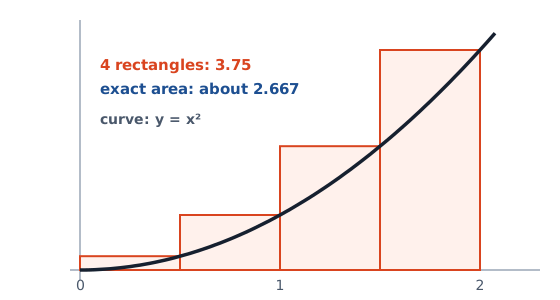
The modern version uses rectangles. By dividing a region into many small shapes that have known area formulas, we can sum these areas and obtain a reasonable estimate of the true area1. Use smaller and smaller rectangles and the approximations get closer and closer to the area1. Taking a limit then gives the exact area under the curve1. That limit of rectangle sums is the definition of the definite integral, and the diagram at the top of this page shows 4 of those rectangles.
What to know before integration
Integration leans on 3 earlier ideas. Limits come first, because taking a limit is what turns an estimate from rectangles into the exact area1. Derivatives come second, because the Fundamental Theorem works by reversing them3. Sigma (summation) notation comes third: it writes the long sums of rectangle areas compactly1. If any of these is shaky, the pages on limits and derivatives cover them.
Worked example (our arithmetic): the area under y = x² from 0 to 2
The function and the method follow the textbook problem on estimating an area with rectangles4. In each interval we form a rectangle whose height is the function value at a specific point in the interval4. Here the interval from 0 to 2 is cut into 4 pieces of width 0.5, and then into 8 pieces of width 0.25:
| Rectangles | Heights used (x² at each point) | Sum of heights × width | Estimate |
|---|---|---|---|
| 4, right edges | 0.25, 1, 2.25, 4 | 7.5 × 0.5 | 3.754 |
| 4, left edges | 0, 0.25, 1, 2.25 | 3.5 × 0.5 | 1.754 |
| 4, midpoints | 0.0625, 0.5625, 1.5625, 3.0625 | 5.25 × 0.5 | 2.6254 |
| 8, right edges | 0.0625, 0.25, 0.5625, 1, 1.5625, 2.25, 3.0625, 4 | 12.75 × 0.25 | 3.18754 |
For this increasing function the right edges overshoot: choosing the height at the right end makes each rectangle take in more area than the graph4. The left edges undershoot, because each rectangle misses some of the area4. The midpoint estimate does quite well4. For a decreasing function the pattern reverses: right endpoints underestimate and left endpoints overestimate4. Doubling the rectangles from 4 to 8 pulls the right-edge estimate from 3.75 down to 3.1875, closer to the true value.
The exact answer comes from the Fundamental Theorem of Calculus, covered below. An antiderivative of x² is x³/3, so the area is the value at 2 minus the value at 037:
| Step | Arithmetic |
|---|---|
| Antiderivative of x² | x³ / 33 |
| Value at 2 | 2³ / 3 = 8 / 33 |
| Value at 0 | 0³ / 3 = 03 |
| Area | 8/3 − 0 = 2.6667 (rounded)7 |
The estimates 3.75, 3.1875 and 2.625 all sit near 2.6667, and refining the rectangles closes the gap14.
Definite integral vs indefinite integral
The word “integral” covers related things, and the difference matters. A definite integral is a number2. An indefinite integral asks a different question: what function did we differentiate to get this function5. The answer is not a single function. There are infinitely many functions that would work, and they all differ by a constant5.
| Definite integral | Indefinite integral | |
|---|---|---|
| What it is | A number, the signed area over an interval from a to b26 | A family of functions, the antiderivatives5 |
| Bounds | Has limits of integration a and b2 | None, but carries a constant of integration5 |
| Process name | Integration | The process of finding the indefinite integral is called integration5 |
Often people say integral and let the context decide which one is meant5. Thinking of the indefinite integral as “what did we differentiate” is the habit to keep5. For example, x² has derivative 2x, so an antiderivative of 2x is x², and so is x² + 5 and x² − 9, a different constant each time.
Signed area: when the curve dips below the axis
The first definition of area assumed the graph stays above the axis, and real problems do not always meet that restriction2. The definite integral generalizes the concept of the area under a curve for exactly that reason2. Areas above the horizontal axis count as positive and areas below count as negative6. The integral computes the signed area6.
So net signed area can be positive, negative or zero2. If the area above the x-axis is larger, the net signed area is positive; if the area below is larger, it is negative2.
Worked example (our arithmetic): the function f(x) = 2x between x = −3 and x = 3. The graph is a straight line that forms 2 triangles, 1 above and 1 below the axis, and the geometry is a textbook example2:
| Piece | Base | Height | Area = ½ × base × height |
|---|---|---|---|
| Triangle above the axis, x from 0 to 3 | 3 | 6 | +92 |
| Triangle below the axis, x from −3 to 0 | 3 | 6 | −92 |
| Net signed area | 9 − 9 = 02 |
The integral is 0 even though the shaded area is not2. Zero here means the pieces cancel, not that nothing is there. Keep that in mind whenever a problem asks for total area rather than net change.
The Fundamental Theorem of Calculus
Computing a definite integral from rectangle sums is cumbersome, and so is using only geometric area formulas3. The way out relies on the relationship between differentiation and integration3. That relationship was discovered and explored by Newton and Leibniz during the late 1600s and early 1700s3. The Fundamental Theorem of Calculus is an extremely powerful theorem that establishes the relationship between differentiation and integration, and gives a way to evaluate definite integrals without using Riemann sums or calculating areas3.
If f is continuous and F′ = f, then the integral of f from a to b equals F(b) − F(a)7. In words: find any antiderivative, evaluate it at both ends, and subtract. This is why the indefinite integral matters. The major advance in integration came in the 17th century with the independent discovery of the theorem by Leibniz and Newton6. The theorem demonstrates a connection between integration and differentiation, and the connection, combined with the comparative ease of differentiation, can be exploited to calculate integrals6.
Worked example (our arithmetic): the area under one hump of the sine curve, a standard example in the MIT lecture7. An antiderivative of sin x is −cos x:
| Step | Arithmetic |
|---|---|
| F(x) | −cos x |
| F(π) | −cos π = −(−1) = 17 |
| F(0) | −cos 0 = −17 |
| Integral from 0 to π | F(π) − F(0) = 1 − (−1) = 27 |
The area under one hump of sin x is exactly 27. No rectangles, no limit by hand. That is the whole point of the theorem, and the page on the derivative rules is the other half of the toolbox, because every differentiation rule read backward is an integration fact.
Applications of integrals
Integrals appear in many practical situations6. Take a swimming pool. From the length, width and depth of a rectangular pool with a flat bottom, you can work out the volume of water it holds. If the pool is oval with a rounded bottom, integrals are required to find exact values for those quantities6. In each case, one may divide the sought quantity into infinitely many infinitesimal pieces and sum the pieces to achieve an accurate approximation6.
The same move recovers a distance from a speed. The speedometer readings on one side of the theorem add up to the change in position on the other7.
Worked example (our arithmetic): a car starts from rest and speeds up so that its speed is v(t) = 4t meters per second, for t from 0 to 5 seconds. The numbers are invented for this example, and the method is the theorem above7:
| Step | Arithmetic |
|---|---|
| Antiderivative of 4t | 2t²7 |
| At t = 5 | 2 × 25 = 507 |
| At t = 0 | 07 |
| Distance traveled | 50 − 0 = 50 meters7 |
| Check by geometry | The area under v(t) is a triangle with base 5 and height 20: ½ × 5 × 20 = 507 |
Work in physics is another quantity read as an area under a curve8. In every application the question is the same: what is being added up, and over what interval.
A short history of the integral
| When | What happened |
|---|---|
| 4th century BC | Method of exhaustion, the first documented systematic technique for integrals6 |
| 17th century | Leibniz and Newton independently discover the Fundamental Theorem of Calculus6 |
| 1675 | Leibniz introduces the notation for the indefinite integral6 |
The early work of Newton and Leibniz lacked rigor. Calculus acquired a firmer footing with the development of limits6, which is why the page on limits is worth reading next if the phrase “limit of rectangle sums” felt like a leap.
Integral calculus in one paragraph
Integral calculus is the study of integrals and what they do. It has a computing side, where a definite integral is a number found as a limit of sums12. It has a reversing side, where an indefinite integral recovers the function that was differentiated5. The Fundamental Theorem of Calculus links the 2 and lets a definite integral be evaluated without Riemann sums3. And it has an applying side, where the sum of many small pieces gives volumes, areas and work68.
Common mistakes
- Forgetting the constant. The indefinite integral is a family of functions, so a constant of integration belongs in the answer5.
- Confusing area with net signed area. The definite integral can be 0, positive or negative, because areas below the axis count as negative26.
- Treating the right-edge estimate as exact. For an increasing function it overestimates, and for a decreasing function it underestimates4.
- Mixing up the kinds of integral. A definite integral is a number, and an indefinite integral is a family of functions25.
Where to go next
Integrals sit beside the other core ideas. The limit explains what “closer and closer” means, and the derivative explains the rate that an integral adds up. The rest of the core ideas section builds on all three. For integrals in everyday scenes, see the tub that fills in a normal morning. The open texts used here are free to read: OpenStax on the definite integral, OpenStax on the Fundamental Theorem, Lamar University on the area problem and the MIT lecture.
Read next
Derivative rules cheat sheet
Derivative rules of a first calculus course on one page: all six trig functions, a^x, logs, inverse trig, with examples.
Core ideasWhat Is a Derivative in Calculus? Simple Explanation
A derivative is the instantaneous rate of change of a function: the slope of its tangent line. Plain meaning, worked examples, notation and when it fails.
Core ideasWhat Is a Limit in Calculus? Plain Meaning, Examples
A limit is the value a function approaches as its input nears a point. Plain meaning, worked examples, when limits fail to exist, and the formal definition.
Sources
- 5.1 Approximating Areas, Calculus Volume 1 · OpenStax (Rice University) · openstax.org · checked October 21, 2026
- 5.2 The Definite Integral, Calculus Volume 1 · OpenStax (Rice University) · openstax.org · checked October 21, 2026
- 5.3 The Fundamental Theorem of Calculus, Calculus Volume 1 · OpenStax (Rice University) · openstax.org · checked October 21, 2026
- Calculus I: The Area Problem · Paul's Online Math Notes, Lamar University · tutorial.math.lamar.edu · checked October 21, 2026
- Calculus I: Indefinite Integrals · Paul's Online Math Notes, Lamar University · tutorial.math.lamar.edu · checked October 21, 2026
- Integral · Wikipedia · en.wikipedia.org · checked October 21, 2026
- 18.01 Single Variable Calculus, Lecture 19: First Fundamental Theorem of Calculus · MIT OpenCourseWare · ocw.mit.edu · checked October 21, 2026
- 2.1 A Preview of Calculus, Calculus Volume 1 · OpenStax (Rice University) · openstax.org · checked October 21, 2026
Published . Every source shows the day it was read. Diagrams: original, by the editors. How we check facts · Report an error.