How it works · Math of money
Compound Interest Formula: Examples and How to Calculate
The compound interest formula A = P(1 + r/n)^(nt) with a calculator, worked examples, solving for rate and time, APY and the Rule of 72.
Checked against 12 sources (10 textbook, course or government) · By Ambient Math editors
The short answer. Compound interest follows A = P(1 + r/n)^(nt): P is the starting amount, r the yearly rate as a decimal, n the compounding periods per year and t the years67. Invest $3,000 at 3% compounded quarterly and the account is worth about $4,045.05 after 10 years6.
- You need
- Starting amount, yearly rate, compounding periods per year, years6
- Example
- $3,000 at 3% compounded quarterly for 10 years is about $4,045.056
- Doubling shortcut
- Divide 72 by the rate; at 9% that is about 8 years2
On this page
- What compound interest is
- The compound interest formula
- How do you calculate compound interest?
- Worked example 1: $3,000 at 3% compounded quarterly
- Worked example 2: $1,500 at 4.3% compounded quarterly
- Simple versus compound interest, side by side
- How often interest compounds
- How to calculate compound interest on $10,000 at 10% for 3 years
- What is the compound interest on $8,000 at 5% for 2 years?
- What are the formulas for compound interest?
- APR, APY and the effective rate
- The Rule of 72
- Compound interest in a spreadsheet
- When compounding meets a late bill
- Mistakes that spoil the answer
- Where the idea came from
- Next steps
Money left in an account does not just wait. Each time interest is paid it joins the balance and starts earning too, and one formula captures that loop for any rate, any schedule and any number of years. Below you get the formula and a calculator, worked examples with every step shown, the versions for finding a starting amount, a rate or a time, and the difference between a quoted rate and the yield a bank must show. The arithmetic is the point. It does not tell you where to put money; for your own case, talk to a licensed adviser. The money section collects the neighboring formulas.
What compound interest is
Interest earned on the money you saved and on the interest you earn along the way is compound interest1. Put shortly, it is the interest you earn on interest2. A glossary entry from the same agency defines it as interest paid on principal and on accumulated interest3.
The FDIC lays out the vocabulary. The money you deposit in a savings account is called principal, and the money you earn on your principal is called interest4. Each time interest is earned it is added to the principal, so the next round of interest is figured on a larger number4. Earning money on your principal and interest over and over again is compound interest4.
Simple interest is the contrast: it pays only on the original amount. A Texas State University exercise invests $500 at a simple interest rate of 6% and finds $2.50 of interest in one month7. Compounding changes the bookkeeping. Financial institutions divide the year into a certain number of periods and add simple interest to an account after each period7.
The compound interest formula
For an account that compounds n times a year, the balance after t years is A = P(1 + r/n)^(nt)67. The symbols are the same in every textbook, with small changes of letter.
| Symbol | Meaning | Source |
|---|---|---|
| A | Amount accumulated after t years, including interest | 8 |
| P | Starting amount of the account, often called the principal | 6 |
| r | Annual percentage rate (APR) expressed as a decimal; the FDIC writes 3 percent as .03 | 64 |
| n | Number of compounding periods in one year | 6 |
| t | Time in years | 6 |
Percent becomes a decimal by dividing by 100, and the yearly rate divided by n gives the rate for one period. For a rate compounded every six months, the Texas State notes find 12%/2 = 6% per period, and for quarterly compounding 12%/4 = 3%7. In their notation the periodic rate is r/m7.
Where the formula comes from
The key idea is that for each period that passes, the amount at the end of the period equals the amount at the beginning multiplied by (1 + i), where i is the periodic rate7. Repeat that for every period and the multiplications stack into a power.
The FDIC shows the stacking one month at a time. Its example deposits $100 and adds 3 percent: multiply the $100 principal by 3 percent, so $100 x .03 equals $3 in interest4, then do the same on $103, which gives $3.094. After six months the deposit has earned $19.414.
| Month | Principal | Interest | Balance |
|---|---|---|---|
| July | $100.00 | $3.00 | $103.004 |
| August | $103.00 | $3.09 | $106.094 |
| September | $106.09 | $3.18 | $109.274 |
| October | $109.27 | $3.28 | $112.554 |
| November | $112.55 | $3.38 | $115.934 |
| December | $115.93 | $3.48 | $119.414 |
One thing to know if you check this table against its own wording. The problem is written as 3 percent interest compounded monthly4, but the table adds 3 percent every month, which is a monthly rate. Read as 3% a year compounded monthly, the same deposit would grow far less in six months.
Worked example (our arithmetic): the FDIC deposit under both readings. Inputs: $100, 3 percent, six months4.
| Reading | Calculation | After 6 months4 |
|---|---|---|
| 3% per month (what the table does) | 100 × 1.03^6 | 119.414 |
| 3% per year, compounded monthly | 100 × (1 + 0.03/12)^6 | 101.514 |
How do you calculate compound interest?
The steps are the same for every problem.
- Write down the inputs. The starting amount P, the yearly rate, the number of compounding periods per year n and the years t6.
- Convert the rate to a decimal. Divide the percent by 100; the FDIC writes 3 percent as .034.
- Find the rate per period. Divide the yearly rate by n; with quarterly compounding the periodic rate is the yearly rate divided by four7.
- Count the periods. Multiply n by t.
- Raise (1 + periodic rate) to the number of periods. Use the exponent key on a calculator or spreadsheet6.
- Multiply by P. The result is A, the balance including interest8.
- Subtract P to see the interest alone: Ann's edge over Sally in a Texas State exercise is found by subtracting one total from the other7.
Worked example 1: $3,000 at 3% compounded quarterly
An OpenStax precalculus problem asks how much an account will be worth in 10 years if $3,000 earns 3% interest compounded quarterly6. Quarterly means n is 4. The textbook answer is about $4,045.056.
Worked example (our arithmetic). Inputs from6: P = 3,000, r = 3%, n = 4, t = 10.
| Step | Calculation | Result |
|---|---|---|
| Rate per period | 0.03 / 4 | 0.00756 |
| Number of periods | 4 × 10 | 406 |
| Growth factor | 1.0075^40 | 1.3483496 |
| Balance A | 3,000 × 1.348349 | 4,045.056 |
| Interest earned | 4,045.05 − 3,000 | 1,045.056 |
Try your own numbers
Compound interest calculator
Fixed rate, no deposits or withdrawals, no fees or taxes. The arithmetic happens on this page, with no data leaving your device.
- Balance after the term
- –
- Interest earned
- –
- Yearly yield (APY)
- –
Enter n as 1 for annual, 12 for monthly, 52 for weekly or 365 for daily compounding10; quarterly is 46. The calculator opens on the first worked example, so you can see it match the textbook. Change n and watch how little the answer moves compared with changing the rate.
Worked example 2: $1,500 at 4.3% compounded quarterly
A DePaul University study guide deposits $1,500.00 at an annual interest rate of 4.3%, compounded quarterly, and asks for the balance after 6 years. It comes to approximately $1,938.848.
Worked example (our arithmetic). Inputs from8: P = 1,500, r = 4.3%, n = 4, t = 6.
| Step | Calculation | Result |
|---|---|---|
| Rate per period | 0.043 / 4 | 0.010758 |
| Number of periods | 4 × 6 | 248 |
| Growth factor | 1.01075^24 | 1.2925588 |
| Balance A | 1,500 × 1.292558 | 1,938.848 |
Simple versus compound interest, side by side
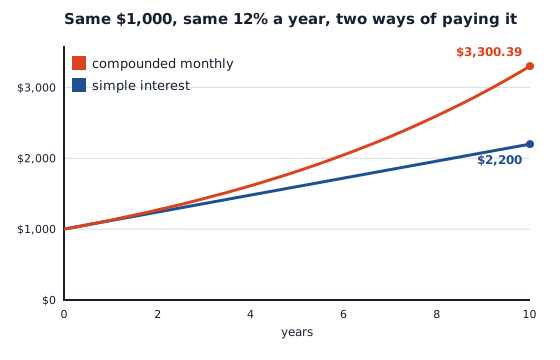
Texas State sets two savers against each other. Sally invests $1,000 at 12% simple interest for three years, and Ann invests $1,000 at 12% compounded monthly for the same three years7.
| Years | Simple interest | Compounded monthly | Ann’s edge |
|---|---|---|---|
| 3 | $1,360 | $1,430.77 | $70.777 |
| 10 | $2,200 | $3,300.39 | $1,100.397 |
Early on the two are close. Ann leads by $70.77 after three years and by $1,100.39 after ten, because her interest keeps being reinvested7. The chart above draws the whole ten years.
Investor.gov shows the same effect with small numbers. With $100 earning 5% a year, you have $105 at the end of the first year and $110.25 at the end of the second2. The extra $0.25 is interest on the $5 of interest2. With no further deposits, that $100 grows to more than $162 in 10 years and almost $340 in 25 years2.
A classroom problem on the same page invests a single $730, the cost of a $2 slice of pizza every day for a year, at 5%: after five years it is $931.69 and after 30 years $3,155.022. Time does most of the work. A second exercise makes the point at a larger scale: $100 in a bank paying 5% compounded yearly for fifty years reaches $1146.74, while $1,000 left in a safe stays the same7.
How often interest compounds
Compounding more often pays more, but with shrinking returns. OpenStax invests $1,000 at 10% for one year and finds that the account value increases as the compounding frequency increases6.
| Compounding | Value after one year |
|---|---|
| Annually | $11006 |
| Semiannually | $1102.506 |
| Quarterly | $1103.816 |
| Monthly | $1104.716 |
| Daily | $1105.166 |
The increase from annual to semi-annual compounding is larger than the increase from monthly to daily compounding6. Worked example (our arithmetic): annual to semiannual adds 1102.50 − 1100 = 2.50, while monthly to daily adds 1105.16 − 1104.71 = 0.45.
Continuous compounding and the number e
Push the frequency up without limit and you get continuous compounding, which can be regarded as letting the compounding period become infinitesimally small10. OpenStax calls the growth formula built on e the continuous compounding formula in business settings6. The number e is irrational, its decimal expansion going on forever without repeating6, and it was named by the Swiss mathematician Leonhard Euler (1707–1783)6.
A person who invested $1,000 in an account earning a nominal 10% per year compounded continuously has $1,105.17 after one year6. Daily compounding gave $1105.166. The two are one cent apart, which is why most savers never need the continuous version.
Three accounts, one deposit
Another Texas State exercise gives a bank three accounts. Bronze earns 12% annual interest compounded monthly, Silver earns 12.2% compounded twice a year, and Gold earns 12.4% compounded once a year. Deposit $100 and see what you have at the end of the year7. The results are Bronze $112.68, Silver $112.57 and Gold $112.407. The account with the lowest quoted rate wins, because it compounds most often. That is the reason regulators require a yield, covered below.
How to calculate compound interest on $10,000 at 10% for 3 years
Worked example (our arithmetic). Inputs: P = 10,000, r = 10%, t = 3, annual compounding so n = 1, formula from6.
| Step | Calculation | Result |
|---|---|---|
| Growth factor | (1 + 0.10)^3 | 1.3316 |
| Balance A | 10,000 × 1.331 | 13,310.006 |
| Interest | 13,310.00 − 10,000 | 3,310.006 |
| Same deposit, monthly (n = 12) | 10,000 × (1 + 0.10/12)^36 | 13,481.826 |
What is the compound interest on $8,000 at 5% for 2 years?
Worked example (our arithmetic). Inputs: P = 8,000, r = 5%, t = 2, annual compounding so n = 1, formula from6.
| Step | Calculation | Result |
|---|---|---|
| Growth factor | (1 + 0.05)^2 | 1.10256 |
| Balance A | 8,000 × 1.1025 | 8,820.006 |
| Interest | 8,820.00 − 8,000 | 820.006 |
| Same deposit, monthly (n = 12) | 8,000 × (1 + 0.05/12)^24 | 8,839.536 |
What are the formulas for compound interest?
One formula, rearranged to solve for whichever quantity you do not know.
Solve for the starting amount
When the goal is known, divide instead of multiply. OpenStax’s college-savings problem wants $40,000 in 18 years from an account earning 6% compounded semi-annually, and the answer is that Lily needs to invest $13,8016. Texas State asks how much to deposit at 12% per year (1% per month) compounded monthly to have $500 in 3 years; the answer is 500/(1.01^36) = 349.467.
Worked example (our arithmetic). Inputs from6: A = 40,000, r = 6%, n = 2, t = 18. P = A / (1 + r/n)^(nt) = 40,000 / 1.03^36 = 40,000 / 2.898278 = 13,801.30, which rounds to the textbook’s 13,801.
Solve for the rate
An OpenStax exercise asks readers to use properties of rational exponents to solve the compound interest formula for the interest rate6, with data for an account compounded semi-annually, with an initial deposit of $9,000, worth $13,373.53 after 10 years6. Taking the nt-th root gives r = n[(A/P)^(1/(nt)) − 1].
Worked example (our arithmetic). Inputs from6: P = 9,000, A = 13,373.53, n = 2, t = 10. A/P = 1.485948; (A/P)^(1/20) = 1.020000; r = 2 × (1.020000 − 1) = 0.040000, which is 4.00% a year.
Solve for the time
Take logarithms to bring the exponent down: t = ln(A/P) / (n × ln(1 + r/n)). The Texas State exercise for $1,000 at 12% compounded monthly reads the answer off a graph: about 10 months to reach $1,1007.
Worked example (our arithmetic). Inputs from7: P = 1,000, A = 1,100, 1% per month. Months = ln(1.10) / ln(1.01) = 0.095310 / 0.009950 = 9.58, so the balance passes $1,100 during the 10th month, in line with the graph estimate.
APR, APY and the effective rate
Savings are advertised with a yield. The annual percentage yield measures the total amount of interest paid on an account based on the interest rate and the frequency of compounding5. It is expressed as an annualized rate, based on a 365-day year5. For a typical savings account without a stated maturity, the calculation is based on an assumed term of 365 days5, assuming that all principal and interest remain on deposit and that no other transactions occur5. APY reflects only interest, so a sign-up bonus is not part of it5.
OpenStax gives the same idea under another name: when interest is compounded more than once a year, the effective interest rate ends up being greater than the nominal rate6. The effective annual rate is the total accumulated interest that would be payable up to the end of one year, divided by the principal sum10. Regulation DD, the federal rule behind APY, works examples: $61.68 in interest on $1,000 over a 365-day year is an APY of 6.17%5, and assuming daily compounding, the institution pays $53.90 in interest on a $1,000 deposit, an APY of 5.39%5.
Worked example (our arithmetic). APY = (1 + r/n)^n − 156.
| Account (from7 and5) | Calculation | APY |
|---|---|---|
| Bronze: 12% compounded monthly | (1 + 0.12/12)^12 − 1 | 12.68%567 |
| Silver: 12.2% compounded twice a year | (1 + 0.122/2)^2 − 1 | 12.57%567 |
| Gold: 12.4% compounded once a year | 1.124 − 1 | 12.40%567 |
| 5.25% compounded daily (Regulation DD tier example) | (1 + 0.0525/365)^365 − 1 | 5.39%567 |
The Rule of 72
To estimate how long money takes to double, divide 72 by the interest rate2. At a 9% return that is about every 8 years2. It is a quick check, not the formula.
Worked example (our arithmetic). Exact doubling time = ln 2 / ln(1 + r), compared with 72 / r2.
| Rate | Exact | Rule of 722 |
|---|---|---|
| 5% | 14.21 years | 14.40 years2 |
| 9% | 8.04 years | 8.00 years2 |
| 20% | 3.80 years | 3.60 years2 |
The rule drifts at high rates, so use the formula when the answer matters.
Compound interest in a spreadsheet
Excel’s FV function calculates the future value of an investment based on a constant interest rate11. Make sure you are consistent about the units you use for rate and nper11: for monthly payments on a four-year loan at 12 percent annual interest, Microsoft uses 12%/12 for rate and 4*12 for nper11. Deposits are entered as negative numbers and cash you receive as positive11, and the lump sum goes in the pv argument11.
Worked example (our arithmetic). Example 1 as a formula: =FV(3%/4, 4*10, 0, -3000) returns 4,045.05, matching6.
When compounding meets a late bill
Compounding is not limited to savings. The Bureau of the Fiscal Service calculates monthly compounding interest owed on payments made after the payment due date9. The first part of its equation calculates compounded monthly interest, and the second part calculates simple interest on any additional days beyond the number of months9. In its example the amount owed is $1,500, the due date is April 1, the agency does not pay until June 15, and the rate is 6%; the interest is $18.839.
Worked example (our arithmetic). Inputs from9: 1,500 × (1 + 0.06/12)^2 × (1 + 0.06/360 × 15) − 1,500 = 1,500 × 1.010025 × 1.0025 − 1,500 = 18.83.
Mistakes that spoil the answer
- Using the yearly rate for every period. Divide the yearly rate by n first7. The FDIC’s 3 percent table is this mistake read the other way: a 3 percent monthly rate is a very different account from 3 percent a year4.
- Mixing units. If the rate is per month, count periods in months11.
- Ranking accounts by the quoted rate. Bronze at 12% beats Gold at 12.4%7.
- Forgetting to subtract P. A is the balance; interest alone is A minus P7.
- Rounding the growth factor early. Rounding 1.348349 to 1.35 turns 4,045.05 into 4,050.00, nearly five dollars off (our arithmetic from6).
- Assuming withdrawals fit the formula. APY assumes no other deposits or withdrawals5.
Where the idea came from
Compound interest was known to ancient civilisations, but the first traces of mathematicians analysing it come from the medieval era10. Charged by lenders, it was once regarded as the worst kind of usury and severely condemned by Roman law and the common laws of many other countries10. Today it is the basis of savings accounts, and of the constant e.
Next steps
Run a bank’s quoted rate through the formula, or the calculator above, and compare the result with the stated yield. A loan payment is this formula run in reverse, the subject of the loan payment formula page, and how long to pay off a loan solves it for time. Interest is a rate acting on a balance, the same idea as the cooling coffee in calculus in everyday life, and the rule for differentiating e^(rt) is on the derivative rules cheat sheet. For the textbook versions, see the OpenStax exponential functions chapter and the Investor.gov calculator, which also accepts monthly contributions12.
Common questions
How to calculate compound interest on 10,000 at 10% rate for 3 years?
Compounding once a year, n is 1, so A = 10,000 × (1 + 0.10)^3 = 13,310.00 and the interest is 13,310.00 − 10,000 = 3,310.00. This is our arithmetic from the formula in6 with the inputs 10,000, 10% and 3 years. Monthly compounding gives about 13,481.82 instead.
Read next
Loan payment formula, step by step
The fixed monthly loan payment formula, a calculator, where it comes from, worked examples and common mistakes.
Math in daily lifeCalculus in everyday life, one morning
Follow one ordinary day and watch calculus run under a cooling coffee, a speedometer, a fenced garden, a bacteria count and a filling tub, with the math shown.
Core ideasDerivative rules cheat sheet
Derivative rules of a first calculus course on one page: all six trig functions, a^x, logs, inverse trig, with examples.
Sources
- How does compound interest work? · Consumer Financial Protection Bureau · consumerfinance.gov · checked October 21, 2026
- What is compound interest? · Investor.gov, U.S. Securities and Exchange Commission · investor.gov · checked October 21, 2026
- Compound Interest (glossary) · Investor.gov, U.S. Securities and Exchange Commission · investor.gov · checked October 21, 2026
- Chapter 5: Compound Interest · Federal Deposit Insurance Corporation · fdic.gov · checked October 21, 2026
- Appendix A to Part 1030, Annual Percentage Yield Calculation (Regulation DD) · Electronic Code of Federal Regulations · ecfr.gov · checked October 21, 2026
- 4.1 Exponential Functions, Precalculus · OpenStax (Rice University) · openstax.org · checked October 21, 2026
- Simple and Compound Interest · Mathworks, Texas State University · txst.edu · checked October 21, 2026
- Compound Interest Formula · Quantitative Reasoning Center, DePaul University · qrc.depaul.edu · checked October 21, 2026
- Monthly Compounding Interest Calculator · Bureau of the Fiscal Service, U.S. Department of the Treasury · fiscal.treasury.gov · checked October 21, 2026
- Compound interest · Wikipedia · en.wikipedia.org · checked October 21, 2026
- FV function · Microsoft Support · support.microsoft.com · checked October 21, 2026
- Compound Interest Calculator · Investor.gov, U.S. Securities and Exchange Commission · investor.gov · checked October 21, 2026
Published . Every source shows the day it was read. Diagrams: original, by the editors. How we check facts · Report an error.