How it works · Math of money
APR vs APY: The Difference, With the Math and Examples
APR is the yearly rate before compounding; APY is the rate after it. See the formula, 5% and 24% examples, a calculator and how loan fees change APR.
Checked against 10 sources (10 textbook, course or government) · By Ambient Math editors
The short answer. APR is a yearly rate that leaves out compounding, and APY is the yearly rate after compounding, so the same account shows an APY at or above its stated rate12. A 5% rate compounded monthly has an APY of 5.12% (our arithmetic)3. On loans, APR also counts fees such as points and loan fees45.
- APY
- Total interest after compounding, over a 365-day period1
- APY formula
- (1 + r ÷ n)^n − 1, where n is compoundings per year3
- 5% compounded monthly
- APY 5.12% (our arithmetic)3
- Average card APR
- 22.36% on accounts assessed interest, August 20267
- National savings rate
- 0.38% as of October 19, 20268
On this page
A savings account and a credit card each quote a yearly rate, yet neither number tells you what a year of balance actually does. The gap between the quoted rate and the real one is compounding, and APR and APY sit on opposite sides of it. Below: what each term means in federal rule text, the APY formula with a worked case, a calculator, worked examples at two rates, how loan fees change APR, and what a “good” APY or APR can be compared with. The money section holds the formulas next to this one.
What APR and APY each measure
The annual percentage yield, or APY, is the total interest paid on an account over a 365-day period, taken from the interest rate and the frequency of compounding (12 CFR 1030.2)1. The annual percentage rate, or APR, is a measure of the cost of credit, expressed as a yearly rate (12 CFR 1026.22)4. One term covers what a deposit earns, and the other covers what a loan costs.
The word “rate” hides a second difference. The interest rate on a deposit account is the annual rate of interest paid on the account which does not reflect compounding1. On the disclosure forms for deposits, that rate may also be called the “annual percentage rate”1. So APR is sometimes the label on a rate that has not been compounded yet, and APY is always the compounded version1.
| APR | APY | |
|---|---|---|
| Used for | Borrowing: loans, credit cards4 | Deposit accounts1 |
| Compounding | Not included in a stated deposit rate1; a card’s APR is a periodic rate times the periods in a year6 | Included, over a 365-day period1 |
| Fees | Counted for loans, as part of the finance charge5 | Bonuses worth $10 or less are left out2 |
| Rule text | Regulation Z4 | Regulation DD1 |
The APY formula, step by step
The textbook version is called the effective annual yield. It converts compound interest to its equivalent simple interest rate, so two accounts that compound on different schedules can be compared directly3. It is built on $1 invested for 1 year3.
- Write the quoted rate as a decimal. A 6% rate is r = 0.063.
- Divide by the number of compounding periods in a year. The variable n is the number of times the interest is compounded in a year, 4 for quarterly, 12 for monthly, 365 for daily3.
- Add 1, raise the sum to the power n, subtract 1. That is Y = (1 + r ÷ n)^n − 1, and Y is the equivalent annual simple interest rate3.
- Multiply by 100 for percent. A rate of 6% compounded quarterly gives 1.015^4 − 1 = 0.0614, which is equivalent to a simple interest rate of 6.14%3.
Regulation DD uses a second form built from dollars instead of rates. The APY equals 100 times [(1 + Interest ÷ Principal) raised to 365 ÷ Days in term, minus 1], where Principal is the amount assumed deposited at the start and Interest is the total dollars earned on it over the term2. For an account with no stated maturity, the term is assumed to be 365 days, and the calculation assumes all principal and interest stay on deposit with no other transactions2.
Worked example (our arithmetic). The rule text works one case: $61.68 of interest on $1,000 over 365 days is an APY of 6.17%2. Run backwards, our arithmetic shows a 6% rate compounded monthly pays exactly that:
| Step | Calculation | Result |
|---|---|---|
| Monthly rate | 6% ÷ 12 | 0.5%3 |
| Growth factor | 1.005^12 | 1.0616783 |
| Interest on $1,000 | 1,000 × (1.061678 − 1) | $61.682 |
| APY | 100 × 61.68 ÷ 1,000 | 6.17%2 |
The same bank can therefore call an account “6% interest” and “6.17% APY” in one sentence, and both are correct2.
Try your own numbers
APR to APY calculator
One year, one steady rate, interest added back at the schedule you pick. Nothing you type leaves this page.
- APY
- –
- Interest after one year
- –
- Balance after one year
- –
- APY minus quoted rate
- –
The defaults reproduce the 5% monthly case below3. Set the schedule to yearly and the APY drops back to the quoted rate3.
What is the difference between 5% APR and 5% APY?
For a deposit, the gap depends on how often interest is added. A 5% quoted rate has an APY of exactly 5.00% if interest is paid once a year, and a higher APY if interest is paid more often, because later interest is earned on earlier interest310. Earning interest on principal and on interest over and over again is compound interest10.
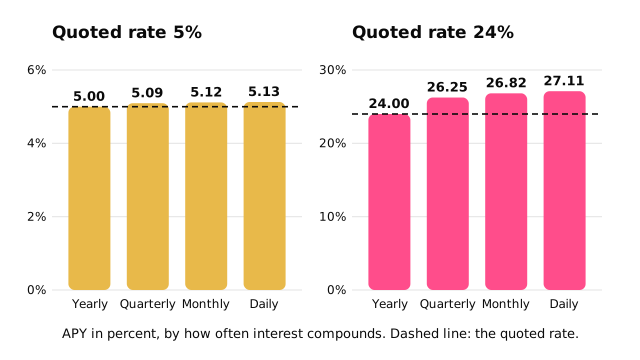
Worked example (our arithmetic). Inputs: the quoted rates 5% and 24%, and the effective-yield formula3. The figure draws the same numbers.
| Compounded | n | 5% quoted gives APY | 24% quoted gives APY |
|---|---|---|---|
| Yearly | 1 | 5.00%3 | 24.00%3 |
| Quarterly | 4 | 5.09%3 | 26.25%3 |
| Monthly | 12 | 5.12%3 | 26.82%3 |
| Daily | 365 | 5.13%3 | 27.11%3 |
At 5% the four schedules differ by 0.13 points, about $1.27 a year on $1,000 (our arithmetic)3. At 24% they differ by 3.11 points, about $31.15 a year on $1,000 (our arithmetic)3. Compounding matters more the higher the rate.
A smaller case has the same shape: 5% compounded daily is equivalent to earning 5.13% as simple interest3. And it shows why the schedule can swing a comparison. Three banks quote 2.08% compounded monthly, 2.09% compounded annually and 2.05% compounded daily3. The bank with the lowest headline rate is not the lowest earner, because the effective yields are 2.10%, 2.09% and 2.07% and the monthly account has the highest3.
What is 5% APY on $1,000 monthly?
A 5% APY already includes the monthly compounding, so $1,000 left for a year ends at $1,050.00 and has earned $50.0013. The monthly rate that produces it is slightly under 0.41%, and the stated rate before compounding is about 4.89% (our arithmetic)3.
Worked example (our arithmetic). Inputs: 5% APY, monthly steps, the effective-yield formula solved for the monthly rate i, which is 1.05^(1/12) − 13.
| Case | Calculation | Result |
|---|---|---|
| Monthly rate | 1.05^(1/12) − 1 | 0.4074%3 |
| First month’s interest on $1,000 | 1,000 × 0.004074 | $4.073 |
| Quoted rate before compounding | 12 × 0.4074% | about 4.89%3 |
| $1,000 left for 12 months | 1,000 × 1.05 | $1,050.003 |
| $1,000 added at each month’s end, 12 months | balance × 1.004074 + 1,000, repeated | $12,272.58 on $12,000 deposited3 |
The last row reads the question the other way: a $1,000 deposit every month rather than once. Interest of $272.58 on $12,000 is the compounding doing its work at the same 5% APY (our arithmetic)3.
APR vs interest rate
On a loan the two numbers diverge because of fees. The finance charge is the cost of consumer credit as a dollar amount, and it includes any charge payable directly or indirectly by the consumer and imposed by the creditor as an incident to or a condition of the extension of credit5. Interest is only the first item on its list; points, loan fees, appraisal and credit report fees, and similar charges follow it5. Fees charged by a mortgage broker are finance charges even when the lender does not require the consumer to use a broker5.
The APR then relates the amount and timing of value received by the consumer to the amount and timing of payments made4. It is worked out by the actuarial method in Appendix J of Regulation Z4. So two loans with the same interest rate can have different APRs, because the one with more upfront charges delivered less money for the same payments.
Worked example (our arithmetic). Inputs: a $10,000 loan, 12 equal monthly payments, a 6% interest rate; the payment is $860.66 from the loan payment formula (our arithmetic)4. We treat a $200 loan fee as a finance charge5 and solve for the monthly rate that makes the payments worth the $9,800 actually received, then multiply by 12 as the credit-card rule does46.
| Loan fee | Money received | Interest rate | APR | Effective yearly cost |
|---|---|---|---|---|
| $0 | $10,000 | 6.00% | 6.00%4 | 6.17%3 |
| $100 | $9,900 | 6.00% | 7.89%4 | 8.18%3 |
| $200 | $9,800 | 6.00% | 9.80%4 | 10.25%3 |
| $300 | $9,700 | 6.00% | 11.74%4 | 12.40%3 |
A $200 fee on a $10,000 one-year loan adds 3.80 points to the APR (our arithmetic). The effect shrinks as the term lengthens, because the same fee is spread over more months of use. The disclosed APR is allowed some slack: it is accurate if it is within one-eighth of a percentage point above or below the figure determined by the rule, and one-quarter of a point for an irregular transaction4.
How credit card APR works
A card’s APR is not compounded in the disclosure. Where periodic rates are used to compute the finance charge, the APR to be disclosed is computed by multiplying each periodic rate by the number of periods in a year6. A daily periodic rate therefore becomes a daily rate times 3656. The effective cost of carrying a balance is higher than that quoted figure when interest is added to the balance, which is the same compounding gap as above3.
Worked example (our arithmetic). Inputs: a 24% APR, a $1,000 balance, no payments for a year, interest added back daily or monthly63.
| Interest added | Growth factor | Balance after one year | Effective rate |
|---|---|---|---|
| Daily | (1 + 0.24 ÷ 365)^365 | $1,271.153 | 27.11%3 |
| Monthly | (1 + 0.24 ÷ 12)^12 | $1,268.243 | 26.82%3 |
The “24% APR” label and the 27.11% effective figure describe the same card3. Late fees and penalties would come on top and are not in this arithmetic.
Is an APR of 24% good?
For a borrower, a lower APR means a lower cost of credit4. The Federal Reserve’s consumer credit release of October 7, 2026 puts the rate on credit card accounts assessed interest at 22.36% in the latest column, August 20267. That figure is the annualized ratio of total finance charges at all reporting banks to the average daily balances they were charged on7. The all-accounts figure is a different measure: the stated APR averaged across all credit card accounts7. A 24% APR sits 1.64 points above that average of 22.36% (our arithmetic)7.
Is an APY of 3% good?
Compare it with what depositors earn on average. The national rate for savings was 0.38% as of October 19, 2026 (FDIC rate table), against 0.63% for money market accounts and 1.76% for 12-month CDs8. The national rate is the average of rates paid by all insured depository institutions and credit unions for which data is available, weighted by each institution’s share of domestic deposits8.
Worked example (our arithmetic). Inputs: $1,000 held for a year at each APY81.
| Rate | Source | Interest on $1,000 |
|---|---|---|
| 3.00% APY | the example in the question | $30.001 |
| 1.76% | National rate, 12-month CD, October 19, 2026 | $17.608 |
| 0.63% | National rate, money market, October 19, 2026 | $6.308 |
| 0.38% | National rate, savings, October 19, 2026 | $3.808 |
At 3% APY the account earns about 7.9 times the national savings rate (our arithmetic)8. Whether that is “good” also depends on prices rising: the Federal Reserve judges inflation of 2 percent over the longer run, measured by the personal consumption expenditures price index, as most consistent with its mandate9. A yield above that pace adds buying power, and one below it loses some, which is arithmetic and not a recommendation about any account9.
Reading an APY disclosure
Four rules in Regulation DD explain most surprises in an advertised APY.
- Bonuses mostly stay out. The APY does not include the value of a bonus worth $10 or less2.
- Variable rates freeze. For a variable-rate account, the institution bases the calculation only on the initial rate in effect when the account is opened or advertised, and assumes it does not change2.
- Steps are averaged. For a $1,000 six-month CD that pays 5% compounded daily for three months and 5.5% for the next three, total interest is $26.68 and the APY is 5.39%2.
- Tiers get their own APY. An APY, or a range, must be disclosed for each balance tier2.
Compare APY with APY and APR with APR. A deposit rate quoted as an interest rate is not compounded1, and the same words on a loan include fees5. For the formulas that sit behind a year of compounding, see the compound interest formula; for a rough doubling time, the Rule of 72; and for how a loan’s payment and APR play out over its term, how long it takes to pay off a loan.
Read next
Compound Interest Formula: Examples and Calculator
The compound interest formula A = P(1 + r/n)^(nt) with a calculator, worked examples, solving for rate and time, APY and the Rule of 72.
Math of moneyThe Rule of 72 Explained: How Fast Money Doubles
Divide 72 by the yearly rate to estimate how long money takes to double. The formula, worked examples, a calculator, an accuracy table and why 72.
Math of moneyHow Long to Pay Off a Loan: Formula and Calculator
Work out how many months a loan takes to pay off with the loan-term formula, a calculator, worked examples and what extra payments change.
Sources
- 12 CFR 1030.2 Definitions (Regulation DD), eCFR · Code of Federal Regulations, 12 CFR Part 1030, via eCFR (Office of the Federal Register) · ecfr.gov · checked October 21, 2026
- Appendix A to Part 1030: Annual Percentage Yield Calculation (Regulation DD), eCFR · Code of Federal Regulations, 12 CFR Part 1030, via eCFR (Office of the Federal Register) · ecfr.gov · checked October 21, 2026
- 6.4 Compound Interest, Contemporary Mathematics · OpenStax (Rice University) · openstax.org · checked October 21, 2026
- 12 CFR 1026.22 Determination of annual percentage rate (Regulation Z), eCFR · Code of Federal Regulations, 12 CFR Part 1026, via eCFR (Office of the Federal Register) · ecfr.gov · checked October 21, 2026
- 12 CFR 1026.4 Finance charge (Regulation Z), eCFR · Code of Federal Regulations, 12 CFR Part 1026, via eCFR (Office of the Federal Register) · ecfr.gov · checked October 21, 2026
- 12 CFR 1026.14 Determination of annual percentage rate (Regulation Z), eCFR · Code of Federal Regulations, 12 CFR Part 1026, via eCFR (Office of the Federal Register) · ecfr.gov · checked October 21, 2026
- Consumer Credit - G.19, release of October 7, 2026 · Board of Governors of the Federal Reserve System · federalreserve.gov · checked October 21, 2026
- National Rates and Rate Caps, October 2026 · Federal Deposit Insurance Corporation · fdic.gov · checked October 21, 2026
- Why does the Federal Reserve aim for inflation of 2 percent over the longer run? · Board of Governors of the Federal Reserve System · federalreserve.gov · checked October 21, 2026
- Chapter 5: Compound Interest · Federal Deposit Insurance Corporation · fdic.gov · checked October 21, 2026
Published . Every source shows the day it was read. Diagrams: original, by the editors. How we check facts · Report an error.