How it works · Math in daily life
How to Divide Something Fairly: Cut and Choose, Worked Out
Two people: one cuts, the other chooses, and both are guaranteed a fair share. Worked examples, plus the fair methods for 3 or more people.
Checked against 11 sources (4 textbook, course or government) · By Ambient Math editors
The short answer. Let one person cut the item into 2 pieces that they value equally, and let the other person pick first1. The cutter is guaranteed a piece worth 50% of the whole in their own eyes, and the chooser is guaranteed a piece worth at least 50% in theirs1. With more than two people, cut and choose fails and a different method is needed2.
- Two people
- One cuts into 2 pieces equal in their eyes, the other chooses first1
- Guarantee
- Cutter 50% of the whole, chooser at least 50%, each by their own valuation1
- Split 100% three ways
- 1/3 each, about 33.3%4
- Split 12 evenly
- 12 ÷ 2 = 6 each for two people (our arithmetic)1
On this page
- How do you divide something fairly between two people?
- What is fair division in math?
- Worked example: splitting a year at a beach house
- How do you split 12 equally?
- How do you split 100% three ways evenly?
- How do 3 or more people divide fairly?
- Where does cut and choose fall short?
- Where is it used?
- Where does the idea come from?
- Which method should you use?
A candy bar, a pair of children and an argument over who got the bigger half: parents have settled that fight for generations with a rule that is also a piece of game theory. You cut, I choose. This page shows why the rule works, runs the numbers on a textbook example, and then covers what to do when a third person arrives, because the rule breaks at that point.
How do you divide something fairly between two people?
Use divide and choose, also called “I cut, you choose”2. One person is the divider and the other is the chooser, perhaps picked by a coin toss1. The steps run in this order1:
- First, the divider cuts the item into two pieces that are, in the divider’s eyes, equal in value1.
- Second, the chooser selects either piece1.
- Third, the divider receives the piece that is left1.
The trick is the divider’s position. The divider does not know which piece will be theirs, so there is no incentive to cheat1. A divider who cuts one piece larger risks being left with the smaller one2. The chooser can pick either piece, so the chooser is guaranteed at least 50% of the whole in their own eyes1. The divider is guaranteed a piece worth 50%1.
That outcome has a name. It is an envy-free allocation, meaning neither person can claim they would rather have the other’s share9. To an outside observer the split may look uneven, but to the two people involved no one has cause to envy the other2.
What is fair division in math?
Fair division is the mathematical study of splitting resources among parties who each have an entitlement, so that each party gets its due share3. A central rule of the field is that the players divide the goods themselves, because only they know how they value them3. Real settings include inheritance, partnership breakups and divorce settlements3.
Fairness has to be defined before it can be measured, and the field uses several definitions3. There is no objective measure of what an item is worth, so these definitions rest on each person’s own valuation3.
| Criterion | What it requires | Source |
|---|---|---|
| Proportional | Every player gets at least their due share by their own valuation; for three people, at least a third3 | 3 |
| Envy-free | No one wants another player’s share more than their own3 | 3 |
| Equitable | Every player values their own slice equally, so each receives equal value3 | 3 |
| Pareto optimal | No other allocation would make someone better off without making someone else worse off3 | 3 |
For two people with additive values, these first two criteria coincide: every envy-free division is also proportional2. Cut and choose delivers both. The equitable criterion is the hard one, since players need not be truthful when asked their valuation3.
Worked example: splitting a year at a beach house
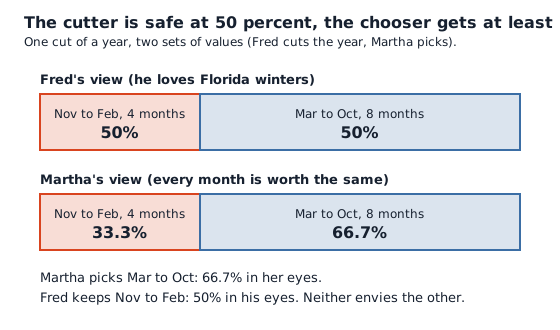
Two retirees, Fred and Martha, buy a vacation house in Florida and agree to split the year into 2 parts1. Fred is the divider and cuts the year into November to February and March to October1. The first piece is 4 months and the second is 8 months, yet Fred values them equally because he likes Florida in the winter1. Martha values every month the same1.
Worked example (our arithmetic): the cut and the two valuations
| Piece | Length | Fred’s value | Martha’s value |
|---|---|---|---|
| November to February | 4 months | 50%1 | 4 ÷ 12 = 33.3%1 |
| March to October | 8 months | 50%1 | 8 ÷ 12 = 66.7%1 |
Martha picks March to October, a piece she values at 8 ÷ 12 = 66.7% of the whole (our arithmetic)1. Fred keeps November to February, which he values at 50%1. Both are at or above the 50% guarantee, and neither would swap. The unequal result is not a flaw. Martha gets more only because she values the months differently from Fred, and the procedure respects that difference.
The method suits people who distrust each other’s motives or cannot talk it through, such as two countries drawing a border or two children splitting a candy bar1. Fred and Martha could simply discuss it, but the formal rule works even when they cannot1.
How do you split 12 equally?
When the thing is uniform, such as 12 identical cookies or a $12 bill, plain division is enough: 12 ÷ 2 = 6 each for two people, 12 ÷ 3 = 4 each for three, and 12 ÷ 4 = 3 each for four (our arithmetic)6. Cut and choose is for the other case, where the parts are not interchangeable.
Here is a pack where equal counts are not equal values. A pizza has 4 slices of cheese and 4 slices of veggie with a total value of $126. Marcus and Ben like both flavors equally, so each values every slice at $1.506. Abby only likes cheese and values each cheese slice at $3 and veggie at $06. A fair share for any of the 4 players is $36.
Worked example (our arithmetic): why counting slices fails
| Person | Value of one cheese slice | Value of one veggie slice | Value of the whole pizza |
|---|---|---|---|
| Marcus or Ben | $1.50 | $1.50 | 8 × 1.50 = $126 |
| Abby | $3 | $0 | 4 × 3 = $126 |
Give Abby 2 slices of veggie and she holds $0 of value, even though she received 2 of the 8 slices, a fourth of them (our arithmetic)6. Splitting by count is even. Splitting by value is fair. They differ whenever tastes differ.
How do you split 100% three ways evenly?
Each share is 1/3 of the whole, or about 33.3%4. The harder part is making cuts that all 3 people accept as that much, and the obvious first attempt fails4.
The tempting approach picks a divider, lets the first chooser take any piece and the second chooser take whatever remains of the 3 pieces, and gives the divider the last one4. The divider is fine and so is the first chooser. The second chooser is the problem4.
Worked example (our arithmetic): the three-person failure
| Person | Piece 1 | Piece 2 | Piece 3 |
|---|---|---|---|
| Chooser 1 | 40% | 30% | 30%4 |
| Chooser 2 | 45% | 30% | 25%4 |
| Divider | 33.3% | 33.3% | 33.3%4 |
Chooser 1 takes Piece 1, which leaves Chooser 2 to choose between Piece 2 and Piece 3, and neither is worth a fair share of 1/3 or about 33.3% to her4. At 30% and 25% she is below the line. The method does not guarantee a fair division4. Divide and choose works only for two parties2.
How do 3 or more people divide fairly?
Two methods work for any number of people. Both give every person a piece they consider at least a fair share, which with N people means at least 1/N of the total8.
The lone divider method
One person is picked at random as the divider, and the rest are choosers5. The steps5:
- The divider cuts the item into N pieces5.
- Each chooser separately lists the pieces they consider a fair share5. This list is the chooser’s declaration, or bid5.
- If every party can be given a piece they declared, do so, and the divider takes the piece that remains5.
- If two or more parties want the same pieces and no others, give a piece nobody contested to the divider, recombine the rest and repeat with the remaining parties5.
Take the failed example above. Both choosers declare Piece 1 only, so the pieces cannot be handed out at once5. Pieces 2 and 3 are uncontested, so the divider receives one of them, say Piece 25. Pieces 1 and 3 are recombined into one piece worth 70% to each chooser5. The two choosers then use divider-chooser on it, and each is guaranteed at least 35%, which is a fair share of the original5.
Worked example (our arithmetic): the recombined piece
| Step | Calculation | Result |
|---|---|---|
| Value of Pieces 1 and 3 to Chooser 1 | 40% + 30% | 70%5 |
| Value of Pieces 1 and 3 to Chooser 2 | 45% + 25% | 70%5 |
| Guaranteed by cut and choose | 70% ÷ 2 | at least 35%5 |
Steinhaus developed the procedure for 3 people, and Harold W. Kuhn later extended it to more8.
The last diminisher method
This method also suits 3 or more people6. The players are assigned an order at random, perhaps by pulling names from a hat6. The first player cuts a slice they value as a fair share6. Each later player either passes, or trims the slice if they think it is worth more than a fair share, and claims it6. After the last player decides, the last person to trim receives the slice, and if nobody trimmed it the cutter keeps it6. Repeat with the rest until 2 people remain, who finish with divider-chooser6.
The pizza above shows it. Marcus cuts 2 slices of cheese, which he values at $36. Abby values the same piece at $6, trims it down to 1 slice of cheese worth her fair share of $3, and takes it, since Ben and Julian pass6. The order matters. Being last to decide is an advantage, because the last player can trim a sliver off and still claim the piece6.
Worked example (our arithmetic): Abby’s trim
| Step | Calculation | Result |
|---|---|---|
| Marcus’s 2 cheese slices at $1.50 each | 2 × 1.50 | $36 |
| Abby’s value of the same 2 slices at $3 each | 2 × 3 | $66 |
| Abby’s trimmed piece, 1 cheese slice | 1 × 3 | $3, her fair share6 |
A simpler version exists for three players too: Ali cuts three pieces equal in her eyes, and Blake and Chris each say which pieces they would accept9. If both reject Ali’s cut, there is a piece neither wants, which goes to Ali, and the other two pieces are pushed together for Blake and Chris to split by cut and choose9. It is long-winded but guarantees a fair split9.
Where does cut and choose fall short?
Three limits are worth knowing.
It can waste value. Suppose Bob likes only chocolate and Carol likes only vanilla2. If Bob cuts without knowing Carol’s taste, his safe move is to put equal chocolate in both halves2. Then Bob gets half the chocolate whichever half Carol takes, when a smarter split would have given each person everything they want2. Fair is not the same as efficient.
It does not give an exact half. The cutter may judge parts of the cake differently from the chooser, and the chooser simply takes what they think is better2.
It fixes the roles. Arguments about who cuts are common, so a symmetric version has both people mark their midpoint, cuts between the two marks, and gives each person the piece holding their own mark2.
For two parties and indivisible goods, one procedure goes further. Adjusted winner is envy-free, equitable and Pareto optimal, and it splits at most one good11.
Where is it used?
The idea is old. In Genesis, Abraham offers Lot the choice of land after dividing it into a western part and an eastern part, and Lot chooses the east2. A similar rule is in the law of the sea: a state applying to mine the ocean floor must offer 2 areas of similar value and the UN authority picks one2.
Modern uses are less dramatic. A shared three-bedroom apartment with rooms of different sizes and one rent to split is what the field calls rental harmony103. It means dividing indivisible rooms and a divisible rent at once3. A division by square feet cannot take every individual preference into account10. The solution described in a New York Times lesson plan uses an algorithm by the mathematician Francis Su, built on Sperner’s Lemma10.
Where does the idea come from?
Fair division as a field dates back to the end of the second world war3. It was devised by Polish mathematicians Hugo Steinhaus, Bronislaw Knaster and Stefan Banach, who met in the Scottish Cafe in Lvov3. Steinhaus, hiding from the Nazis during World War II, asked how to divide resources fairly7. Inspired by divide and choose, he asked his students Banach and Knaster for a procedure that works for any number of people7. Martin Gardner brought the problem of fair division among larger groups to a wide audience in his May 1959 column in Scientific American2.
Which method should you use?
Cut and choose fits two people, lone divider fits 3 or more, and last diminisher is the easier of those two to run at a table256. In each, every person ends up with a piece they value at 1/N or more8. For deeper reading, the free divider-chooser chapter, the lone divider chapter and the last diminisher chapter of one open textbook work through more cases. Fair division is one of the quieter places where math shows up in everyday life, and the Math in daily life section collects more, such as the hidden math in a normal day and what calculus is used for.
Common questions
What is fair division in math?
Fair division is the problem of splitting resources among parties who are each entitled to a share, so that every party receives its due3. The players do the splitting themselves, because only they know how much they value each part3.
Read next
Calculus in everyday life, one morning
Follow one ordinary day and watch calculus run under a cooling coffee, a speedometer, a fenced garden, a bacteria count and a filling tub, with the math shown.
Math in daily lifeMath in Everyday Life: 7 Examples From One Normal Day
Follow one ordinary day through sleep, GPS, groceries, a forecast, a recipe and savings, and see the arithmetic hiding in each, with the numbers sourced.
Math in daily lifeWhat Is Calculus Used For? Real-Life Examples
What calculus is used for in real life: speed, growth, profit, medicine and engineering, with worked examples, careers and where the ideas came from.
Sources
- 5.2: Divider-Chooser (Math in Society, D. Lippman) · LibreTexts Mathematics (CC BY-SA) · math.libretexts.org · checked October 22, 2026
- Divide and choose · Wikipedia · en.wikipedia.org · checked October 22, 2026
- Fair division · Wikipedia · en.wikipedia.org · checked October 22, 2026
- 5.3: How not to divide with 3 parties (Math in Society, D. Lippman) · LibreTexts Mathematics (CC BY-SA) · math.libretexts.org · checked October 22, 2026
- 5.4: Lone Divider (Math in Society, D. Lippman) · LibreTexts Mathematics (CC BY-SA) · math.libretexts.org · checked October 22, 2026
- 5.5: Last Diminisher (Math in Society, D. Lippman) · LibreTexts Mathematics (CC BY-SA) · math.libretexts.org · checked October 22, 2026
- Last diminisher · Wikipedia · en.wikipedia.org · checked October 22, 2026
- Lone divider · Wikipedia · en.wikipedia.org · checked October 22, 2026
- How Mathematics Can Help You Divide Anything Up Fairly (K. Steckles) · International Maths Challenge · international-maths-challenge.com · checked October 22, 2026
- In Search of the Win-Win Solution: Exploring Techniques in Fair Division · The New York Times, The Learning Network · learning.blogs.nytimes.com · checked October 22, 2026
- Adjusted winner procedure · Wikipedia · en.wikipedia.org · checked October 22, 2026
Published . Every source shows the day it was read. Diagrams: original, by the editors. How we check facts · Report an error.