Story · Math in daily life
Math in Everyday Life: 7 Examples From One Normal Day
Follow one ordinary day through sleep, GPS, groceries, a forecast, a recipe and savings, and see the arithmetic hiding in each, with the numbers sourced.
Math is in an ordinary day from the alarm to the savings account: seven hours of sleep is 420 minutes, 4.7 times the 90 minutes before first REM sleep (our arithmetic)5. This page walks seven stops, from GPS clocks that gain 38 microseconds a day7 to a $2 slice of pizza that becomes $3,155.029, and shows the arithmetic at each one.
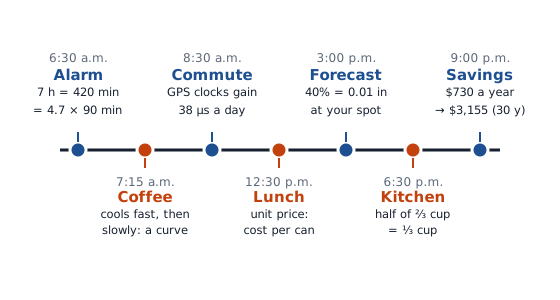
Most arithmetic in a day is invisible because it has already been done for you: on a shelf label, in a forecast, inside a phone. Take the arithmetic back out and you can check it. Math is used in everything from managing schedules to cooking dinner3, and the stops below are small enough to redo on the back of a receipt. Calculus gets its own pages, starting with calculus in everyday life; this one stays with arithmetic, ratios and probability, the math that runs a day before anyone calls it math. The daily life section has the rest.
A normal day is a string of small calculations that someone else already finished.
6:30 a.m.: the alarm and the 90-minute mark
Most adults need 7-9 hours of sleep a night (see the NIH sleep primer)5. In minutes that is 420 to 540 (our arithmetic). A person cycles through non-REM and REM sleep several times a night, with REM periods that get longer and deeper later in the session5, and REM sleep first occurs about 90 minutes after falling asleep5.
Worked example (our arithmetic). Inputs: the 90-minute first-REM mark and the 7-9 hour range from5. Seven hours is 7 × 60 = 420 minutes, and 420 ÷ 90 = 4.67, so a 6:30 alarm after 7 hours falls 4.7 times the first-REM mark after bedtime5. Nine hours is 540 minutes, which is exactly 6 times the mark5. The 90 minutes is the source’s figure for the first REM period only, so this ratio is a yardstick and not a cycle count.
7:15 a.m.: the coffee that cools in a curve
A hot cup loses heat fastest when it is hottest. The drop slows as the cup nears room temperature, which is why the last few degrees take so long. That shape is a curve and not a line, and the page on how fast coffee cools measures it. It is the first hint that change, not just quantity, is the thing worth computing.
8:30 a.m.: the commute and a clock that needs fixing
GPS is a system of 30+ navigation satellites circling Earth6. A receiver in a phone, per NASA’s GPS explainer, works out its distance from four or more of them, and then it knows where you are6. A phone can usually place you within a few yards6. The distances come from signals, and signals come with clocks.
Those clocks run off Earth’s pace. The satellites move so fast that special relativity indicates they should fall behind earthbound clocks by 7 microseconds a day, while the lower gravity in medium Earth orbit should speed them up by 45 microseconds a day7. Combined, atomic clocks aboard GPS satellites run 38 microseconds per day faster than earthbound clocks7. Engineers realized they needed to correct for relativity to get the system to provide accurate time on Earth7. Worked example (our arithmetic): 45 − 7 = 38 microseconds a day, the net gain7.
12:30 p.m.: lunch and unit price
Shopping math is mostly division. Stores often run sales that take a percentage off an original price1, and a shopper deciding between a 12 pack and a 24-pack of soda needs a way to compare1. Unit pricing is that way: it displays the price of all brands and sizes of a product category per the same unit of measure, such as price per kilogram, liter, pound or fluid ounce8.
Worked example (our arithmetic). Inputs: shelf prices we made up for illustration, a $6.48 12 pack and an $11.52 24-pack of the same can; the pack sizes are the choice posed in1, and the unit-price method is from8.
The larger pack saves 6 cents a can, which is $1.44 over 24 cans (our arithmetic)8. A label that puts the unit price near the total price lets shoppers see both at a glance8. The unit of measure should be consistent for all products in like categories8; a comparison breaks when one label counts ounces and its neighbor counts liters.
3:00 p.m.: the forecast and what 40% means
A forecast of a 40 percent chance of rain is a statement about one spot. The National Weather Service defines it so: the probability of precipitation describes the probability that the forecast point in question will receive at least 0.01 inch of rain, so a 40 percent forecast means a 40 percent probability of at least 0.01 inch at the specific point of interest4. It does not say rain falls for 40 percent of the day or over 40 percent of the area4. Forecasters build these numbers with statistical modelling of future temperatures, rainfall and humidity2.
Worked example (our arithmetic). Inputs: a 40 percent chance from4, applied over 5 days. If each day carries an independent 40 percent chance, the chance of staying dry all 5 days is 0.6^5 = 0.078, about 8 percent. The days are rarely independent, so the figure is a rough guide.
6:30 p.m.: cooking and baking, one fraction at a time
Cooking uses ratios and proportions: it is very common to use a half or double of a recipe, and each ingredient has to be recalculated1. A recipe that calls for 2/3 of a cup of flour forces the cook to work out half or double of 2/3 of a cup1. Following a recipe means measuring ingredients accurately, converting temperatures or measurements between imperial and metric, and using ratios to adjust the result2.
Worked example (our arithmetic). Inputs: the 2/3 cup of flour from1.
| Change | Calculation | Amount |
|---|---|---|
| Half the recipe | 2/3 ÷ 2 | 1/3 cup1 |
| Same recipe | 2/3 × 1 | 2/3 cup1 |
| Double the recipe | 2/3 × 2 | 4/3 cups, or 1 1/3 cups1 |
A measuring set has ¼, 1/3, ½ and 1 cup1, so the double batch is a full cup plus a 1/3 cup. Whether a cook is doubling a recipe or converting measurements, the work is fractions, ratios and basic arithmetic3.
9:00 p.m.: savings and a $2 slice
The Securities and Exchange Commission’s investor site turns compound interest into a pizza problem. A $2 slice bought every day for a year costs $7309. If that $730 is saved and invested at 5% interest, after five years it is $931.699, and after 30 years it is $3,155.029. Worked example (our arithmetic): 2 × 365 = $730, and 730 × 1.05^30 = $3,1559. Understanding percentages is how we work out the real cost of a credit card or loan2. The compound interest formula page does the algebra, and the Rule of 72 gives the quick version.
The date on the wall: a calendar that repeats every 400 years
Even the calendar is arithmetic. Under the Gregorian rule, every year divisible by 4 is a leap year, except centurial years, which are leap years only if divisible by 40010. So 2000 was a leap year, while 1900 and 2100 are not10. The calendar is built on a cycle of 400 years that comprises 146097 days, a number evenly divisible by 7, so the calendar repeats exactly after 400 years10.
Worked example (our arithmetic). Leap years in 400 years: 400 ÷ 4 = 100, minus 4 centuries, plus 1 for the year divisible by 400, gives 9710. Days: 400 × 365 + 97 = 146,09710. Average year: 146,097 ÷ 400 = 365.2425 days, which sits close to the tropical year, the cycle of the seasons, at 365.2421896698 days10. The remaining error is one day in about 2500 years10. Pope Gregory’s reform deleted ten days, so that 1582 October 4 was followed by 1582 October 1510.
How math helps solve real-world problems
Math in the real world is easy to miss because students might not immediately notice its presence3. The question “how can math help solve real-world problems?” has the same answer at every stop above: it turns a vague worry into a number you can compare3. The 12 pack beats the 24-pack by 6 cents a can, the forecast covers a single spot, the satellite clock needs a 38 microsecond fix. Everyday uses also reach sports, where probability helps figure the chances of a team winning2, and home decorating, where area tells you how much paint a room needs1.
Try the habit on one number tomorrow: write the unit under it. A price per can, a chance of at least 0.01 inch, a distance in yards. Once the unit is written down, the arithmetic usually follows, and the calculus pages show what changes when the number itself keeps moving3. The calculus uses overview is the next stop.
If this left you with a question, start with Calculus in everyday life, one morning or What Is Calculus Used For? Real-Life Examples.
Sources
- Math Matters in Everyday Life · Northern Illinois University, Math Matters · niu.edu · checked October 21, 2026
- 8 ways we use maths in everyday life · Mathematics Hub (Australia) · mathematicshub.edu.au · checked October 21, 2026
- Math in the Real World · Accelerate Learning (STEMscopes) · blog.acceleratelearning.com · checked October 21, 2026
- Explaining "Probability of Precipitation" · National Weather Service, Peachtree City, GA · weather.gov · checked October 21, 2026
- Brain Basics: Understanding Sleep · National Institute of Neurological Disorders and Stroke, NIH · ninds.nih.gov · checked October 21, 2026
- How Does GPS Work? · NASA Space Place · spaceplace.nasa.gov · checked October 21, 2026
- Putting Einstein to the Test · National Institute of Standards and Technology · nist.gov · checked October 21, 2026
- Unit Pricing Guide, NIST SP 1181-2025 · National Institute of Standards and Technology · nvlpubs.nist.gov · checked October 21, 2026
- What is compound interest? · Investor.gov, U.S. Securities and Exchange Commission · investor.gov · checked October 21, 2026
- Calendars and their History · NASA Goddard Space Flight Center · eclipse.gsfc.nasa.gov · checked October 21, 2026
Published . Every source shows the day it was read. Diagrams: original, by the editors. How we check facts · Report an error.