How it works · Math in the world
How Fast Does Coffee Cool? Newton's Law of Cooling
Coffee cools fast at first and slower later. The law behind it, how to find your cup's cooling constant, measured data, and what milk and lids change.
Checked against 6 sources (5 textbook, course or government) · By Ambient Math editors
The short answer. Coffee cools at a rate proportional to how far it sits above room temperature, so it drops fast at first and slower later5. A measured cup in a 74 degF room had a cooling constant of 0.0453 per minute1, and 800 ml of water cooled at about half the rate of 100 ml2.
- The law
- Rate of cooling is proportional to the gap above room temperature5
- A measured cup
- k = 0.0453 per minute, starting 112 degF above the room1
- Drinkable range
- Warm drinkable coffee sits between 110 and 140 degF1
- Milk
- Cold milk added later cools the coffee a little more; room-temperature milk makes no difference3
On this page
A mug of coffee on a desk is one of the cleanest experiments in physics. You pour it, you wait, and the temperature falls along a curve you can predict from two measurements. A school problem that many students meet is exactly this: measure the temperature drop of a cup of hot coffee and discover Newton’s law1. Below you get the law, the steps to apply it to your own cup, real data from three experiments, and the places where the simple model drifts from the truth. It is a calculus topic, so the daily life section and the world section both fit.
Newton’s law of cooling in plain words
The rate of heat loss of a body is directly proportional to the difference in temperature between the body and its environment5. In symbols, with T the coffee’s temperature, Ts the room’s and k a constant for the cup, the rate dT/dt equals −k times (T − Ts)41. Because the rate depends on the gap, and the gap keeps shrinking, the solution is an exponential decrease of the temperature difference over time5:
T(t) = Ts + (T0 − Ts) × e^(−kt)1
Here T0 is the starting temperature. At t = 0 the formula returns T0, and as t grows it settles at the room temperature Ts1. The constant k carries everything about the cup: it encompasses conduction, convection and radiation1, and it depends on the cup’s heat transfer properties, so an experiment must use the same cup in the same orientation1. A bigger k means faster cooling.
The idea is old. Isaac Newton published his work on cooling anonymously in 17015. It was the first heat transfer formulation5. That is why a single page of calculus, the one on what a derivative is, is enough to follow the whole argument.
How to calculate how fast your coffee cools
You need two temperature readings and the room temperature. Then three steps give you everything else.
- Measure. Record the temperature now (T0) and again after a known number of minutes. Record the room temperature (Ts)4.
- Find k. Divide the later gap by the starting gap and take the natural logarithm: k = −ln[(T − Ts) / (T0 − Ts)] / t4.
- Predict. Put k back into the formula to get the temperature at any time, or solve it for the time to reach a target temperature: t = ln[(T0 − Ts) / (T − Ts)] / k4.
A textbook version of this has a pizza, but the arithmetic is the same as for coffee: a pizza comes out of the oven at 200 °F in a 75 °F kitchen and is 190 °F after one minute4. The aim is to wait until it reaches 150 °F4. The textbook answer is an additional 6.12 minutes4.
Worked example (our arithmetic): the textbook pizza, with the formula above4
| Step | Calculation | Result |
|---|---|---|
| Starting gap | 200 − 75 | 125 °F4 |
| Gap after 1 minute | 190 − 75 | 115 °F4 |
| Cooling constant | −ln(115 / 125) / 1 | 0.0834 per minute4 |
| Time to reach 150 °F | ln(125 / (150 − 75)) / 0.0834 = ln(1.6667) / 0.0834 | 6.13 minutes4 |
The result matches the textbook’s 6.12 to rounding4. Swap the pizza for a mug and only the numbers change.
A measured cup: the Florida data
A University of Florida write-up dated December 2017 measured water and coffee in a cup with a thermocouple1. For a cup of water heated to about 190 °F, the fit used k = 0.0453 with a starting gap of 186 − 74 = 1121. Warm drinkable coffee typically sits between 110 °F and 140 °F1. Those two facts are enough to ask when the cup becomes drinkable.
Worked example (our arithmetic): coffee poured at 190 °F in the 74 °F room of that experiment, k = 0.0453 per minute1
| Question | Calculation | Answer |
|---|---|---|
| Time for the gap to halve | ln 2 / 0.0453 | 15.3 minutes1 |
| Time to reach 140 °F | ln(116 / 66) / 0.0453 | 12.4 minutes1 |
| Time to reach 110 °F | ln(116 / 36) / 0.0453 | 25.8 minutes1 |
| Temperature at 10 minutes | 74 + 116 × e^(−0.453) | 147.7 °F1 |
| Temperature at 20 minutes | 74 + 116 × e^(−0.906) | 120.9 °F1 |
| Temperature at 30 minutes | 74 + 116 × e^(−1.359) | 103.8 °F1 |
The curve makes the first-minutes behavior plain. The cup loses about 42 °F in the first 10 minutes and about 27 °F in the next 10 (our arithmetic), then slows further, even though each interval has the same length1. The percentage decay is constant. The number of degrees lost per minute is not.
The same write-up added cream, about 10% of the coffee volume, and found that black coffee and coffee with cream followed nearly the same exponential rate1. It reads that as evidence that radiation plays only a minor role in the cooling1, which fits its statement that radiation is of negligible importance at sub-boiling temperatures1.
Why a larger volume cools more slowly: three beakers
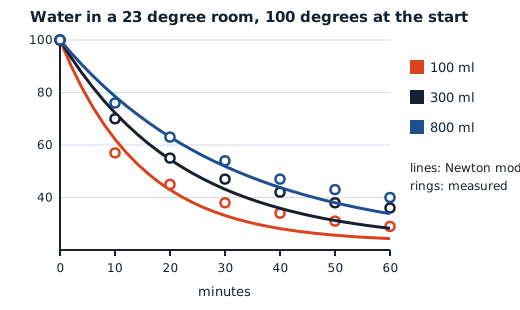
A University of Georgia experiment used three beakers of water, 100 ml, 300 ml and 800 ml, all starting at 100 °C in a room at 23 °C2. The smaller beakers cooled more quickly than the larger ones2. Fitting Newton’s law to each gave a different constant:
Worked example (our arithmetic): half-lives and model predictions from the fitted constants2
| Volume | Fitted k (per minute) | Gap halves every | Model at 30 min | Measured at 30 min | Measured at 60 min |
|---|---|---|---|---|---|
| 100 ml | 0.06762 | 10.3 min | 33.1 °C | 38 °C2 | 29 °C2 |
| 300 ml | 0.04472 | 15.5 min | 43.1 °C | 47 °C2 | 36 °C2 |
| 800 ml | 0.03272 | 21.2 min | 51.9 °C | 54 °C2 | 40 °C2 |
The constant for 800 ml was about half the constant for 100 ml2. That is the geometry of a cup: more water holds more heat for the same surface to lose.
Where the simple law fails
The table above shows the model’s flaw: it predicts a cooler beaker at minute 30 than the thermometer reads. In every beaker the measured temperature fell faster than the model early and more slowly than the model late2. The author points to evaporation, which is high near boiling and removes more heat than convective exchange with the room does, and to the countertop, which pulled heat out at first2. The conclusion is still that the law is a reasonable approximation for an object cooling in a constant ambient temperature2. The larger sample followed the model more closely than the smaller ones2.
A 2024 Physics Education paper on soup bowls and coffee cups reaches the same split verdict: Newton’s law was verified as applicable, the contributions of different heat transfer mechanisms were quantified, and the demonstrations show the important role of evaporative cooling in many cases, versus convection and radiation6. The general limits are written into the law itself: radiative heat transfer does not obey it5, and it holds well for forced air and pumped liquid cooling5. It is more accurate when the working temperature variations are small5. A hot drink in still air is on the edge of that range, so treat the numbers on this page as a good shape and a rough forecast.
Does adding milk early keep coffee hotter?
A popular belief says cream added at the start keeps the mixture warmer for longer. A Memorial University worked problem asks the question precisely: does white coffee cool faster if the milk goes in immediately or if the milk is added later3? Its model assumes instant complete mixing3. The result depends on the milk’s temperature. If the milk is at room temperature, the time at which it is added has no effect on the temperature of the mixture afterward3. If the milk is colder than the room, delaying its addition cools the coffee down faster, and if the milk is warmer than the room, adding it immediately cools fastest3.
The Florida write-up reaches the same ordering from a different angle. The curve after cream is added stays below the black-coffee curve, and the mixture follows the same curve no matter when the cream goes in1. Its conclusion is about insulation: to keep coffee as hot as possible, good insulation such as a thermos bottle is required1.
Worked example (our arithmetic): 200 ml of coffee at 90 °C, 20 ml of milk at 5 °C, room 20 °C, k = 0.0453 per minute13
Delaying the cold milk gives a mixture about 0.2 °C cooler at minute 30, which is the direction the model predicts3 and a difference far below what a kitchen thermometer resolves. The volumes, temperatures and k here are our assumptions, chosen to show the size of the effect.
The calculus behind it
The law is a differential equation, an equation linking a quantity to its own rate of change. Solving it is the standard way to introduce separable equations in a calculus course, and Newton’s law of cooling is one of the two applications that the textbook uses to illustrate them4. The steps are short: separate the variables, integrate both sides, exponentiate, and use the starting temperature to fix the constant4. The rate you see on the dashboard of this problem is a derivative, and the formulas that produce it are on the derivative rules cheat sheet. For the same idea set inside a whole morning, with a speedometer and a filling tub, read calculus in everyday life.
Mistakes with the cooling formula
- Mixing temperature scales. The ratio of gaps works in Fahrenheit or Celsius, since only differences enter. A starting gap of 112 degF is the same physics as a gap of about 62 degC (our arithmetic)1.
- Dropping the room temperature. The gap is measured from the room, not from zero. Using the raw temperature in the logarithm gives a nonsense k4.
- Reusing one cup’s k for another cup. The constant depends on the cup’s heat transfer properties1, and in the beaker data it differed by a factor of two between 100 ml and 800 ml2.
- Trusting the model near boiling. Evaporation is high there, and the measured curve departs from the model2.
- Expecting precision. Even a careful fit has errors of several degrees, as the beaker table shows2.
Common questions
Read next
How Much Gold Is in an Oscar? The Plating Math
An Oscar is cast bronze with a thin 24-karat gold plating. See the plating math: about 0.5 to 6.5 grams of gold, and why solid gold would cost about $414,000.
Math in the worldWhat Is Pi? Meaning, Value, Uses and History
Pi is a circle's circumference divided by its diameter, about 3.14. See the formulas, how many digits you need, what pi is used for, and its history.
Math in the worldWhy Power Lines Use High Voltage: The Math of Line Loss
High voltage means low current, and heat loss grows with the square of the current. Worked example, transformers, HVDC and underground cables explained.
Sources
- Cooling of a cup of coffee (Kurzweg, University of Florida, December 2017) · University of Florida, Department of Mechanical and Aerospace Engineering · web.mae.ufl.edu · checked October 21, 2026
- Newton's Law of Cooling: An Experimental Investigation (Gieseking) · University of Georgia, College of Education coursework · jwilson.coe.uga.edu · checked October 21, 2026
- Coffee Cooling: an example of first order ordinary differential equations · Memorial University of Newfoundland, Faculty of Engineering · engr.mun.ca · checked October 21, 2026
- 4.3 Separable Equations, Calculus Volume 2 · OpenStax (Rice University) · openstax.org · checked October 21, 2026
- Newton's law of cooling · Wikipedia · en.wikipedia.org · checked October 21, 2026
- How a soup bowl and a coffee cup cool down · Physics Education, IOP Publishing (2024) · iopscience.iop.org · checked October 21, 2026
Published . Every source shows the day it was read. Diagrams: original, by the editors. How we check facts · Report an error.