How it works · Math in the world
How Much Does Snow Weigh? The Math of Snow Load
A foot of snow weighs about 3 to 12 pounds per square foot. Use depth × water content × 5.2 to work out your own roof, driveway and snowstorm.
Checked against 7 sources (7 textbook, course or government) · By Ambient Math editors
The short answer. A foot of fresh snow weighs about 3 to 12 pounds on each square foot, because new snow is typically 5 to 20 percent water1 and a foot-deep square foot of water weighs 62.4 pounds2. Multiply depth in inches by the water fraction by 5.2 to get pounds per square foot (our arithmetic)2.
- The formula
- Load in lb per sq ft = depth in inches × water fraction × 5.2 (our arithmetic from 62.4 ÷ 12)2
- Water in new snow
- Typically 5 to 20 percent; the North American average is about 8 percent1
- Old rule
- 10 inches of snow to 1 inch of water, 10:13
- Pitched roof
- Multiply the flat load by the cosine of the pitch2
Snow looks light because it is mostly air. The weight comes from the small share that is ice and water, and that share changes from storm to storm, which is why the answers you find online disagree. The math needs three numbers: depth, water content, and the weight of water. This page builds the formula, tests it on a roof and a driveway, and shows where it stops being reliable.
How heavy is 1 ft of snow?
Per square foot of ground or flat roof, a foot of new snow weighs about 3 to 12 pounds, and about 5 pounds at the average water content21. The spread comes from the water content. Newly fallen snow typically holds 5 to 20 percent water, with about 8 percent as the average across North America1. Snow at about 7 percent or less counts as light and snow at 11 percent or more counts as heavy1.
Worked example (our arithmetic): load in pounds per square foot, from depth × water fraction × 5.221
| Depth | 5% water (light) | 8% water (average) | 11% water (heavy) | 20% water (very wet) |
|---|---|---|---|---|
| 10 inches | 2.6 | 4.2 | 5.7 | 10.421 |
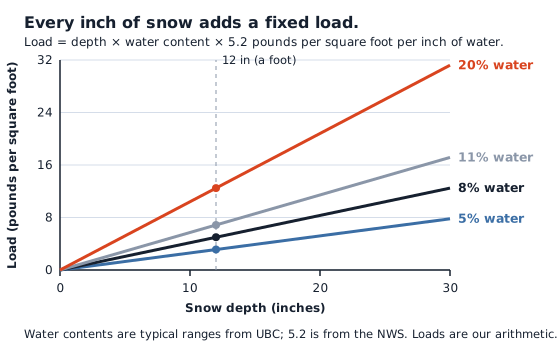
| 12 inches (1 foot) | 3.1 | 5.0 | 6.9 | 12.521 |
| 20 inches | 5.2 | 8.3 | 11.4 | 20.821 |
| 30 inches | 7.8 | 12.5 | 17.2 | 31.221 |
Every cell is depth × water fraction × 5.2, rounded to one decimal place2. For the 12-inch row at 8 percent, 12 × 0.08 × 5.2 = 4.99, which is the 5.0 in the table21. The water fractions are the typical 5 to 20 percent of new snow, the 8 percent average and the 11 percent heavy threshold1; the 5.2 is explained next2.
Where the formula comes from
The National Weather Service starts from the weight of water: 1000 kilograms per cubic meter, which is 62.4 pounds per cubic foot2. Put that water in a column one square foot wide and one foot deep and it weighs 62.4 pounds, so each inch of depth weighs 5.2 pounds2. Dividing 62.4 by 12 gives the same 5.2 (our arithmetic)2.
The second ingredient is the water equivalent, the depth of water that would cover the ground if the snow were liquid4. The essential measurement for a snow load estimate is that water equivalent2. Multiply the water equivalent in inches by 5.2 and you have the load in pounds per square foot2. The NWS example: 2.0 inches of water equivalent gives 10.4 pounds per square foot against a flat roof2.
When you only know the depth of snow, you convert it to water equivalent with the water fraction. That is the step in the table: 12 inches of snow at 8 percent water holds 12 × 0.08 = 0.96 inches of water (our arithmetic)1. Then 0.96 × 5.2 = 4.99 pounds per square foot (our arithmetic)2.
Why there is no single number for snow
Snow density has a wide range. Newly fallen snow is generally between 30 and 300 kilograms per cubic meter1. The water-content shortcut divides the density by 10 and adds a percent sign, so the range is 3 to 30 percent (our arithmetic)1. In weight per cubic foot, 3 percent water is 62.4 × 0.03 = 1.9 pounds and 30 percent is 62.4 × 0.30 = 18.7 pounds (our arithmetic)21. A sample of newly compacted snow on a race course was probably around 350 kilograms per cubic meter1, which is 35 percent water (our arithmetic).
Several things push the density up or down:
- Temperature. The warmer it is, the denser new snow tends to be1. The relationship holds down to about -15 degrees Celsius, and colder than that the density hardly changes1.
- Wind. Faster winds go with denser new snow1. Wind can also break flakes apart, which lowers the accumulation per unit of water3.
- The storm itself. Ratios can change dramatically within a single snow event3. The warmer the layer of air near the freezing point, the lower the ratio3.
- Cold air. Deep cold, in general, promotes higher snow ratios3.
The 10:1 rule and its limit
The old rule of thumb said 10 inches of snow holds 1 inch of water, a 10:1 ratio, which is the same as 10 percent water3. Recent studies suggest 12:1 is more representative on average for the Upper Midwest, and the NWS adds that a rule of thumb is usually off the mark3. NOAA’s constant 10:1 forecast product multiplies the model’s water amount by 10 and so overestimates snow in marginally warm air and underestimates it in very cold air5.
A ratio and a water fraction are two views of the same quantity (our arithmetic). A 10:1 ratio is 1 ÷ 10 = 0.10, or 10 percent water, and a 12:1 ratio is 1 ÷ 12 = 0.083, or about 8.3 percent water, close to the 8 percent North American average31.
Worked examples: roof, pitched roof and driveway
Worked example (our arithmetic): a flat roof of 1,500 square feet after 20 inches of snow at 11 percent water21
| Step | Calculation | Result |
|---|---|---|
| Water equivalent | 20 × 0.11 | 2.2 inches1 |
| Load per square foot | 2.2 × 5.2 | 11.44 pounds per square foot2 |
| Total on the roof | 11.44 × 1,500 | 17,160 pounds2 |
The same snow on a pitched roof presses less directly on the surface. The NWS method multiplies the flat load by the cosine of the roof pitch2. In the agency’s example, a roof 35 degrees up from the horizon under a load of 10.4 pounds per square foot gives 10.4 × cos 35 = 8.5 pounds per square foot against the roof2. Applied to our 11.44: 11.44 × 0.819 = 9.37 pounds per square foot (our arithmetic)2. The weight along the slope still matters, since snow stays on a pitched roof only while friction holds it2.
Worked example (our arithmetic): a driveway 12 feet wide and 40 feet long after 10 inches of snow at the 8 percent average21
| Step | Calculation | Result |
|---|---|---|
| Area | 12 × 40 | 480 square feet2 |
| Load per square foot | 10 × 0.08 × 5.2 | 4.16 pounds per square foot21 |
| Total to shovel | 4.16 × 480 | 1,996.8 pounds, about 2,000 pounds21 |
A light dusting of snow is easy, and a heavy foot is not. The same driveway under 10 inches of 20 percent snow is 10 × 0.20 × 5.2 × 480 = 4,992 pounds (our arithmetic)21.
Measure the snow you have
Formulas give a range; a measurement gives your number. Take a core of the snow all the way to the ground with a long cylinder, melt it indoors and read the depth of water; that is the water equivalent2. The NWS asks its observers to measure water equivalent, snowfall and snow depth, which it calls some of the most difficult but important weather elements to measure accurately6. Choose a spot where blowing and drifting are minimized, and leave the largest drifts out of the measurement6.
Roofs vary more than open ground. Measure the snow on your own roof if possible, because depth can vary a lot over a small area2. The weight tables are a rough estimate to be used with caution, and snow that ages and settles does not stay uniform2. Scientists weigh a known volume of snow to find its density, which is the same idea at a smaller scale7.
Snow load is a straight line
Plot load against depth and you get a straight line through zero, as in the chart above2. The slope of the line is the load added by each extra inch: 0.416 pounds per square foot for each inch of 8 percent snow (0.08 × 5.2, our arithmetic)21. In calculus language that slope is the derivative of the load with respect to depth, and it is constant because the density is assumed constant2. Real snowpacks are not that tidy: a snowpack gets denser over a season7, so the slope bends upward as the pile ages. For the idea of a slope as a rate of change, see what a derivative is.
For other places where one simple physical rule sets a size, see why seasons happen and how fast coffee cools, or browse the World section. The sources behind the numbers are the NWS Juneau snow load article, the NWS La Crosse snow ratio page and the UBC snow density notes.
Common questions
How heavy is 20 inches of snow?
On a flat surface, 20 inches of typical new snow at 8 percent water is 8.3 pounds per square foot, from 20 × 0.08 × 5.2 (our arithmetic)21. The range runs from 5.2 pounds for 5 percent snow to 20.8 pounds for 20 percent snow21.
Read next
How Fast Does Coffee Cool? Newton's Law of Cooling
Coffee cools fast at first and slower later. The law behind it, how to find your cup's cooling constant, measured data, and what milk and lids change.
Math in the worldWhy Seasons Happen: Earth's Tilt, Sun Angle and Daylight
Earth's 23.44 degree tilt causes the seasons, not distance from the Sun. See the sun-height math, daylight by latitude, and why the tilt slowly changes.
Core ideasWhat Is a Derivative in Calculus? Simple Explanation
A derivative is the instantaneous rate of change of a function: the slope of its tangent line. Plain meaning, worked examples, notation and when it fails.
Sources
- Density of Newly-Fallen Snow (ATSC 113) · University of British Columbia, Earth, Ocean and Atmospheric Sciences · eoas.ubc.ca · checked October 22, 2026
- Cloudburst Chronicle: Snow Loads (J. Curtis) · National Weather Service, Juneau, Alaska · weather.gov · checked October 22, 2026
- What Are Snow Ratios? · National Weather Service, La Crosse, Wisconsin · weather.gov · checked October 22, 2026
- Snow Water Equivalent and Depth Information · National Weather Service, Mid-Atlantic River Forecast Center · weather.gov · checked October 22, 2026
- NWP Snow Accumulation Products · NOAA Virtual Lab, Forecast Operations Guide · vlab.noaa.gov · checked October 22, 2026
- Snow Measurement Information · National Weather Service, Grand Junction, Colorado · weather.gov · checked October 22, 2026
- Converting snow depth to snow water equivalent using climatological variables · The Cryosphere (Copernicus) · tc.copernicus.org · checked October 22, 2026
Published . Every source shows the day it was read. Diagrams: original, by the editors. How we check facts · Report an error.