Story · Math in the world
Why Seasons Happen: Earth's Tilt, Sun Angle and Daylight
Earth's 23.44 degree tilt causes the seasons, not distance from the Sun. See the sun-height math, daylight by latitude, and why the tilt slowly changes.
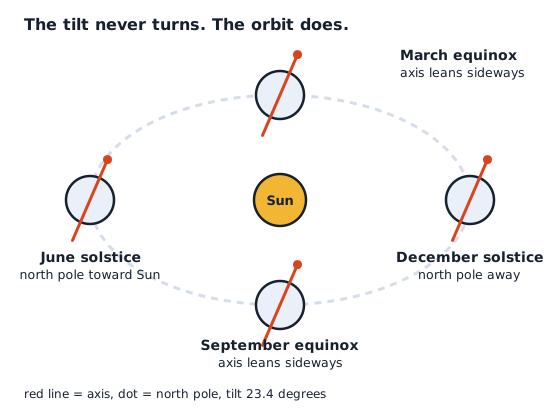
Earth's axis is tilted 23.44 degrees to its orbit5, and it keeps pointing the same way all year, so each hemisphere takes turns leaning toward the Sun1. Distance is not the cause: Earth is closest to the Sun around January 3 and farthest around July 44, so the Northern Hemisphere has winter at closest approach1.
- Distance
- Perihelion 147.095 million km, aphelion 152.100 million km5
- Daylight at mid-latitudes
- About 15 hours near the summer solstice, near nine hours near the winter solstice3
- Tilt over time
- Varies between 22.1 and 24.5 degrees in a cycle of about 40,000 years4
A hot July afternoon in the Northern Hemisphere arrives when Earth is near the farthest point of its orbit from the Sun1. That one fact breaks the most popular explanation of the seasons and is the fastest way into the real one. Below: the orbit numbers, the tilt, the sun-height math you can run for your own latitude, and what changes when the tilt itself drifts over thousands of years.
Earth’s lopsided orbit does not make the seasons
The popular explanation is distance: Earth sits closer to the Sun in summer, the story goes, and that is why it is hotter1. The story fails on the calendar. In the Northern Hemisphere it is winter when Earth is closest to the Sun and summer when it is farthest away1. If distance were the cause, it would be hotter in the northern hemisphere in January than in July3.
The orbit is slightly stretched, and the numbers are small. Perihelion, the closest point, is 147.095 million km from the Sun and aphelion, the farthest, is 152.100 million km5. In miles that is 91,400,000 at perihelion and 94,500,000 at aphelion1. The gap is over 3 million miles, which is not much relative to the whole distance1. The orbit’s eccentricity, a measure of how far it is from a circle, is 0.01675. Perihelion falls on or about January 3 and aphelion on or about July 44.
Worked example (our arithmetic): how big is the distance effect?
| Step | Calculation | Result |
|---|---|---|
| Distance gap | 152.100 − 147.095 | 5.005 million km5 |
| Share of the average distance | 5.005 ÷ 149.598 (semimajor axis from the same fact sheet) | about 3.3%5 |
| Aphelion over perihelion | 152.100 ÷ 147.095 | 1.0345 |
| Sunlight ratio, perihelion over aphelion (sunlight falls with the square of distance) | 1.034 × 1.034 | about 1.07, so about 7% more sunlight in January5 |
NASA’s own rounded figure for the same difference is about 6 percent more incoming sunlight from July to January4. Either way the Southern Hemisphere, which is tilted toward the Sun in January, gets a small distance bonus on top of its summer, and the Northern Hemisphere gets a small penalty on top of its winter. The seasonal swings we feel are far larger than that, so something else is in charge.
Why does axial tilt cause seasons?
Earth’s axis is tilted 23.44 degrees from the perpendicular to its orbital plane5. NOAA gives the same tilt as 23.45 degrees2. The likely origin is an early collision: it is thought that something big hit the young Earth and knocked it off-kilter, a NASA Space Place account1.
The tilt matters because of one more fact: as Earth orbits the Sun, its axis always points in the same direction1. Astronomers call that axial parallelism10. So half an orbit apart, the same pole faces opposite ways relative to the Sun10. When the North Pole tilts toward the Sun it is summer in the Northern Hemisphere, and when the South Pole tilts toward the Sun it is winter there1.
Two effects stack up in the tilted hemisphere. First, it gets more hours of sunlight each day9. Second, midday sunlight strikes the ground at an angle nearer the vertical, so it delivers more energy per unit of surface area9. The NWS adds a third effect: with the Sun high, less sunlight gets scattered before reaching the ground, because it travels a shorter path through the atmosphere3.
Rotation and revolution are different jobs. Earth spins around its axis once a day, which gives day and night1. It circles the Sun once every 365.25 days9. The tilt is a fixed lean, and the circling is what carries the lean from one side of the Sun to the other.
The four key dates
Near June 21, the summer solstice, the Sun is directly over the Tropic of Cancer at 23.5 degrees north latitude3. About 90 days later, around September 21, the autumnal equinox puts the Sun directly over the equator3. Near December 21, the winter solstice, the Sun is directly over the Tropic of Capricorn at 23.5 degrees south latitude3. The spring equinox near March 21 again has the Sun over the equator3. One orbit takes 365.256 days against the stars5, so the four marks are about a quarter of that apart.
The Sun’s latitude at those moments equals the tilt, which is why the tropics sit at 23.5 degrees3. The two hemispheres swap roles: winter in North America is summer in Australia9. A Southern Hemisphere resident sees the Sun more northerly in the sky during June, July and August2. In North America the winter Sun rises in the southeast and sets in the southwest, and the summer Sun rises in the east, stands overhead at noon and sets in the west2.
How high the noon Sun gets: the math
The tilt turns into a formula you can use. The solar angle at noon, measured up from the horizon, is 90 minus the latitude of the location, plus the solar declination, as a UC Irvine course slide sets it out7. The declination is the latitude where the Sun is overhead, so it is +23.5 at the June solstice, 0 at the equinoxes and −23.5 at the December solstice37. A course example for Toronto at latitude 44 N works out to 46 at an equinox, 69.5 at the June solstice and 22.5 at the December solstice7.
Worked example (our arithmetic): latitude 40 N, using the 23.44 degree tilt as the declination at the solstices57
| Date | Calculation | Noon Sun height |
|---|---|---|
| Equinox | (90 − 40) + 0 | 50 degrees7 |
| June solstice | (90 − 40) + 23.44 | 73.44 degrees57 |
| December solstice | (90 − 40) − 23.44 | 26.56 degrees57 |
| Swing between the two solstices | 73.44 − 26.56 | 46.88 degrees, which is twice the tilt57 |
The same energy spreads over more ground when the Sun is low9. As a geometric estimate, the share that lands on one square meter of flat ground scales with the sine of the Sun’s height. That is 0.959 at 73.44 degrees and 0.447 at 26.56 degrees, so the June noon delivers about 2.1 times the energy per square meter that the December noon does (our arithmetic)9. This is the main reason for the temperature difference, and it is why a tilt change of just a degree or two matters over thousands of years.
At the equator the formula needs one adjustment. At 0 degrees latitude the June solstice gives (90 − 0) + 23.44 = 113.44, which is past straight overhead, so the real height is 180 − 113.44 = 66.56 degrees (our arithmetic)7. The December solstice gives the same 66.56, and the equinoxes give 907. Near the equator the Sun is always high, which is why the seasons there are weak.
Try your own latitude
Noon Sun and day length calculator
Pick a latitude (north is positive, south is negative) and a date. It approximates the Sun's declination with a smooth cosine curve, then applies the noon formula above. Day length ignores atmospheric refraction. Nothing you type leaves this page.
- Sun's declination
- –
- Noon Sun height
- –
- Day length
- –
- Noon energy per flat ground area
- –
Try latitude 40 on June 21 and December 21, and the result should land close to the 73 and 27 degrees worked above7. Then try latitude 0, and then 70.
Daylight by latitude
The tilt also sets how long the day lasts. At the equator, daylight stays within a few minutes of 12 hours all year3. At mid-latitudes it ranges from about 15 hours around the summer solstice to near nine hours close to the winter solstice3. The effect grows toward the poles.
| Place | Daylight | Effect |
|---|---|---|
| Equator | Daylight within a few minutes of 12 hours year round3 | Weak seasons |
| Mid-latitudes | About 15 hours in summer, near nine in winter3 | Clear seasons |
| Arctic Circle, 66.5 degrees north | The Sun never sets from early June to early July3 | Midnight sun |
| Barrow, Alaska, just over 71 degrees north | About a month of Sun never rising on each side of the winter solstice, two months of total darkness3 | Polar night |
| North Pole | Six months of light from the spring equinox to just after the autumnal equinox3 | Extreme |
Notice the Arctic Circle latitude: 66.5 degrees is 90 − 23.53. That is the same tilt number again, showing up as the latitude where the Sun can stay above the horizon for a whole day.
Would seasons exist without a tilt?
Not the familiar four. With zero tilt, the Sun’s declination would stay at 0 all year, so the noon height at latitude 40 N would stay at 90 − 40 = 50 degrees on every date7. Our arithmetic above shows what the tilt adds to that: plus or minus 23.445. Daylight at mid-latitudes would stay near 12 hours instead of swinging between roughly nine and 15 hours3. Only the small distance effect would remain, with about 6 percent more sunlight in January than in July4.
Other planets show the idea in the data. Venus is tilted 177.4 degrees and Uranus 97.8 degrees, nearly on its side6. Mars, Saturn and Neptune lean at 25.2, 26.7 and 28.3 degrees, close to Earth’s 23.46. Mercury, at 0.034 degrees, and Jupiter, at 3.1, lean almost not at all6.
| Planet | Tilt to its orbit |
|---|---|
| Earth | 23.4 degrees6 |
| Mars | 25.2 degrees6 |
| Saturn | 26.7 degrees6 |
| Neptune | 28.3 degrees6 |
| Jupiter | 3.1 degrees6 |
| Mercury | 0.034 degrees6 |
Does the tilt change?
Yes, slowly, and by amounts that are tiny on a human timescale. Earth’s tilt averages 23.5 degrees and varies from near 22 to 24.5 degrees3. A NASA description puts the full cycle at about 40,000 years, with the tilt moving between 22.1 and 24.5 degrees4. The tilt at the start of 2000 was about 23.4 degrees, and it is now decreasing by about 47 arcseconds per century8.
More tilt means more severe seasons, with warmer summers and colder winters, and less tilt means cooler summers and milder winters4. As the tilt increases, the seasonal contrast rises in both hemispheres4. The Moon has a stabilizing effect on Earth’s tilt10.
Worked example (our arithmetic): the extremes of the tilt cycle at latitude 40 N47
| Tilt | Calculation | June noon | December noon |
|---|---|---|---|
| 22.1 degrees (low end) | (90 − 40) ± 22.1 | 72.1 degrees47 | 27.9 degrees47 |
| 23.44 degrees (now) | (90 − 40) ± 23.44 | 73.44 degrees57 | 26.56 degrees57 |
| 24.5 degrees (high end) | (90 − 40) ± 24.5 | 74.5 degrees47 | 25.5 degrees47 |
Two other slow cycles change how the seasons play out. The shape of the orbit shifts between elliptical and nearly circular over 90,000 to 100,000 years, and its eccentricity ranges from nearly zero to 0.074. Axial precession, the slow turn of the axis direction, changes the dates of perihelion and aphelion4. Today northern summer occurs near aphelion4. Combined, the three cycles shape the long climate record4.
Common mix-ups
- “Summer means closer.” The Sun is closest around January 3 and farthest around July 44.
- “The tilt flips back and forth.” The axis keeps pointing the same direction as Earth orbits1.
- “The tilt is 23.5 degrees exactly.” The average is 23.5, the tilt varies between 22.1 and 24.5 degrees, and the current fact-sheet value is 23.44345.
- “Seasons are the same everywhere.” Near the equator daylight stays near 12 hours; at the Arctic Circle the Sun never sets for weeks3.
For another place where a smooth curve and a fixed constant decide a daily experience, see how fast coffee cools. The same idea of a rate depending on a gap sits behind what a derivative is, and hidden math in a normal day walks through more everyday numbers. For the circle constant that every orbit diagram quietly uses, read what pi is, and for the opposite problem of moving energy over wires, see why power lines use high voltage. Every page about the physical world around us is in the world section.
Common questions
What has seasons because its axis is tilted much like Earth?
Mars, Saturn and Neptune have tilts of 25.2, 26.7 and 28.3 degrees, close to Earth's 23.46. By the same geometry, a planet with a steady tilt like these has each hemisphere lean toward its star in turn1. Jupiter, at 3.1 degrees, leans very little6.
How much will Earth's rotational axis tilt change in 2026?
Very little. The tilt is decreasing by about 47 arcseconds per century8, which is about 0.47 arcseconds in one year, or roughly 0.00013 degrees. That is our arithmetic from the source rate, far too small to notice in any season8.
Would seasons exist if the Earth wasn't tilted?
Not the familiar ones. With no tilt the Sun would stay over the equator all year, and the noon sun at any latitude would keep one height37. Distance would still change sunlight a little, since Earth gets about 6 percent more sunlight in January than in July4.
If this left you with a question, start with How Fast Does Coffee Cool? Newton's Law of Cooling or What Is Pi? Meaning, Value, Uses and History.
Sources
- What Causes the Seasons? · NASA Space Place (JPL) · spaceplace.nasa.gov · checked October 21, 2026
- Why does Earth have Seasons? · NOAA NESDIS · nesdis.noaa.gov · checked October 21, 2026
- What Causes the Seasons? · National Weather Service, Sioux Falls, SD · weather.gov · checked October 21, 2026
- Milutin Milankovitch · NASA Earth Observatory · science.nasa.gov · checked October 21, 2026
- Earth Fact Sheet · NASA Space Science Data Coordinated Archive · nssdc.gsfc.nasa.gov · checked October 21, 2026
- Planetary Fact Sheet · NASA Space Science Data Coordinated Archive · nssdc.gsfc.nasa.gov · checked October 21, 2026
- How to Calculate Solar Angle? (ESS5, Prof. Jin-Yi Yu) · University of California, Irvine, Earth System Science · ess.uci.edu · checked October 21, 2026
- Earth's axial tilt versus time (Jeffery) · University of Nevada, Las Vegas, Department of Physics and Astronomy · physics.unlv.edu · checked October 21, 2026
- Experiment: How do seasons arise from the tilt of Earth's axis? · Science News Explores (Science Buddies) · snexplores.org · checked October 21, 2026
- Axial tilt · Wikipedia · en.wikipedia.org · checked October 21, 2026
Published . Every source shows the day it was read. Diagrams: original, by the editors. How we check facts · Report an error.