Reference · Math in the world
What Is Pi? Meaning, Value, Uses and History
Pi is a circle's circumference divided by its diameter, about 3.14. See the formulas, how many digits you need, what pi is used for, and its history.
Rev. · 9 refs · 7 textbook or government · Ambient Math editors
Pi is the circumference of a circle divided by its diameter, a constant of about 3.14 for every circle, big or small1. It is irrational, so its decimal digits never end or repeat1, and NASA's Jet Propulsion Laboratory uses 15 decimals, 3.141592653589793, for interplanetary navigation2.
- Definition
- Circumference divided by diameter, the same for any circle1
- NASA JPL navigation
- 3.141592653589793, 15 decimals2
- Digits for the universe
- 37 decimal places pin down a circle the size of the known universe to one hydrogen atom2
- Pi Day
- March 14, first held in 19885
On this page
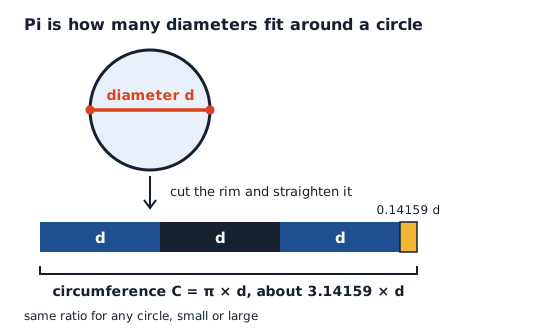
Pi turns up wherever something is round, curved or repeating, from NASA mission planning to the bell curve15. Below: the value and definition first, then the formulas, the digits anyone actually needs, the uses, and a history that runs from a temple casting to a computation of 100 trillion digits37.
Pi at a glance
| Question | Short answer |
|---|---|
| What is it? | The circumference of a circle divided by its diameter, the same for any circle1 |
| What is its value? | Approximately 3.141598; 3.14 is usually precise enough1 |
| Is it a fraction? | No. Pi is irrational, a number that cannot be expressed as a simple fraction1 |
| What else is true of it? | It is transcendental, which rules out squaring the circle with ruler and compass3 |
| Why the symbol? | William Jones used the Greek letter for periphery in a book of 17065 |
| When is Pi Day? | March 14 every year5 |
What is pi?
Pi is the circumference of a circle divided by the circle’s diameter, and it is the same for any circle, no matter how big or small1. The circumference is the distance around a circle, and the diameter is a straight line across it through the center1. Put another way, pi counts how many diameters fit around the rim1.
Three diameters fit around the rim with a little left over. With pi near 3.14, the leftover is about 0.14 of a diameter (our arithmetic)1.
Worked example (our arithmetic): the same ratio for two pizzas, using C = π × d, A = π × r × r with the full value of pi19
| Pizza | Diameter | Radius | Circumference | Area |
|---|---|---|---|---|
| Small | 12 inches | 6 inches | 37.70 inches1 | 113.10 square inches9 |
| Large | 16 inches | 8 inches | 50.27 inches1 | 201.06 square inches9 |
| Large over small | 16 ÷ 12 = 1.33 | 1.33 times1 | 201.06 ÷ 113.10 = 1.78 times9 |
The rim grows in step with the diameter, and the area grows with the square of the radius9. That is why a 16 inch pizza is not 1.33 times the small one but 1.78 times as much to eat (our arithmetic)9.
Pi formulas
| What you want | Formula | Notes |
|---|---|---|
| Pi from a circle | π = C ÷ d | The definition1 |
| Circumference from the diameter | C = π × d | Where d is the diameter19 |
| Circumference from the radius | C = π × d, with d twice the radius | The circumference is the perimeter of a circle9 |
| Area of a circle | A = π × r × r | The textbook formula for the area of a circle9 |
| Full turn in radians | A little more than six radii around, which is twice pi | One radian is the angle whose arc equals the radius6 |
Radians are the reason pi shows up in trigonometry and calculus: dividing a circle into 360 degrees is an arbitrary choice, while the radian is built from the circle itself6. The same constant sits inside the formula for the area under a normal curve, a calculus result5. For the calculus ideas behind infinite digit-by-digit calculations, see what a limit is.
Try a circle with a rounded pi
Circle calculator with a chosen pi
Enter a radius in any unit, choose how much of pi to use, and see what the rounding costs. Nothing you type leaves this page.
- Circumference
- –
- Area
- –
- Error against full pi
- –
- Circumference off by
- –
Which value of pi is good enough?
Usually the approximation 3.14 is precise enough, even for NASA scientists and engineers1. For its highest accuracy calculations, interplanetary navigation, the JPL education team uses 3.1415926535897932. Rounding pi to 3.14 changes a result by a small, predictable fraction, and three examples from JPL show how few digits the real world needs.
| Case | Size | What 15 decimals gives |
|---|---|---|
| Voyager 1 | About 16 billion miles from Earth2 | A circle 40 billion miles across, with 15 decimals of pi, would have a circumference wrong by little more than half an inch2 |
| Earth | More than 7,900 miles across at the equator, circumference roughly 24,900 miles2 | The discrepancy would be the size of a molecule, more than 30,000 times thinner than a hair2 |
| Known universe | A radius of about 46 billion light years2 | 37 decimal places (38 digits with the 3) match the accuracy of one hydrogen atom2 |
Worked example (our arithmetic): what rounding to 3.14 costs on Earth’s circumference12
| Step | Calculation | Result |
|---|---|---|
| Relative error of 3.14 | (3.141592654 − 3.14) ÷ 3.141592654 | about 0.051%12 |
| Applied to Earth’s circumference of 40,100 km | 40,100 × 0.00051 | about 20 km short2 |
| Applied to a 12 inch pizza | 37.70 × 0.00051 | about 0.02 inches short1 |
Twenty kilometres is too much for a navigation fix and nothing for a pizza. That gap is why precision depends on the job, and why world record holders may have memorized more than 70,000 digits of pi while a JPL engineer explains you only need a tiny fraction for most calculations2.
What is the actual purpose of pi?
Pi is fundamental for calculating anything that involves circles, curves or spheres, and it is used in geometry, physics, engineering and even computer science1. Its purpose is to link a straight measurement to a round one.
| Field | What pi does | Example |
|---|---|---|
| Spacecraft landing | Gives the circular area a parachute needs to slow a spacecraft in the atmosphere | NASA uses pi to calculate that area1 |
| Planetary science | Gives an object’s volume, which with its mass gives density | Density helps scientists guess what a planet or asteroid is made of1 |
| Fuel planning | Gives tank and fuel line volumes | Rocket scientists figure out how much fuel a spacecraft needs1 |
| Navigation | Converts distances along circular paths | JPL uses 15 decimals for interplanetary navigation2 |
| Physics | Appears in field equations and the uncertainty principle | Einstein’s field equations, Maxwell’s equations, Heisenberg’s uncertainty principle5 |
| Statistics | Appears in the formula for the normal distribution | An area under a normal curve involves pi5 |
| Trigonometry | Sets the radian measure of angles | A radian is the angle whose arc equals the radius6 |
Why pi never ends
Pi is an irrational number, so it goes on forever and never repeats its sequence of numbers1. An irrational number is one that cannot be expressed as a simple fraction1. Because the decimal expansion for pi goes on forever with no discernible pattern, that is one of the hallmarks of an irrational number5. It was suspected for many years that pi was irrational, and Johann Lambert proved it in 176153. Wikipedia dates his proof to 17688, and this page keeps the 1761 date that both the college and the history source give.
Pi is also transcendental, as the MacTutor history and others record. Ferdinand von Lindemann proved this in 18828, and it means pi is not the solution of any polynomial equation with integer coefficients3. A square equal in area to a given circle cannot be built with a ruler and compass, which ended the ancient quest to square the circle3.
The digits of pi
The first 100 decimals of pi, from a university reference table of 2000 places4, are:
3.14159265358979323846264338327950288419716939937510 582097494459230781640628620899862803482534211706794
Those digits have so far passed all statistical tests for randomness3, and detailed analyses found them consistent with normality8. Whether pi is normal, meaning every block of digits shows up equally often, has not been proven or disproven8. In the first 200 decimals, the pair 67 appears exactly once, at the 98th decimal4. Because the digits behave randomly, a short pair like that has no special meaning.
History of pi
| When | Event |
|---|---|
| Around 950 BC | A temple casting is described in a verse that implies pi equals 33 |
| Around 250 BC | Archimedes brackets pi with a regular polygon of 96 sides8 |
| 5th century AD | Chinese mathematicians reach seven digits and Indian mathematicians five8 |
| 1699 and 1701 | Sharp gets 71 correct digits, and Machin gets 1003 |
| 1706 | William Jones uses the symbol with its present meaning3 |
| 1737 | Euler adopts the symbol and it becomes standard3 |
| 1761 | Lambert proves pi is irrational5 |
| 1873 | Shanks publishes 707 places, of which only 527 are correct3 |
| 1882 | Lindemann proves pi is transcendental8 |
| 1897 | The Indiana House passes a bill that would have legislated a new value3 |
| 1949 | The ENIAC computer reaches 2,037 digits in 70 hours8 |
| 2019 to 2022 | Records of 31.4, 62.8 and 100 trillion digits78 |
From Solomon’s casting to Archimedes
The temple verse reads as a round basin ten cubits across with a line of thirty cubits around it, and that gives pi equal to 33. The earliest values of pi, including this one, were almost certainly found by measurement3. The ratio itself has been known for so long that its discovery is untraceable3.
Archimedes made the first theoretical calculation, drawing polygons inside and outside the circle and doubling the number of sides from a hexagon to 96 sides83. He bracketed pi between 3.1408 and 3.14298. The achievement, in the words of one history, is not that he stopped at 96 sides but that he went so far3.
Worked example (our arithmetic): the Archimedes bracket and its midpoint8
| Step | Calculation | Result |
|---|---|---|
| Lower bound | given | 3.14088 |
| Upper bound | given | 3.14298 |
| Midpoint | (3.1408 + 3.1429) ÷ 2 | 3.141858 |
| Error of the midpoint | 3.14185 − 3.14159 | about 0.000268 |
Records and a few false starts
Computing digits became a contest. Shanks spent years on 707 places and published them in 1873, but only 527 were correct, so 180 were wrong (our arithmetic)3. In 1945 Ferguson found that the error began at the 528th place3. In 1949 a computer reached 2,037 digits on ENIAC in 70 hours8. Google Cloud announced a 100 trillion digit record in 20228, after a run of 157 days, 23 hours and 31 minutes7.
Worked example (our arithmetic): the speed of the 100 trillion digit record7
| Step | Calculation | Result |
|---|---|---|
| Elapsed time in days | 157 + 23 ÷ 24 + 31 ÷ 1,440 | 157.98 days7 |
| Digits per day | 100 trillion ÷ 157.98 | about 633 billion digits a day7 |
| Digits per second | 100 trillion ÷ (157.98 × 86,400) | about 7.3 million digits a second7 |
In 1897 the Indiana House of Representatives unanimously passed a bill introducing a new mathematical truth about circles, and the Indiana Senate postponed it indefinitely3.
Pi Day
Pi Day is March 14, because March is the third month and 3/14 reads as 3.14, as a Randolph-Macon College mathematician explains5. A physicist in San Francisco, Larry Shaw, held the first one on March 14, 19885. In 2009 the United States Congress declared March 14 national Pi Day5. NASA also runs a yearly challenge of illustrated problems where students use pi the way its scientists and engineers do2.
Common mix-ups
- Pi equals a simple fraction. It does not: pi cannot be expressed as a simple fraction1, and any fraction used for it is a rounding8.
- Pi is 3.14. The rounding is usually precise enough1 but 3.14 is off by about 0.051 percent from the real value (our arithmetic)1.
- Pi has a hidden pattern. The digits have no discernible pattern and pass statistical randomness tests53.
- More digits make a better circle. For the known universe, 37 decimal places already reach the width of an atom2.
For other places where one fixed number drives a daily experience, read why seasons happen, where a steady tilt of the axis drives the year, why power lines use high voltage, and how fast coffee cools. See also the world section.
Common questions
What does the Bible say about pi?
A verse in I Kings 7:23 gives a round basin ten cubits across with a line of thirty cubits around it, which implies pi equals 33. The object was a very large brass casting, where high geometric precision was neither possible nor necessary3.
RelatedWhy Seasons Happen: Earth's Tilt, Sun Angle and DaylightWhy Power Lines Use High Voltage: The Math of Line LossHow Fast Does Coffee Cool? Newton's Law of Cooling
Sources
- What Is Pi? (Grades 5-8) · NASA · nasa.gov · checked October 21, 2026
- How Many Decimals of Pi Do We Really Need? · NASA Jet Propulsion Laboratory Education · jpl.nasa.gov · checked October 21, 2026
- A history of Pi · MacTutor History of Mathematics, University of St Andrews · mathshistory.st-andrews.ac.uk · checked October 21, 2026
- 2000 places of Pi · MacTutor History of Mathematics, University of St Andrews · mathshistory.st-andrews.ac.uk · checked October 21, 2026
- What is pi used for? The world's favorite irrational number · Randolph-Macon College · rmc.edu · checked October 21, 2026
- 5.1 Angles, Precalculus 2e · OpenStax (Rice University) · openstax.org · checked October 21, 2026
- Even more pi in the sky: Calculating 100 trillion digits of pi on Google Cloud · Google Cloud Blog · cloud.google.com · checked October 21, 2026
- Pi · Wikipedia · en.wikipedia.org · checked October 21, 2026
- Using the Properties of Circles to Solve Problems (OpenStax Prealgebra) · Lumen Learning, from OpenStax Prealgebra · courses.lumenlearning.com · checked October 21, 2026
Published . Every source shows the day it was read. Diagrams: original, by the editors. How we check facts · Report an error.