How it works · Math in the world
Why Power Lines Use High Voltage: The Math of Line Loss
High voltage means low current, and heat loss grows with the square of the current. Worked example, transformers, HVDC and underground cables explained.
Checked against 12 sources (9 textbook, course or government) · By Ambient Math editors
The short answer. For a given amount of power, a higher voltage means a lower current, and less current means less line loss1. Heat loss grows with the square of the current, so halving the current cuts the loss by a factor of four11. In a textbook 8 ohm line at 2.3×10⁵ volts, 98% of the generated power reaches the city2.
- The rule
- Raise the voltage by a factor of 10 and the loss falls by a factor of 100 for the same wires11
- Transmission voltages
- Over 200 kV, sometimes as great as 700 kV1; up to 765 kV in parts of the U.S. grid10
- U.S. losses
- About 5% of electricity lost in transmission and distribution, 2018 through 20224
- At the user
- Reduced to 120, 240 or 480 V for safety1
- HVDC breakeven
- About 124 miles for overhead lines7
On this page
- The rule in four steps
- Where the heat comes from
- Worked example: one line, five voltages
- A step-up transformer in numbers
- What counts as high voltage
- How the voltage is raised and lowered
- Why not use even higher voltage?
- High-voltage direct current versus alternating current
- Overhead lines versus underground cables
- How much is lost in practice
- A short history
- Staying safe near power lines
- Common mix-ups
The sockets in a German home deliver 230 volts, yet the lines that carry that electricity from a power plant run at up to 380,000 volts6. The gap is deliberate. Moving large amounts of power over long distances is mostly a fight against heat in the wires, and voltage is the lever that wins it. Below is the arithmetic, a worked example you can rerun, and the three follow-up questions people ask: how the voltage gets raised and lowered, why direct current is making a comeback on very long lines, and why most lines still hang from towers.
The rule in four steps
- Electric power is current times voltage. The power delivered to the city is P = IV2.
- A wire wastes power as heat. When current flows in a conductor, electrical energy is converted into thermal energy within the conductor3. The power dissipated by the wires is I squared times R, so the lower the current, the less energy per second the wires dissipate2.
- Raise the voltage and the current falls. The higher the voltage at which power is delivered, the lower the current that flows to the substation2.
- The loss falls with the square. Reducing the current by a factor of two lowers the energy lost to conductor resistance by a factor of four for any given size of conductor11. Raising the voltage by a factor of 10 cuts the loss by a factor of 100 with the same size of wire211.
Transmission uses these steps in the opposite order from what you might expect. Power is sent long distances at high voltages because less current is required for a given amount of power, which means less line loss1. The voltage of a given line is chosen to fit the job: it is set by the length of the transmission path and the power the recipients need6.
Where the heat comes from
Current is a flow of charge. The electric field accelerates free electrons, and that extra kinetic energy is converted into thermal energy through collisions with the ions of the conductor’s lattice3. With a resistor, the voltage drop across it is dissipated as heat3. A transmission cable is a very long, very good resistor, and its resistance does not shrink just because the load is far away. That fixed resistance is the reason the only free variable is the current2.
Worked example: one line, five voltages
A University of Tennessee physics problem sets the scene: a high-voltage transmission line connecting a city to a power plant consists of a pair of copper cables, each with a resistance of 4 Ω2. The line delivers 1.7×10⁵ kW at 2.3×10⁵ V2. The current is then I = P ÷ V, which is 7.4×10² A2. The power lost is I² R, and 98% of the generated power reaches the city2.
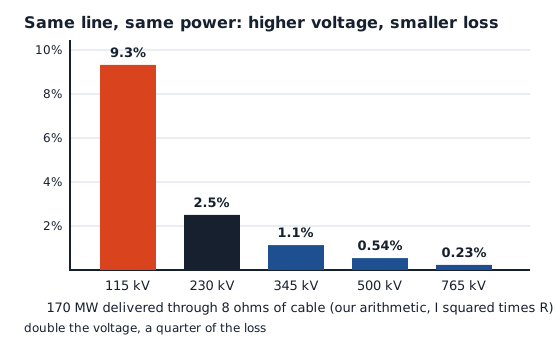
Worked example (our arithmetic): 170 megawatts delivered through 8 ohms of cable, using I = P ÷ V and loss = I² × R2
| Voltage | Current | Power lost | Share of generated power lost |
|---|---|---|---|
| 115 kV | 170,000,000 ÷ 115,000 = 1,478 A | 1,478² × 8 = 17.5 MW | 9.3%2 |
| 230 kV (the textbook case) | 170,000,000 ÷ 230,000 = 739 A | 739² × 8 = 4.37 MW | 2.5%2 |
| 345 kV | 170,000,000 ÷ 345,000 = 493 A | 493² × 8 = 1.94 MW | 1.1%210 |
| 500 kV | 170,000,000 ÷ 500,000 = 340 A | 340² × 8 = 0.93 MW | 0.54%210 |
| 765 kV | 170,000,000 ÷ 765,000 = 222 A | 222² × 8 = 0.40 MW | 0.23%210 |
At 230 kV the arithmetic lands on 7.4×10² A and about 4.4 million watts, the same as the worked problem2. Doubling the voltage from 115 kV to 230 kV cuts the loss from 17.5 MW to 4.37 MW, a factor of four (our arithmetic), exactly as the square law predicts11.
For contrast, the same problem delivers the power at 110 V. The current would be 1.6×10⁶ A, and only 0.0009% of the generated power would arrive2. That is why the textbook concludes that transmission at high voltage is much more efficient than at low voltage2.
Try your own line
Line-loss calculator
Enter the power delivered in megawatts, the line voltage in kilovolts and the total cable resistance in ohms. It applies current = power ÷ voltage and loss = current squared × resistance. Nothing you type leaves this page.
- Current
- –
- Power lost as heat
- –
- Share of generated power lost
- Loss at double the voltage
- –
The default inputs reproduce the textbook case. Change the voltage to 115 and watch the loss quadruple, then to 460 and watch it drop to a quarter11.
A step-up transformer in numbers
An OpenStax example shows the trade in small. A portable x-ray unit has a step-up transformer that turns a 120 V input into the 100 kV output the x-ray tube needs, and its primary has 50 loops and draws 10.00 A1.
Worked example (our arithmetic): the same power on both sides of the transformer1
| Quantity | Calculation | Result |
|---|---|---|
| Input power | 120 V × 10.00 A | 1,200 W1 |
| Secondary loops | 50 × (100,000 ÷ 120) | about 41,667 loops1 |
| Output current | 1,200 W ÷ 100,000 V | 0.012 A, or 12 mA1 |
The voltage rose by a factor of about 833, and the current fell by the same factor, from 10 A to 12 mA (our arithmetic)1. As expected, the output current is significantly less than the input1. A power line does the same thing at a larger scale: it trades current for voltage and keeps the power1.
What counts as high voltage
Names for voltage classes differ by country, and the German radiation-protection office sorts them like this6:
| Class | Voltage | Typical use |
|---|---|---|
| Low voltage | Up to 1,000 volts | Domestic and commercial connections, 230/400 volts6 |
| Medium voltage | Over 1,000 volts | Local and regional distribution, 10, 20 or 30 kV6 |
| High voltage | Over 30,000 volts | Smaller power plants, regional transport, cities, 110 kV6 |
| Extra-high voltage | Over 150,000 volts | Large power plants and wide-area grids, 220 and 380 kV6 |
In the United States, the common use of the term differs: American industry standards call 100 kV to 230 kV high voltage and anything above 230 kV and below 1,000 kV extra-high voltage10. Both ladders agree on the point of the page: transmission sits in the top classes, and homes sit in the bottom one610.
The masts give a rough clue to the class. High-voltage and extra-high-voltage lines usually hang from high lattice steel masts, while low- and medium-voltage lines are more likely to be carried on smaller poles made of wood, concrete or tubular steel6. Bundled conductors are a second clue: 220 kV lines use bundles, a 380 kV line carries three or four conductors in parallel, and bundles are much less frequent at 110 kV6.
How the voltage is raised and lowered
High voltage is only practical because transformers can change it. In the OpenStax physics text vocabulary, a step-up transformer increases voltage, and a step-down transformer decreases it1. If the voltage goes up, the current goes down, and the other way round1. Transformer efficiency often exceeds 99%1.
| Stage | Typical voltage | Where |
|---|---|---|
| Power station | Greater than 10 kV | Electric power is usually generated at this level1 |
| Long-distance transmission | Over 200 kV, sometimes as great as 700 kV | Transformers step it up to limit energy losses1 |
| Highest in the U.S. grid | 765 kV | Parts of the grid transmit at up to 765,000 volts10 |
| Local distribution | 5 to 13 kV | Sent short distances after a substation1 |
| At the user | 120, 240 or 480 V | Reduced for safety at the user site1 |
Substation transformers play the crucial role: they step voltages up or down to suit each stage of the journey5. Distribution lines then carry the lower-voltage electricity, which is safer to use in homes and businesses5. High voltages pose greater hazards, so transformers produce a lower voltage at the user’s location1.
Transformers also explain the early victory of alternating current. At the start of the 20th century, high-voltage grids used alternating current only6. The Department of Energy points to cost: AC became the standard because DC power systems were expensive and technically complex7. The deeper reason is physical, because transformers rely on Faraday’s law of induction and cannot change DC voltages1.
Why not use even higher voltage?
The voltage cannot be increased indefinitely6. The sources show two limits. The first is corona discharge, an electrical discharge into the air around the conductor, which at extremely high voltages grows large enough to offset the lower resistive losses11. Bundle conductors, several parallel wires per phase, are used at high voltages to reduce corona loss11. A 380 kV line often carries three or four conductors in parallel, held apart by spacers6.
The second is air itself. During operation of a 500,000-volt line, arcing can occur across a distance of seven feet or more9. Electrical contact can happen even when an object does not touch the conductor9. For that reason the utilities that operate lines publish clearance rules, such as keeping vehicles and large equipment at least 15 feet from the power lines9.
There is also an economic reason to climb the voltage ladder, beyond lost energy. A higher-voltage line could replace multiple transmission lines operated at a lower voltage10. One 765 kV circuit can carry six times more power than a 345 kV line, so utilities can deliver more power with fewer lines10. Higher-voltage electricity also makes long-distance transmission more efficient and less expensive5. The first 765 kV system came online in 196910.
High-voltage direct current versus alternating current
Alternating current changes direction 100 times a second in Western Europe, a frequency of 50 Hz6. Direct current does not, and today it is also possible to run high-voltage grids with direct current, avoiding the energy loss that occurs with alternating current6. That makes high-voltage direct current, HVDC, a good alternative for long transport routes, mainly through subsea cables in Western Europe6.
| Alternating current (AC) | High-voltage direct current (HVDC) | |
|---|---|---|
| Voltage change | Transformers step voltage up and down1 | Power goes through a converter station that converts AC to DC7 |
| Efficiency | Standard on the grid7 | Greater efficiency over long distances7 |
| Loss | Baseline | Over long distances, losses can be up to 30-50% lower than a comparable AC system7 |
| Cost | Cheaper over short distances7 | Converter stations are expensive, with a breakeven distance of about 124 miles for overhead lines and 37 miles for submarine lines7 |
| Joins separate grids | Not listed | Connects asynchronous systems7 |
Converter stations can account for as much as 60% of the total fixed cost of an HVDC project8. The per-mile cost of HVDC projects ranges between $1.17 million and $8.62 million8. HVDC links also join grids that cannot be tied together directly: the U.S. power grid is divided into three asynchronous systems, the Eastern, the Western and the Texas interconnection7. The country’s first HVDC system, the Pacific DC Intertie, was completed in 19707. For very long underground or subsea runs, DC cables are not limited in length by their capacitance11.
Most lines in the United States are still AC: the U.S. electric transmission network consists of about 700,000 circuit miles of lines, and most of them operate on alternating current8.
Overhead lines versus underground cables
Over land, electricity is transported mainly on overhead lines, with some underground cables6. The conductors of overhead lines are not surrounded by an insulating layer, so they are hung out of the reach of humans6. In Germany, high-voltage and extra-high-voltage power lines are predominantly implemented as overhead lines6. They usually sit on high lattice steel masts6.
| Overhead lines | Underground cables | |
|---|---|---|
| Insulation | None around the conductor; kept out of reach6 | Each conductor insulated, so conductors sit much closer together6 |
| Cost | Cable and excavation costs are much lower than for burying11 | Cable and excavation costs are much higher11 |
| Repairs | Faults are easier to reach than in buried lines11 | Faults in buried lines take longer to locate and repair11 |
| Land and looks | Takes a right-of-way and is more visible11 | Takes no right-of-way, lower visibility, less affected by weather11 |
| Typical use | Long-distance extra-high-voltage routes6 | Mostly low-voltage connections, now increasingly extra-high-voltage over long distances6 |
How much is lost in practice
The U.S. Energy Information Administration estimates that annual transmission and distribution losses averaged about 5% of the electricity transmitted and distributed in the United States in 2018 through 20224. That figure includes the lower-voltage distribution wires near homes as well as the high-voltage grid, so it is not the loss on one long line45. The grid combines thousands of miles of high-voltage power lines and millions of miles of low-voltage ones5.
A short history
The first long-distance demonstration already used high voltage. In 1891 a 15 kV line of 175 km carried power with an overall efficiency that exceeded 75%12. By our subtraction that is a loss of up to a quarter of the power, against about 5% for the whole U.S. delivery system today412.
| Year | Event |
|---|---|
| 1891 | A 15 kV three-phase line about 175 km long carries 300 horsepower to the Frankfurt exhibition12 |
| 1969 | The first 765 kV system comes online in the U.S.10 |
| 1970 | Pacific DC Intertie, the country’s first HVDC system, is completed7 |
Staying safe near power lines
Transmission wires sag, or droop, between their supporting structures because of their weight, and they usually come closest to the ground halfway between structures9. The sag increases when the line is heated by load and ambient temperatures, so what was safe to drive under in December could mean disaster in July9. That load heating is the same line loss this page is about, showing up as lower wires29.
Rules of thumb from the utility that operates these lines9:
- Overhead conductors are not covered by insulating materials, unlike wiring at home9.
- Vehicles and large equipment must stay at least 15 feet away from power lines, a federal Occupational Safety and Health Administration requirement9.
- Nothing should rise higher than 13 feet above the ground in pedestrian areas, or 15 feet in other areas, when under a power line9.
- A noticeable voltage can be induced on a large vehicle, a fence, a metal building or an irrigation system near a line, and shocks from induced voltage do not usually present a hazard, which is why they are called nuisance shocks9.
Common mix-ups
- “High voltage is more dangerous, so it must waste more.” It wastes less. The current is what heats the wire, and the current is lower at high voltage2.
- “Power lines send DC.” Most lines in the U.S. send alternating current8, though HVDC is used on long routes and links between grids7.
- “The most dangerous lines are the highest voltage ones.” Injuries occur more frequently with lower-voltage lines of 12,500 to 115,000 volts, because contact is more likely9.
If you enjoy tracing a physical rule through real numbers, try how fast coffee cools, why the seasons happen and what pi is. The ideas of a rate and a square both rest on what a derivative is. More everyday physics and numbers sit in the world section.
Read next
Why Seasons Happen: Earth's Tilt, Sun Angle and Daylight
Earth's 23.44 degree tilt causes the seasons, not distance from the Sun. See the sun-height math, daylight by latitude, and why the tilt slowly changes.
Math in the worldWhat Is Pi? Meaning, Value, Uses and History
Pi is a circle's circumference divided by its diameter, about 3.14. See the formulas, how many digits you need, what pi is used for, and its history.
Math in the worldHow Fast Does Coffee Cool? Newton's Law of Cooling
Coffee cools fast at first and slower later. The law behind it, how to find your cup's cooling constant, measured data, and what milk and lids change.
Sources
- 23.7 Transformers, College Physics 2e · OpenStax (Rice University) · openstax.org · checked October 21, 2026
- Electrical energy and power (PHYS 222, worked transmission-line problem) · University of Tennessee, Department of Physics and Astronomy · labs.phys.utk.edu · checked October 21, 2026
- 9.5 Electrical Energy and Power, University Physics Volume 2 · OpenStax (Rice University) · openstax.org · checked October 21, 2026
- How much electricity is lost in transmission and distribution in the United States? · U.S. Energy Information Administration · eia.gov · checked October 21, 2026
- Electricity explained: Delivery to consumers · U.S. Energy Information Administration · eia.gov · checked October 21, 2026
- What are high-voltage power lines? · Federal Office for Radiation Protection (BfS), Germany · bfs.de · checked October 21, 2026
- Connecting the Country with HVDC · U.S. Department of Energy, Office of Electricity · energy.gov · checked October 21, 2026
- EIA study examines role of high-voltage direct current lines in integrating renewables · U.S. Energy Information Administration · eia.gov · checked October 21, 2026
- Living and Working Around High-Voltage Power Lines · Western Area Power Administration, U.S. Department of Energy · wapa.gov · checked October 21, 2026
- Transmitting Electricity at High Voltages · Beta Engineering · betaengineering.com · checked October 21, 2026
- Electric power transmission · Wikipedia · en.wikipedia.org · checked October 21, 2026
- Milestones: Long Distance Electric Power Transmission Using Three-Phase Alternating Current, 1891 · Engineering and Technology History Wiki (IEEE) · ethw.org · checked October 21, 2026
Published . Every source shows the day it was read. Diagrams: original, by the editors. How we check facts · Report an error.