Story · Math in the world
Godzilla and the Square-Cube Law: How Big Can Animals Get?
Double an animal's size and its weight grows 8 times, its bones 4. Worked numbers for Godzilla's legs, his appetite, dinosaurs and the largest possible animal.
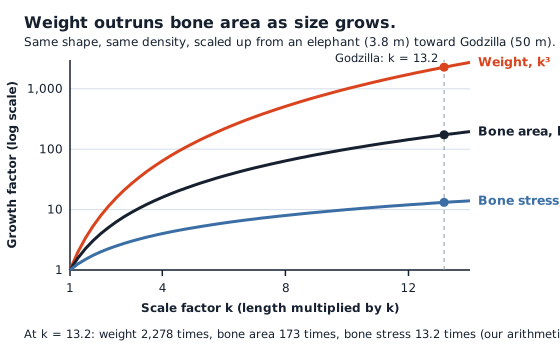
Scale an elephant, 3.8 m at the shoulder, up to Godzilla's 50 m and weight grows 2,278 times while bone area grows 173 times, so bone stress rises 13.2 times (our arithmetic)12. Even if the legs held, resting energy needs would be about 21 million kilocalories a day, roughly 10,000 times the 2,000 a person eats (our arithmetic)342.
- Godzilla from an elephant
- Scale factor 13.2: weight 2,278 times, bone area 173 times (our arithmetic)12
- Bone stress
- Rises 13.2 times, which is 3.3 to 4.4 times the 200 MPa breaking stress (our arithmetic)512
- Biggest on land
- Sauropods above 50 tonnes by conservative estimates7
- Biggest ever
- Antarctic blue whales above 330,000 pounds8
A film monster has to answer two physics questions before it answers the food one. Can its legs carry it? Can it shed the heat its body makes? Both come from one piece of geometry that Galileo set down in the seventeenth century. This page works the geometry through with real numbers, then uses it to estimate what Godzilla would eat if he could exist at all.
What is the square-cube law?
When an object grows by a factor k in every direction, its surface area grows by k² and its volume by k³6. Galileo first described the relationship in 1638 in Two New Sciences6. The result is that volumes change faster than areas, and areas change faster than linear dimensions5.
A cube with sides of 1 meter has 6 square meters of surface and 1 cubic meter of volume6. Double the sides and the surface becomes 24 square meters, while the volume becomes 8 cubic meters6.
Worked example (our arithmetic): what growing by a factor k does to a shape
| Scale factor k | Surface or cross-section (k²) | Volume and weight (k³) | Area per unit of volume (1 ÷ k) |
|---|---|---|---|
| 2 | 4 | 8 | 0.56 |
| 3 | 9 | 27 | 0.336 |
| 10 | 100 | 1,000 | 0.16 |
| 13.2 | 173 | 2,278 | 0.0766 |
Keep the last column in mind, because it decides two things. Strength depends on area, and weight depends on volume. A bigger body has less surface for each kilogram it has to hold up, cool and feed.
Does the square-cube law apply to animals?
Yes. The force a muscle can produce and the strength of a bone are proportional to their cross-sectional areas, while the weight of an animal is proportional to its volume5. Other jobs split the same way: oxygen uptake follows the area of the lungs, digestion the area of the gut and heat loss the area of the body, but the oxygen and food that must be supplied and the heat that is produced follow mass5. If an animal works well at one size, a change of size alone puts these functions out of step5.
Bones
If an animal grows with no change in shape, the load on its bones rises with volume and the bone’s cross-section only with area5. Eventually the bones break under the animal’s own weight5. Real animals avoid that by changing shape: larger animals have proportionally stouter, thicker bones5, and an elephant’s bones are proportionately much larger than a mouse’s6.
J. B. S. Haldane drew the lesson for giants in his 1928 essay On Being the Right Size6. A square inch of a giant’s bone had to support 10 times the weight of a square inch of human bone, and the human thigh bone breaks at about 10 times body weight6.
Measured bone stress shows how tight the margin is. Bone breaks at about 200 megapascals, and the working stress in walking mammals runs about a fourth to a third of that5. The safety factor is only 3 to 5, and it stays constant from chipmunks to elephants, a 25,000-fold range, because bone shape and posture change5. An elephant’s legs are stacked in an almost vertical position under its body, which keeps the load directed along the bone15.
Heat
Large mammals such as elephants have a harder time cooling themselves than small ones such as mice6. Elephants use their ears: blood in the ear veins is cooled as the ears flap, and body temperature falls by several degrees1.
Energy
Surface-area reasoning suggested that metabolic rate should scale with mass to the power 2/39. Kleiber found that the basal metabolic rate fits a power of 3/4 better39. It still lacks a theoretical explanation that is entirely satisfactory3. That matters for the food question below.
Does Godzilla violate the square-cube law?
Yes, if he is a scaled-up animal. The 1954 film scaled Godzilla to 50 m tall so that he could just peer over the largest buildings in Tokyo2. Character profiles list his weight as 20,000 to 60,000 metric tons2. Adult Asian elephants weigh 6,000 to 12,000 pounds, or 2,750 to 5,420 kilograms, and stand 1.8 to 3.8 meters at the shoulder1.
Worked example (our arithmetic): the biggest elephant scaled to Godzilla’s height
| Step | Calculation | Result |
|---|---|---|
| Scale factor | 50 ÷ 3.8 | k = 13.212 |
| Bone cross-section | 13.2² | 173 times larger12 |
| Weight | 13.2³ | 2,278 times larger12 |
| Scaled mass | 5,420 kg × 2,278 | about 12.3 million kg, or 12,300 metric tons12 |
| Stress on each bone | 2,278 ÷ 173 | 13.2 times higher5 |
| Working stress, elephant at 1/4 to 1/3 of 200 MPa | 50 to 67 MPa | 658 to 877 MPa for the giant5 |
| Against the 200 MPa breaking stress | 658 ÷ 200 and 877 ÷ 200 | 3.3 to 4.4 times too high5 |
The scaled mass of 12,300 metric tons is the same order as the 20,000 to 60,000 tons in the profiles2, so the elephant comparison is fair. The same arithmetic is in LaBarbera’s lecture for King Kong: a fivefold increase in height means a 25-fold increase in bone cross-section, a 125-fold increase in mass and about five times the stress5. Godzilla’s factor is 13.2, not 5.
Two repairs are available in biology. The first is stouter bones, as in the scaling from mouse to elephant56. The second is posture, since straight legs keep loads along the bone5. Both together hold the safety factor for animals up to elephant size5. Elephants already use both repairs, so a further 13.2 times on the stress has nowhere to come from (our arithmetic)5.
Heat is the second problem. The area for each unit of volume falls to 1 ÷ 13.2, which is 0.076 of the elephant’s, so each kilogram of Godzilla has about 7.6 percent as much skin to lose heat through (our arithmetic)612. The body heats faster than it cools. Bodies lose heat through their surface but produce it throughout their mass3.
Do dinosaurs violate the square-cube law?
No. The sauropods were the largest land animals ever, surpassing the largest herbivorous mammals by an order of magnitude in body mass7. Several lineages produced giants above 50 metric tonnes by conservative estimates7. Published estimates for the titanosaur Argentinosaurus run 70 to 90 tonnes7. Most other dinosaur lineages rarely exceeded 10 tonnes7.
They stayed inside the law by changing their build. Sauropod skeletons combined dense limb bones as thick as tree trunks, vertebrae so riddled with air sacs that they resemble honeycomb, and small skulls of sometimes paper-thin bone10. The limb bones work like columns under a building, and the weight a column carries grows with its thickness10. An erect, column-like forelimb evolved in parallel, and that was necessary for sauropods to reach multi-tonne mass7.
The air sacs lowered weight for the volume: living sauropods probably had a specific density of about 0.8 kilograms per liter, closer to a bird than to a mammal7. An avian-style respiratory system would also have cut the cost of breathing, reduced specific gravity and helped remove excess body heat7. Heat and weight, the two problems above, were both addressed.
Worked example (our arithmetic): Godzilla against the biggest real dinosaur
| Comparison | Calculation | Result |
|---|---|---|
| Godzilla (1954 profile, low end) over Argentinosaurus (70 t) | 20,000 ÷ 70 | about 286 times heavier72 |
| Godzilla over the high estimate (90 t) | 20,000 ÷ 90 | about 222 times heavier72 |
Even the lightest profile weight is more than 200 times beyond the biggest land animal known72. A dinosaur is a calibration point, and Godzilla is far past it.
What is the biggest an animal could theoretically get?
On land, the theoretical limit is above 100 tonnes. Research by Jyrki Hokkanen at the University of Helsinki suggests that the biomechanical limit for terrestrial body mass is well over 100 metric tons10. The limit comes from a trade-off: thicker limb bones carry more weight, but mobility decreases as they thicken, so there is an upper limit on thickness for a functional animal10. Published estimates for the largest sauropod, 70 to 90 tonnes, sit under that ceiling7.
In water the rule bends, because the buoyancy of water offsets some of the effects of gravity6. That is the primary reason the largest animals ever to exist are aquatic6. The blue whale is the largest animal ever to live on our planet8. Antarctic blue whales reach up to about 110 feet and more than 330,000 pounds, while North Atlantic and North Pacific whales grow to about 90 feet and over 100,000 pounds8. A sauropod standing in water would struggle to breathe if its lungs were deeper than 8 to 10 feet, so standing in a lake does not rescue a land giant5.
How much would Godzilla eat?
Food is the slowest part of the answer, because it needs Kleiber’s law. For an animal of mass w kilograms, the basal metabolic rate is about 70 × w^0.75 kilocalories a day3. The exponent is the key. A cat 100 times the mass of a mouse uses only about 32 times the energy, which is 100^0.753.
Worked example (our arithmetic): resting energy by Kleiber’s law
| Animal | Mass w | Calculation | Resting energy per day |
|---|---|---|---|
| Person (an assumed 70 kg) | 70 kg | 70 × 70^0.75 = 70 × 24.2 | about 1,694 kcal3 |
| Godzilla, 1954 profile low end | 20,000 metric tons = 20 million kg | 70 × (20 million)^0.75 = 70 × 299,070 | about 20.9 million kcal32 |
| Godzilla, profile high end | 60,000 metric tons = 60 million kg | 70 × (60 million)^0.75 | about 47.7 million kcal32 |
The person’s 1,694 sits close to the 2,000 calories a day used as a general guide for nutrition advice4. Godzilla’s low-end 20.9 million is 20.9 million ÷ 2,000 = about 10,467 times that guide, or roughly 10,500 people’s daily food (our arithmetic)342.
The exponent saves him a great deal. If appetite grew in direct proportion to mass, Godzilla at 20 million kg would weigh 20 million ÷ 70 = 285,714 times a person and would need 285,714 × 1,694 = about 484 million kcal a day (our arithmetic)3. Kleiber’s law gives 20.9 million, which is 23 times less3. The exponent works in reverse too: a shrunken person in a classic film would have to eat his own weight daily, like a shrew5.
In tons of food
An elephant is the closest real animal for a food estimate, and it eats about 165 to 330 pounds a day, assimilating only about 44 percent of that1. Godzilla’s mass is 20 million ÷ 5,420 = about 3,690 times a top-size elephant’s, and 3,690^0.75 is about 473 (our arithmetic)312. So his resting needs are about 473 elephant-days of food each day. At 165 to 330 pounds an elephant-day, that is 78,000 to 156,000 pounds, or about 39 to 78 tons at 2,000 pounds a ton (our arithmetic)1. The estimate assumes Godzilla eats the same food as an elephant, and a diet of denser food would weigh less.
Treat every number here as an estimate. Kleiber’s law describes basal rates, not a rampage, and both the 3/4 exponent and its explanation are debated39. Read the totals as one estimate, not a measurement.
Why does Godzilla keep getting bigger?
Godzilla has doubled in size since 1954, a pace far beyond the rate of evolution seen in 2,500 natural organisms11. The 2014 American film scaled him to 108.2 m and 81,650 metric tons2. Against the 1954 figures that is 108.2 ÷ 50 = 2.16 times taller, and a square-cube scale-up of that height would multiply mass by 2.16³ = about 10 (our arithmetic)2. The 2014 mass is only 81,650 ÷ 20,000 = about 4.1 times the 1954 low end, so the 2014 design is lighter than a straight scale-up of the 1954 one (our arithmetic)2.
What to take from the numbers
Size never scales one thing at a time. Weight grows as the cube, strength and cooling as the square, and food as a power in between. For a smaller case of the same effect, read how fast coffee cools, and for loads that add up across an area, see the weight of snow. Both sit in the World section, next to the high-voltage page.
The best sources behind this page are the University of Chicago biology lecture, the sauropod review in Biological Reviews and the NOAA blue whale profile.
If this left you with a question, start with How Fast Does Coffee Cool? Newton's Law of Cooling or How Much Does Snow Weigh? The Math of Snow Load.
Sources
- Asian Elephant · Smithsonian's National Zoo · nationalzoo.si.edu · checked October 22, 2026
- Godzilla (character) · Wikipedia · en.wikipedia.org · checked October 22, 2026
- Kleiber's law · Wikipedia · en.wikipedia.org · checked October 22, 2026
- Calories on the Nutrition Facts Label · U.S. Food and Drug Administration · fda.gov · checked October 22, 2026
- The Biology of B-Movie Monsters (M. LaBarbera) · University of Chicago, eCUIP Digital Library · ecuip.lib.uchicago.edu · checked October 22, 2026
- Square–cube law · Wikipedia · en.wikipedia.org · checked October 22, 2026
- Biology of the sauropod dinosaurs: the evolution of gigantism · Biological Reviews (PubMed Central) · ncbi.nlm.nih.gov · checked October 22, 2026
- Blue Whale · NOAA Fisheries · fisheries.noaa.gov · checked October 22, 2026
- On the thermodynamic origin of metabolic scaling · Scientific Reports (PubMed Central) · ncbi.nlm.nih.gov · checked October 22, 2026
- How Sauropod Dinosaurs Became the Biggest Land Animals Again and Again · Scientific American · scientificamerican.com · checked October 22, 2026
- Godzilla Is Back and He's Bigger Than Ever · Dartmouth College · home.dartmouth.edu · checked October 22, 2026
Published . Every source shows the day it was read. Diagrams: original, by the editors. How we check facts · Report an error.