How it works · Math in the world
How Much Gold Is in an Oscar? The Plating Math
An Oscar is cast bronze with a thin 24-karat gold plating. See the plating math: about 0.5 to 6.5 grams of gold, and why solid gold would cost about $414,000.
Checked against 12 sources (3 textbook, course or government) · By Ambient Math editors
The short answer. An Oscar statuette is cast bronze with a 24-karat gold plating35. The Academy guards the gold weight8, but US trade rules set a plating range of 0.175 microns up to 2 1/2 microns2. Over the statuette's surface that is about 0.45 to 6.5 grams of gold, roughly $48 to $686 at the 2025 average price of $3,300 per troy ounce1 (our arithmetic).
- What it is
- Gold-plated bronze on a black metal base, 13.5 in tall, 8.5 lb3
- Plating thickness
- 0.175 microns is the US minimum for "gold electroplate", 2 1/2 microns for "heavy"2; one 2019 estimate for the Oscar is 0.38 microns9
- Our estimate of the gold
- About 0.45 to 6.5 grams, worth about $48 to $686 at $3,300 per troy ounce1 (our arithmetic)
- Cost to produce
- $400 to $1,000 per statuette, estimates vary5
- Resale
- Winners must first offer it back to the Academy for $1.005
On this page
The gold on an Oscar is a skin, and the arithmetic of a skin is short: surface area times thickness times density. The Academy does not hand out the thickness, so this page builds a range from published trade rules, checks one popular claim against it, and compares the result with the price tags people attach to the statuette.
What an Oscar is made of
The Oscar statuette is gold-plated bronze on a black metal base. It stands 13.5 in (34.3 cm) tall and weighs 8.5 lb (3.9 kg)3. Gold is the finish, not the body. The same weight appears in a second source, with a height of 13.5 inches7.
The recipe has changed over the years.
| Period | Core metal | What changed |
|---|---|---|
| First ceremonies | Solid bronze, gold-plated3 | The original recipe3 |
| Within a few years | Britannia metal, a pewter-like alloy, plated in copper, nickel silver and 24-karat gold3 | Bronze abandoned3 |
| World War II | Painted plaster, for three years3 | Metal shortage3 |
| 1987 to 2015 | Tin alloy with gold plating, about 50 made each year in Chicago by R.S. Owens & Company3 | Chicago foundry3 |
| 2016 on | Bronze again, from Polich Tallix Fine Art Foundry in Walden, New York3 | Return to the original core3 |
Britannia metal is mostly tin. One source gives the Britannium interior as 93 percent tin, 5 percent antimony and 2 percent copper7. A second gives 92% tin, 6% antimony and 2% copper8. The two disagree by a point, which is a reminder that nobody outside the foundry has the exact recipe. Since 2016 the core question is moot: the statuettes are bronze again3.
How the gold goes on
The gold is not poured or wrapped. It is electroplated, which means a part sits in a bath and an electric current moves metal from the solution onto the surface. The Brooklyn plating shop describes the bath as not melted gold, but almost a salt bath with a current that turns the part gold10.
The statuette travels through several steps310:
- A mold, a wax copy, a ceramic shell and 12 layers of coating are made first. The wax is then melted out of the shell and replaced with bronze10.
- The dull bronze goes into a copper bath, which fills in small surface flaws10.
- The process repeats with nickel, and then with 24-carat gold10.
Production is slow and small. Fifty statuettes take roughly three months35. The Brooklyn shop gives around 60 statues their luster in a given year10. More than 2,800 statuettes had been issued by 20157.
What the law calls “gold plated”
Gold plating has legal names when it is sold as jewelry, and those names come with minimum thicknesses. The Federal Trade Commission’s Jewelry Guides allow “Gold Plate” or “Gold Electroplate” for a layer of at least 0.175 microns of fine gold (approximately 7/1,000,000ths of an inch), applied electrolytically on all significant surfaces2. A layer of two and one half microns, or about 100/1,000,000ths of an inch, earns “Heavy Gold Electroplate”2.
A micron is a millionth of a meter, so 0.175 microns is 175 nanometers2. Oscars are trophies, not jewelry, and the Guides do not govern them. They are still the best public yardstick for what “plated” means, and they give us a low and a high end for the estimate.
Estimating the gold: the worked example
The inputs are the statuette’s size, the plating thickness and the density of gold. The Academy gives few technical specifications8, so this is an estimate with the assumptions in view. One page uses the listed height of 13.5 inches and width of 5.25 inches, and adds an estimated depth of 1.75 inches8. Treating the statuette as a box gives a surface area of 207.375 square inches, and a box overstates the area of a curved form8. Gold has a density of 19.3 g/cm³ in one source4 and 19.32 in the Physics Factbook12, and the tables below use 19.3212. A troy ounce is 31.1035 grams11. The 2025 average price is 3,300 dollars per troy ounce, the U.S. Geological Survey estimate based on data from January through November1.
Worked example (our arithmetic): surface area, then volume of gold
| Step | Calculation | Result |
|---|---|---|
| Box surface area | 2 × (13.5 × 5.25 + 13.5 × 1.75 + 5.25 × 1.75) | 207.375 square inches8 |
| Convert to square centimeters | 207.375 × 2.54 × 2.54 (34.3 cm over 13.5 in is 2.54 cm per inch) | about 1,338 square centimeters38 |
| Volume at the 2 ends of the legal range | 1,338 × 0.0000175 cm and 1,338 × 0.00025 cm | 0.0234 cubic centimeters and 0.334 cubic centimeters2 |
Worked example (our arithmetic): volume, mass and value at several thicknesses
| Thickness | Volume of gold (cm³) | Mass (g), at 19.32 g/cm³ | Troy ounces, at 31.1035 g | Value at $3,300 per troy ounce |
|---|---|---|---|---|
| 0.175 microns, the US minimum for gold electroplate2 | 0.0234 | 0.45212 | 0.014511 | $481 |
| 0.38 microns, one 2019 estimate for the Oscar9 | 0.0508 | 0.98212 | 0.031611 | $1041 |
| 0.5 microns, a round figure between the two2 | 0.0669 | 1.29212 | 0.041611 | $1371 |
| 2.5 microns, the US minimum for heavy gold electroplate2 | 0.334 | 6.46212 | 0.20811 | $6861 |
So a statuette plated anywhere between the legal minimum and the heavy-plating mark carries about 0.45 to 6.5 grams of gold, worth about $48 to $686 at the 2025 average price. Scale the last column by the day’s price to update it. One 2019 estimate of $57 for the whole plating at a 0.38 micron thickness9 matches the order of magnitude: the same 0.38 microns costs about $104 at the 2025 price (our arithmetic)19.
How thin is that?
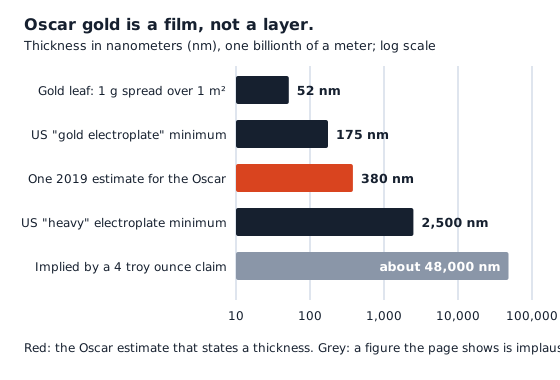
The chart puts the numbers on one scale. The plating sits between about 0.175 and 2 1/2 microns2, and the useful comparison is gold leaf. A single gram of gold can be beaten into a sheet of 1 square meter4.
Worked example (our arithmetic): the thickness of that sheet
| Step | Calculation | Result |
|---|---|---|
| Volume of 1 gram | 1 ÷ 19.32 | 0.05176 cubic centimeters124 |
| Area of 1 square meter | 100 × 100 | 10,000 square centimeters4 |
| Thickness | 0.05176 ÷ 10,000 | 0.000005176 cm, which is about 52 nanometers412 |
| Legal minimum against that sheet | 175 ÷ 51.76 | about 3.4 times thicker24 |
The Oscar’s plating is therefore a few times thicker than leaf. It is thick enough to survive handling, and far too thin to be a layer of metal you could weigh in your hand. One estimate puts it at about 200 times thinner than a human hair9.
The 4 troy ounce claim does not hold up
Search results for this question include a $6,452.93 melt value built on 4 troy ounces of gold plating8. That number collides with the geometry above. Its method is a scale-up: the Academy guards the amount of gold used, so the author took the gold in Olympic medals, 6 grams over a silver core, and scaled it up8. That is a guess about a different object, not a measurement of an Oscar.
Worked example (our arithmetic): how thick would 4 troy ounces be?8
| Step | Calculation | Result |
|---|---|---|
| Mass in grams | 4 × 31.1035 | 124.414 grams11 |
| Volume | 124.414 ÷ 19.32 | 6.440 cubic centimeters12 |
| Thickness over 1,338 square centimeters | 6.440 ÷ 1,338 | 0.004813 cm, about 48 microns8 |
| Against the legal minimum | 48.13 ÷ 0.175 | about 275 times the gold-electroplate minimum2 |
| Against the heavy plating mark | 48.13 ÷ 2.5 | about 19 times the heavy-plating minimum2 |
A layer of 48 microns would be far heavier than anything that counts as plating under the Jewelry Guides, and the E! estimate of the whole statuette’s production cost, $400 to $1,000, could not cover it25. We choose the thin-film estimate: it fits the trade thresholds, the producers’ own description of a bath process, and the production cost.
If it were solid gold
The solid-gold question has a one-line answer: weight times price. Take the 3.9 kg the statuette weighs3, divide by 31.1035 grams per troy ounce11, and multiply by the price1.
Worked example (our arithmetic): the same weight in solid gold
| Step | Calculation | Result |
|---|---|---|
| Mass in grams | 3.9 kg × 1,000 | 3,900 grams3 |
| Troy ounces | 3,900 ÷ 31.1035 | about 125.4 troy ounces11 |
| Value at $3,300 | 125.4 × 3,300 | about $413,8001 |
Older figures differ because the price differed. One 2015 article puts solid gold at about $160,0007, which implies about $1,276 per troy ounce for 125.4 troy ounces (our arithmetic). The 2013 page quoted above reaches $184,672 with 116 troy ounces and a reference price of $1,5928. The USGS price for 2025 averages $3,300, up 38% from 20241.
| Estimate | Price per troy ounce | Troy ounces | Solid-gold value |
|---|---|---|---|
| 2013 page8 | $1,5928 | 1168 | $184,6728 |
| 2015 article7 | about $1,276 (implied, our arithmetic)7 | 125.4311 | $160,0007 |
| 2025 average1 | $3,3001 | 125.4311 | about $413,800 (our arithmetic)1 |
The statuette’s value in metal rose with gold, and the plating’s value rose with it. A solid-gold Oscar would also be a very different object from the one on the shelf, so treat these numbers as a measure of the price of gold, not of an Oscar1.
Cost to make, and what an Oscar sells for
Production costs for a statuette of 8 1/2 pounds and 13 1/2 inches run from $400 to $1,000, and the estimates move with the cost of gold at any given time5. Another source gives $400 for the production cost9. These figures include more than metal, since materials and labor are both counted5.
Resale is a separate story, because the Academy controls it. Winners may not sell the statuette without first offering to sell it to the Academy for the sum of $1.00, and the rule applies to heirs and assigns5. The rule came with the agreements of 1951 in one source and dates from 1950 in another53. The practical result is that an Oscar resold on the open market in most cases yields no more than a dollar6.
Statuettes from before that rule belong to the recipient, and some have sold for large sums3. Michael Jackson paid $1.5 million in 1999 for the Best Picture statuette from Gone with the Wind6. Beatrice Welles sold her father’s Citizen Kane screenplay statuette for $862,000 in 20116. A U.S. District Court judge had granted her the right to sell it in 20045. These prices reflect history and scarcity. They have almost nothing to do with the grams of gold on the surface.
Common mix-ups
- “It is solid gold.” The core is bronze3, and the gold is a plating of 24-karat gold5.
- “The gold weighs a few ounces.” Our range is 0.45 to 6.5 grams, which is 0.0145 to 0.208 troy ounces211 (our arithmetic).
- “It is worth $414,000.” That is the solid-gold arithmetic, not the metal in the statue13 (our arithmetic).
- “Gold plating is a cheap fake.” Plating is a standard finish with legal minimum thicknesses, and the same trade term covers 0.175 microns up to 2 1/2 microns and beyond2.
- “Thick plating would look the same.” Gold plating can hide a different metal: tungsten has been used in counterfeiting gold bars by plating a tungsten bar with gold4.
For another everyday object where one fixed constant and one measured length settle the answer, see what pi is. The seasons page works from a similar kind of constant in why seasons happen, and hidden math in a normal day collects more of these checks. Every page about the physical world is in the world section.
Read next
Why Seasons Happen: Earth's Tilt, Sun Angle and Daylight
Earth's 23.44 degree tilt causes the seasons, not distance from the Sun. See the sun-height math, daylight by latitude, and why the tilt slowly changes.
Math in the worldWhat Is Pi? Meaning, Value, Uses and History
Pi is a circle's circumference divided by its diameter, about 3.14. See the formulas, how many digits you need, what pi is used for, and its history.
Math in daily lifeMath in Everyday Life: 7 Examples From One Normal Day
Follow one ordinary day through sleep, GPS, groceries, a forecast, a recipe and savings, and see the arithmetic hiding in each, with the numbers sourced.
Sources
- Mineral Commodity Summaries 2026: Gold · U.S. Geological Survey · pubs.usgs.gov · checked October 21, 2026
- 16 CFR 23.3 Misuse of the terms gold plate, gold electroplate and similar terms (Jewelry Guides) · Federal Trade Commission, via Cornell LII · law.cornell.edu · checked October 21, 2026
- Academy Awards (Oscar statuette section) · Wikipedia · en.wikipedia.org · checked October 21, 2026
- Gold · Wikipedia · en.wikipedia.org · checked October 21, 2026
- How Much Is an Oscar Really Worth? · E! News · eonline.com · checked October 21, 2026
- How much is an Oscar statue worth? · CBS News · cbsnews.com · checked October 21, 2026
- How Much Gold is Actually in the Oscar Award Statue? · Provident Metals · blog.providentmetals.com · checked October 21, 2026
- What's The Melt Value of An Oscar Statue? · Gainesville Coins · gainesvillecoins.com · checked October 21, 2026
- Oscars 2019 | The Oscar Statuette | What's Its Value? · PhysicalGold · physicalgold.com · checked October 21, 2026
- From NY to Hollywood: Secret to the gold shine of the Oscar statue · ABC7 New York · abc7ny.com · checked October 21, 2026
- What is a troy ounce? · The Royal Mint · lifestyle.royalmint.com · checked October 21, 2026
- Density of Gold (The Physics Factbook) · The Physics Factbook · hypertextbook.com · checked October 21, 2026
Published . Every source shows the day it was read. Diagrams: original, by the editors. How we check facts · Report an error.