Reference · Math of health
Sleep Cycle Calculator Math: How the 90 Minute Rule Works
Sleep cycles average 90 minutes, so bedtime math is subtraction. See the formula, bedtime tables, a cosine model, and why cycles vary from 60 to 110 minutes.
Rev. · 9 refs · 3 textbook or government · Ambient Math editors
A sleep cycle averages about 90 minutes, and NHLBI gives a range of 80 to 100 minutes with four to six cycles a night1. Bedtime math is subtraction: wake time, minus a whole number of cycles, minus the minutes it takes to fall asleep. Five cycles are 450 minutes, or 7.5 hours5, but real cycles vary between people from about 60 to 110 minutes4.
- Cycle length
- The cycle starts over every 80 to 100 minutes1; individual variation from around 60 to 110 minutes4
- Cycles per night
- Usually four to six1
- Five cycles
- 450 minutes, or 7.5 hours, at 90 minutes each5
- Adult sleep need
- Between 7 and 9 hours a night2
A bedtime calculator is one subtraction with a repeating unit. The unit is the sleep cycle, and the calculator assumes you know how long yours is. This page shows the subtraction, tables you can read without an app, a calculator that lets you change the cycle length, and a model that shows why a ten-minute error in that one number matters by morning.
The formula
Take the time you must wake up, subtract whole cycles, then subtract the minutes you need to fall asleep. The sleep cycle is the loop between non-REM and REM sleep, and it is roughly 90 minutes on average, with four to six of them in a good night8. The three inputs are wake time, number of cycles and time to fall asleep.
Bedtime = wake time − (cycles × cycle length) − minutes to fall asleep
A worked version: wake at 7:00 AM, use 90-minute cycles, and allow 15 minutes to fall asleep, which is the typical figure on one calculator6.
Worked example (our arithmetic): bedtime for a 7:00 AM alarm56
| Cycles | Asleep (cycles × 90 min) | In bed (add 15 min) | Bedtime |
|---|---|---|---|
| 6 | 540 min, 9 h5 | 555 min, 9 h 15 min6 | 9:45 PM56 |
| 5 | 450 min, 7.5 h5 | 465 min, 7 h 45 min6 | 11:15 PM56 |
| 4 | 360 min, 6 h5 | 375 min, 6 h 15 min6 | 12:45 AM56 |
| 3 | 270 min, 4.5 h5 | 285 min, 4 h 45 min6 | 2:15 AM56 |
The six-cycle and five-cycle rows match the pair of suggestions, 9.45pm or 11.15pm, that a sleep calculator gives for a 7am wake-up4. A charity version leaves out the fall-asleep allowance and counts back 7.5 hours from 7am to get around 11.30pm5. The 15-minute difference between 11:15 and 11:30 is exactly that allowance.
Bedtimes for other wake times
Shift the wake time and every row moves by the same amount. This table reads off the bedtime for five wake times, with 90-minute cycles and a 15-minute fall-asleep allowance56.
Worked example (our arithmetic): bedtimes by wake time, 90-minute cycles, 15 minutes to fall asleep56
| Wake time | 6 cycles (9 h asleep) | 5 cycles (7.5 h asleep) | 4 cycles (6 h asleep) |
|---|---|---|---|
| 6:00 AM | 8:45 PM | 10:15 PM | 11:45 PM |
| 6:30 AM | 9:15 PM | 10:45 PM | 12:15 AM |
| 7:00 AM | 9:45 PM | 11:15 PM | 12:45 AM |
| 7:30 AM | 10:15 PM | 11:45 PM | 1:15 AM |
| 8:00 AM | 10:45 PM | 12:15 AM | 1:45 AM |
Try your own numbers
Sleep cycle bedtime calculator
Set your wake time, the minutes you take to fall asleep and your cycle length. Both of those last two are settings you can change on common calculators8. Nothing you type leaves this page.
- Longest night
- –
- Long night
- –
- Short night
- –
- Shortest night
- –
The defaults reproduce the table above. Try 80 or 100 for the cycle length and watch each bedtime move: that is the sensitivity the next sections explain4.
Cycles, minutes and hours
Rows 4 to 6 are the figures a charity calculator gives, six hours, 7.5 hours and 9 hours5. The rest are the same multiplication.
How the 90 minute cycle works
You cycle through two phases, rapid eye movement (REM) and non-REM sleep, and the cycle starts over every 80 to 100 minutes1. Non-REM has three stages. Stage 1 is the transition between wakefulness and sleep, and stage 2 is when you are asleep1. Stage 3 is deep sleep, when heartbeat and breathing slow to their lowest levels and it may be difficult to wake you31. Stage 1 usually lasts several minutes3.
REM sleep first occurs about 90 minutes after falling asleep3. That fits the 90-minute figure the calculators use. Dreaming usually happens during REM sleep1.
The cycles are not copies of each other. You usually spend more time in deep stage 3 early in the night1, and you usually have more REM sleep later in the night1. Across a night, REM periods get increasingly longer and deeper3. So the cycle length stays about the same while its contents change, which is why a model with identical waves is only an approximation. Deep slow-wave sleep also decreases through adulthood1.
The calculators add one more claim: that waking at the end of a cycle, where sleep is the lightest, feels better7. Waking in the middle of a cycle is the case where you are more likely to feel groggy and disorientated5.
Why the math drifts
The subtraction is exact, but its inputs are not. Cycles across the night are only approximately 90 minutes, with individual variation of around 60 to 110 minutes4. The same person can differ unpredictably from night to night4. Time to fall asleep is hard to predict4, and waking during the night is normal, with the time spent awake unpredictable4.
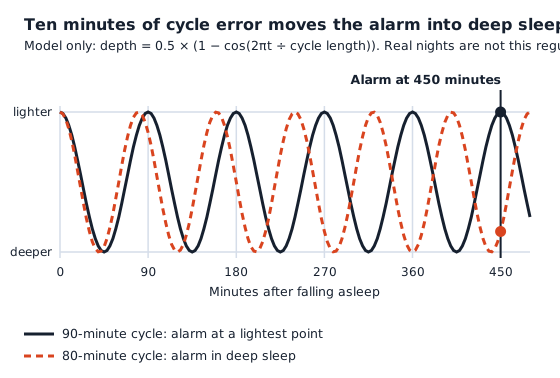
The error compounds, because the calculator multiplies the cycle length by the number of cycles. A model makes the effect visible. Take sleep depth to rise and fall as a cosine wave with period equal to the cycle length, so the lightest points sit at multiples of the cycle length. Set an alarm at 450 minutes, five 90-minute cycles5.
Worked example (our arithmetic): where a 450-minute alarm lands for different true cycle lengths4
| True cycle length | Cycles completed by 450 min | Minutes from the nearest cycle end |
|---|---|---|
| 60 min | 7.5 | 304 |
| 70 min | 6.43 | 304 |
| 80 min | 5.63 | 304 |
| 90 min | 5.00 | 04 |
| 100 min | 4.50 | 504 |
| 110 min | 4.09 | 104 |
The calculation divides 450 by the true length and keeps the fractional part, then takes the smaller of that part and its complement, in minutes. For an 80-minute cycle, 450 ÷ 80 is 5.625, so the alarm falls 0.375 of a cycle, or 30 minutes, before the next cycle end. In the model’s depth formula, depth equals 0.5 × (1 − cos(2π × 450 ÷ 80)), which is 0.85, so the alarm lands 85% of the way to the deepest point4.
Real sleep adds the spread in a person’s own cycle length, so the model understates the uncertainty. The assumptions behind the sleep calculator, and the advice it gives, are not based on scientific evidence. It takes two scientific facts, cycles of approximately 90 minutes and the greater chance of refreshment on waking from REM, and massively over-generalises4. The alternative is a consistent schedule: pamper your body clock with routine sleep and wake times4. If you go to bed sleep deprived, or when your body clock is not expecting it, you may have more deep sleep in the morning and feel groggier at the alarm4.
How much sleep the cycles should add up to
The cycle count is a way to build a total. The total is what the health agencies set. Experts recommend that adults sleep between 7 and 9 hours a night2. Adults who sleep less than 7 hours may have more health issues than those who sleep 7 or more hours2. Teens aged 13 to 18 should sleep 8 to 10 hours per day2.
Match that range to the cycle table. At 90 minutes per cycle, 7 hours is 4.67 cycles and 9 hours is 6 cycles, so the 7-to-9 hour range spans the five- and six-cycle rows25 (our arithmetic). A four-cycle night is 6 hours asleep, below the 7-hour mark25. Sleeping longer than 9 hours is not necessarily harmful and may help young adults, people recovering from sleep deprivation, and people who are sick2.
A sleep tracker adds a second layer of arithmetic. One brand sets 7 to 9 hours of total sleep as the target and tells users to leave an 8 to 10 hour window between bedtime and wake-up, to absorb the time it takes to fall asleep and brief awakenings9. That window is the same buffer as the 15-minute allowance in the formula, scaled up.
Common mix-ups
- “The cycle is exactly 90 minutes.” It is an average: NHLBI gives 80 to 100 minutes and individual spread runs from around 60 to 11014.
- “Waking at a cycle end guarantees a good morning.” Waking from REM makes refreshment more likely, and the calculator over-generalises that4.
- “You fall asleep when your head hits the pillow.” The typical figure is 15 minutes, and it differs on different nights64.
- “More cycles is always better.” Over 9 hours is not necessarily harmful, and for adults the recommendation is a total between 7 and 9 hours2.
For other health numbers built from a formula and a unit, see total daily energy expenditure, maximum heart rate formulas and resting metabolic rate formulas. Every page about the numbers behind your body is in the health section.
Common questions
Is a sleep cycle 45 or 90 minutes?
For adults it is about 90 minutes: the NIH gives 80 to 100 minutes1, and the Sleep Health Foundation allows a spread of about 60 to 110 minutes between people4. The shorter figure does not match an adult average in the sources cited here14.
RelatedHow to Calculate TDEE (Total Daily Energy Expenditure)Maximum Heart Rate Formula: 220 − Age and Better OptionsResting metabolic rate formulas compared
Sources
- Sleep Phases and Stages · National Heart, Lung, and Blood Institute (NIH) · nhlbi.nih.gov · checked October 21, 2026
- How Much Sleep Is Enough? · National Heart, Lung, and Blood Institute (NIH) · nhlbi.nih.gov · checked October 21, 2026
- Brain Basics: Understanding Sleep · National Institute of Neurological Disorders and Stroke (NIH) · ninds.nih.gov · checked October 21, 2026
- The 'Sleep Calculator' is just unscientific hype · Sleep Health Foundation (Australia) · sleephealthfoundation.org.au · checked October 21, 2026
- Sleep Calculator · The Sleep Charity (UK) · thesleepcharity.org.uk · checked October 21, 2026
- Sleep Calculator: What Time You Should Wake Up and Go to Sleep · Sleep Foundation · sleepfoundation.org · checked October 21, 2026
- 90 Minute Sleep Cycle Calculator · Omni Calculator · omnicalculator.com · checked October 21, 2026
- Sleep Calculator · calculator.net · calculator.net · checked October 21, 2026
- Sleep Score (Oura support) · Oura Health · support.ouraring.com · checked October 21, 2026
Published . Every source shows the day it was read. Diagrams: original, by the editors. How we check facts · Report an error.