Reference · Math of health
Maximum Heart Rate Formula: 220 − Age and Better Options
The maximum heart rate formulas compared: 220 minus age, Tanaka, Gellish, Nes and Gulati, with population, error, an age table and worked example.
Rev. · 8 refs · 8 textbook or government · Ambient Math editors
The common maximum heart rate formula is 220 minus age6. A meta-analysis of 18,712 people produced a different line, 208 − 0.7 × age1, and every age-based formula carries a standard error of roughly 10 to 11 beats a minute27. The result is a population average, not a measurement of any one heart.
- 220 − age (Fox)
- From a cohort of men with an average age of 556
- Tanaka, 2001
- 208 − 0.7 × age, 351 studies and 18,712 subjects1
- HUNT, 2013
- 211 − 0.64 × age, 3,320 healthy adults, SEE 10.82
- Typical error
- Standard error about 11 beats a minute6
On this page
- What is the formula for maximum heart rate (MHR)?
- Where 220 − age came from
- Is 220 minus age accurate?
- What is the new formula for maximum heart rate?
- Max heart rate by age: the formulas side by side
- Worked example: a 50-year-old, six formulas
- Factors affecting maximum heart rate
- Implications for exercise: zones built on the estimate
- HRmax calculator: how accurate is it, and how to do it by hand
- Mistakes with the formulas
- What next
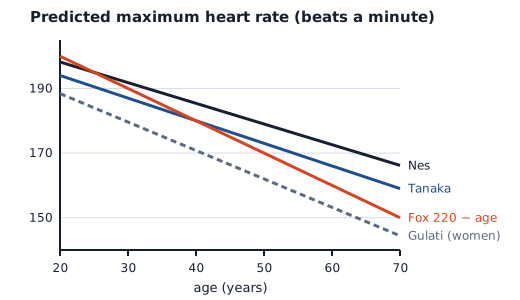
Maximum heart rate, HRmax, is the fastest the heart beats during all-out effort. Finding it directly takes a maximal-effort test, so exercise guides estimate it from age with a straight line. Which line depends on who was tested. This page sets the lines side by side, with the papers behind each one, the error each carries and what that error does to the heart-rate zones built on top. The subject is the math of the estimate. It is not a prescription, and anyone with a heart condition or on heart medication should take the numbers to a clinician. The health section has the neighboring formulas, and the resting metabolic rate formulas page covers another family of fitted lines.
What is the formula for maximum heart rate (MHR)?
The best-known formula is HRmax = 220 − age, usually credited to Fox6. Government exercise guidance pairs it with the zone table: a 40-year-old has a maximum of 180 beats a minute, a 50-year-old 1708. The table figures are averages, so the guide tells readers to use them as general guidelines8.
The shape of every competitor is the same: a straight line, HRmax = intercept − slope × age. The 220 formula has a slope of 1 beat per year. Most newer fits have slopes between 0.64 and 0.88124. Which one you pick changes the answer more for a 60-year-old than a 20-year-old, because the lines meet near the young end and part later6.
| Formula | HRmax = | Built on | Notes |
|---|---|---|---|
| Fox, 1971 | 220 − age | cohort of men with an average age of 556; data compiled in 19717 | The most frequently used6 |
| Robinson, 1938 | 212 − 0.77 × age | earliest known formula67 | Standard error of 7 to 12 beats a minute6 |
| Tanaka, 2001 | 208 − 0.7 × age | meta-analysis of 351 studies, 18,712 subjects1 | Cross-checked in 514 healthy subjects1 |
| Gellish, 2007 | 207 − 0.7 × age | 132 people, 908 tests over 25 years3 | Longitudinal rather than cross-sectional3 |
| Nes (HUNT), 2013 | 211 − 0.64 × age | 3,320 healthy men and women2 | Standard error 10.82 |
| Gulati, 2010 | 206 − 0.88 × age | 5,437 asymptomatic women4 | Women only4 |
Where 220 − age came from
The history is thinner than the formula’s fame. An exercise-physiology review traced it and found it was not developed from original research, but resulted from observation based on data from approximately 11 references7. Textbooks often present it without explanation or citation to original research7, and the earliest equation, Robinson’s, dates from 19387. Its authors conclude the formula has no scientific merit for use in exercise physiology and related fields7.
That is a strong verdict, so read the fine print. The 220 line is a rule of thumb that happens to sit close to the data for some groups. The Fox line was obtained from a cohort of men with an average age of 55 years6, and a later review explains why it misses elsewhere: the cohort mainly included men under the age of 556.
Is 220 minus age accurate?
Not for any particular person, and the direction of the error depends on age. Because achievable HRmax declines with age in both sexes, the Fox equation tends to overestimate in young adults and underestimate in older adults, notably after age 406. It also tends to overestimate in females6. The Tanaka meta-analysis reached the same verdict for older adults: its authors found that the currently used equation underestimates HRmax in them1.
The size of the miss is large. The Tanaka paper’s own standard error is around 11.4 beats a minute6, the Norwegian study’s is 10.82, and Robinson’s ranges from 7 to 126. A 2002 review puts the error inherent in HRmax estimation at 7 to 11 beats a minute7. HRmax can vary by 20 to 30 beats a minute among individuals of the same age, depending on the equation used6.
Direct tests agree. When 99 treadmill tests were compared with nine equations, Bland-Altman plots revealed wide limits of agreement for all nine, suggesting poor agreement between measured and predicted HRmax5. The equations under- and overestimated at the low and high ends of measured HRmax, with the exception of the Fox equation5. That is why the authors found Fox the best option for a general population, while stating that all the equations showed poor agreement5.
What is the new formula for maximum heart rate?
There is not one. Several formulas agree with each other better than they agree with 2206:
- Tanaka (2001). A meta-analysis gave HRmax = 208 − 0.7 × age with r = −0.90, and a laboratory study of 514 healthy subjects gave 209 − 0.7 × age, which the authors called virtually identical1. The line did not differ between men and women, and was not influenced by habitual physical activity1.
- Gellish (2007). Following the same people for up to 25 years gave 207 − 0.7 × age3. That is appreciably different from 220 − age, and it confirms the recent cross-sectional findings3.
- Nes, HUNT study (2013). 3,320 healthy adults gave 211 − 0.64 × age, with no interaction by sex, activity, VO2max or BMI2. Earlier equations underestimated HRmax in subjects older than 302.
- Gulati (2010), women. In 5,437 asymptomatic women the line was 206 − 0.88 × age, lower than 220 − age4. That formula was a more accurate predictor of all-cause mortality in the sample4.
A 2024 review calls Tanaka’s line a more accurate average estimate, especially for older adults, while noting a standard error of about 11.46. No age-only line escapes the error. A more elaborate model that adds body mass, BMI, VO2max, body fat, sex and test mode has the lowest error of those reviewed6, but it needs inputs that few people have.
Max heart rate by age: the formulas side by side
Worked example (our arithmetic): predicted HRmax in beats a minute, each formula applied to each age12346
| Age | Fox 220 − age | Tanaka 208 − 0.7 × age | Gellish 207 − 0.7 × age | Nes 211 − 0.64 × age | Gulati (women) 206 − 0.88 × age |
|---|---|---|---|---|---|
| 20 | 200 | 194 | 193 | 198 | 1886 |
| 30 | 190 | 187 | 186 | 192 | 1806 |
| 40 | 180 | 180 | 179 | 185 | 1716 |
| 50 | 170 | 173 | 172 | 179 | 1626 |
| 60 | 160 | 166 | 165 | 173 | 1536 |
| 70 | 150 | 159 | 158 | 166 | 1446 |
Three patterns stand out. At 20 the 220 line is the highest of the four general lines, by 2 to 7 beats, and by 70 it is the lowest, 8 to 16 beats below the others (our arithmetic). It crosses Tanaka’s line at age 40, where both give 180, which matches the review’s point that Fox errs high in the young and low after 406. Third, the women-only Gulati line sits below the others at every age, by 6 to 22 beats, which fits the report that Fox overestimates in women6.
Worked example: a 50-year-old, six formulas
Worked example (our arithmetic)12346
| Formula | Calculation | HRmax |
|---|---|---|
| Fox | 220 − 50 | 1706 |
| Robinson | 212 − 0.77 × 50 | 173.56 |
| Tanaka | 208 − 0.7 × 50 | 1731 |
| Gellish, 2007 | 207 − 0.7 × 50 | 1723 |
| Nes | 211 − 0.64 × 50 | 1792 |
| Gulati (women only) | 206 − 0.88 × 50 | 1624 |
The four general-population lines span 9 beats, from 170 to 179. Add the standard error of about 11 beats26 and the honest statement is a band: roughly one person in three, treating the error as a normal curve, would fall more than 11 beats from the line, in either direction. That remark is our statistics, not a finding of the papers. So a person aged 50 with a predicted HRmax of 173 could plausibly have a true maximum anywhere from about 162 to 184.
Factors affecting maximum heart rate
Age is the main one. It accounts for 70 to 80% of HRmax variability across different age groups6. The pace of decline is gentler in women than in men6, and in the Tanaka meta-analysis the regression line was not different between men and women, nor influenced by habitual activity1. The sources disagree on sex. Taking the newer, larger HUNT data, which found no interaction with sex, physical activity, VO2max or BMI, the practical position is that age explains most of the variation and the rest is individual2.
Other factors the review lists:
- Fitness. One study found HRmax lower in athletes than in sedentary people6.
- Smoking. It likely attenuates the achievable HRmax6.
- Medication. Beta-blockers and ivabradine reduce HRmax by approximately 10 to 15 beats a minute6. A few high blood pressure medicines lower the maximum heart rate, and the target zone with it8.
- Effort. HRmax is the peak rate reached in a maximal-effort test, often a plateau despite rising workload6. A gold standard for true maximal effort is a respiratory exchange ratio above 1.106.
Implications for exercise: zones built on the estimate
Zones are percentages of HRmax, so the error carries straight through. The federal heart-health guide sets the target zone at 50 to 75 percent of maximum, and for age 50 tabulates 85 to 127 beats a minute against a maximum of 1708. Guidance summarized in the recent review uses higher bands: 64 to 76% of age-predicted HRmax counts as moderate-intensity exercise, and 77 to 95% as vigorous6.
Worked example (our arithmetic): the same age-50 zones from two maxima68
| Zone | If HRmax = 170 (Fox) | If HRmax = 173 (Tanaka) |
|---|---|---|
| 50 to 75% of maximum8 | 85 to 127.5 | 86.5 to 129.75 |
| 64 to 76% (moderate)6 | 108.8 to 129.2 | 110.7 to 131.5 |
| 77 to 95% (vigorous)6 | 130.9 to 161.5 | 133.2 to 164.4 |
The two maxima differ by 3 beats (our arithmetic), and the zones shift by about that much. An error of 11 beats in the maximum shifts every zone by 5 to 10 beats. That is why the same guide ties effort to how it feels: while walking briskly or jogging, you should be able to keep up a conversation without trouble8.
Percentages of HRmax map onto oxygen use. The review gives 55%, 70%, 85% and 90% of age-predicted HRmax as corresponding to 40%, 60%, 80% and 90% of VO2max6. A related approach scales the zone to the heart rate reserve: HR = HRrest + (intended fraction) × (HRmax − HRrest), the Karvonen method7.
Worked example (our arithmetic): Karvonen with an assumed resting rate of 60, HRmax 1707
| Fraction | Calculation | Target rate |
|---|---|---|
| 50% | 60 + 0.5 × (170 − 60) | 1157 |
| 70% | 60 + 0.7 × (170 − 60) | 1377 |
| 85% | 60 + 0.85 × (170 − 60) | 153.57 |
The 85% mark has its own problem. In exercise stress testing, 85% of age-predicted HRmax is used as an endpoint, but one review found its use as an indication of maximal intensity likely arbitrary6. In a group of 469 healthy adults, using 85% as a cutoff underestimated exercise capability6. Only about 50% of 238 patients who reached 85% of HRmax had a respiratory exchange ratio above 1.106.
HRmax calculator: how accurate is it, and how to do it by hand
A calculator for this is one subtraction and one multiplication, so the useful skill is choosing the line, not typing numbers. Pick the formula for your group (the general lines for most adults, the Gulati line only for women), enter your age, and read the answer as the middle of a band about 11 beats wide each way26. For a number you can rely on, measure it: individuals should use data from graded exercise tests to determine HRmax when applicable5.
Mistakes with the formulas
- Treating the result as a limit. HRmax estimates are averages8. Individuals can exceed them or never reach them6.
- Applying a women-only line to men. The Gulati fit came from asymptomatic women4.
- Using a healthy-adult line on patients. Tanaka’s subjects were healthy and free of coronary artery disease, which could limit applicability to patients6.
- Forgetting medication. A drug that lowers the maximum also lowers every zone8.
- False precision. A formula that is wrong by 11 beats does not justify a decimal place6. The tables above keep decimals only to show the arithmetic.
What next
The same pattern, a fitted line with a named population and a standard error, runs through the total daily energy expenditure page, where the line predicts calories instead of beats. The slope of each formula here is a derivative in disguise: the slope of a straight line, as laid out on the derivative rules cheat sheet.
Common questions
Is 220 minus your age accurate?
Only roughly. It tends to run high for young adults and low after about 406, and none of the nine equations tested against 99 treadmill tests agreed well with measured peaks5. Treat it as a rough starting point6.
What is the new formula for max heart rate?
The most cited replacement is Tanaka's 208 − 0.7 × age, from a 2001 meta-analysis1. Gellish's longitudinal data gave 207 − 0.7 × age3, and a Norwegian study of 3,320 adults gave 211 − 0.64 × age2.
How do you calculate your maximum heart rate?
The estimate is a subtraction: put your age into one of the formulas in the table. The direct method is a maximal-effort exercise test, where the peak rate reached is the maximum6.
RelatedHow to Calculate TDEE (Total Daily Energy Expenditure)Resting metabolic rate formulas comparedSleep Cycle Calculator Math: How the 90 Minute Rule Works
Sources
- Age-predicted maximal heart rate revisited · Journal of the American College of Cardiology (Tanaka et al., 2001), via PubMed · pubmed.ncbi.nlm.nih.gov · checked October 21, 2026
- Age-predicted maximal heart rate in healthy subjects: The HUNT fitness study · Scandinavian Journal of Medicine & Science in Sports (Nes et al., 2013), via PubMed · pubmed.ncbi.nlm.nih.gov · checked October 21, 2026
- Longitudinal modeling of the relationship between age and maximal heart rate · Medicine & Science in Sports & Exercise (Gellish et al., 2007), via PubMed · pubmed.ncbi.nlm.nih.gov · checked October 21, 2026
- Heart rate response and chronotropic incompetence in exercise stress testing of asymptomatic women · Women's Health (Mansur and Nunes, 2010), evaluating Gulati et al., Circulation 2010, via PubMed · pubmed.ncbi.nlm.nih.gov · checked October 21, 2026
- Accuracy of Commonly Used Age-Predicted Maximal Heart Rate Equations · International Journal of Exercise Science (Shookster et al., 2020), via PubMed · pubmed.ncbi.nlm.nih.gov · checked October 21, 2026
- Target Heart Rate Formulas for Exercise Stress Testing: What Is the Evidence? · PubMed Central, National Library of Medicine (2024 review) · pmc.ncbi.nlm.nih.gov · checked October 21, 2026
- The surprising history of the HRmax=220-age equation · Journal of Exercise Physiologyonline (Robergs and Landwehr, 2002), University of New Mexico · asep.org · checked October 21, 2026
- Your Guide to Physical Activity and Your Heart · National Heart, Lung, and Blood Institute, National Institutes of Health · nhlbi.nih.gov · checked October 21, 2026
Published . Every source shows the day it was read. Diagrams: original, by the editors. How we check facts · Report an error.