How it works · Learning math
Free Resources to Learn Calculus: A Course, Textbooks, Notes
Learn calculus for free with a full MIT course, three open textbooks, Paul's Online Notes and a study routine. Compare them, then follow an 18-week plan.
Checked against 9 sources (9 textbook, course or government) · By Ambient Math editors
The short answer. Start with MIT OpenCourseWare's Single Variable Calculus, a course built for independent study with lecture videos, worked examples, problem sets with solutions and exams1. Read the free OpenStax textbook beside it2. At one part or exam a week, the 13 parts and 5 exams of that course take 18 weeks (our arithmetic)1.
- Full free course
- MIT 18.01SC: 5 units, 13 parts, 4 exams and a final exam1
- Notes with practice problems
- Paul's Online Notes: Calculus I, II and III4
- Pace
- 18 weeks at one part or exam per week (our arithmetic)1
- Homework time
- Two to four hours per assignment5
You do not need a tuition bill to get a first-year calculus education. A university-grade video course, three open textbooks and a full set of worked notes all cost nothing124. What costs something is time, so this page ranks the free options by what they give you and then lays the best one out as a calendar.
How can I learn calculus for free?
Pair a course with a textbook and a bank of extra problems. The course supplies order and deadlines, the textbook offers a second explanation, and the notes add problems you have not seen.
| Resource | What you get | Best used for |
|---|---|---|
| MIT OpenCourseWare, Single Variable Calculus (18.01SC) | Lecture videos with written notes, worked examples, problem sets with solutions, exams with solutions1 | The spine of a self-study plan |
| MIT OpenCourseWare, Highlights of Calculus | Five videos on the key ideas, then 12 on differential calculus8 | A first look, or a refresher before the full course |
| OpenStax Calculus | Three volumes for a typical two- or three-semester course, free in web view or PDF2 | Reading beside the course, with answers to selected exercises2 |
| Active Calculus | Three free, open-source texts with activities and interactive exercises3 | Learning by doing before reading the proof |
| Paul’s Online Notes | Calculus I, II and III with practice problems and full solutions4 | Extra problems on a single topic |
The full course: MIT OpenCourseWare 18.01SC
The course covers differentiation and integration of functions of one variable and ends with a short look at infinite series1. Its audience is the independent learner: OCW Scholar courses were designed for that group1. The materials include worked examples and interactive applets for key ideas1. It was taught in fall 20101.
Calculus matters outside the classroom for a plain reason: it is fundamental to physics, engineering and economics1. If you want a gentler start, the Highlights series was made for high school students, college students or anyone who needs help with the subject8. Its instructor, Gilbert Strang, has taught at MIT since 19628.
Free textbooks
OpenStax Calculus is written for the standard calculus sequence and is free in web view or PDF2. Volume 1 covers functions, limits, derivatives and integration2. Its examples are followed by a checkpoint question so you can test yourself at once, and answers to selected exercises sit in the answer key2. The applications reach probability, biology, ecology, business and economics, plus physics and engineering2. The book is under a Creative Commons license2.
Active Calculus is the better pick if you learn by trying problems first. Every section has activities, and the web version adds interactive WeBWorK exercises3. Both books are open: you can read them in a browser and they carry Creative Commons licenses23. A library guide from Sacramento State lists more open books, including a calculus text for the life sciences and an applied calculus text9.
Notes with practice problems
Paul’s Online Notes is a full set of material for the topics usually found in Calculus I, II and III4. Calculus I covers limits, derivatives and basic integration4. Calculus II adds advanced integration techniques, parametric equations, polar coordinates, series, vectors and 3D space, and Calculus III covers partial derivatives, multiple integrals and line and surface integrals4. The review chapter is the part to open first if algebra and trigonometry have faded: it covers the topics from those subjects that matter for calculus4.
An 18-week plan from the free course
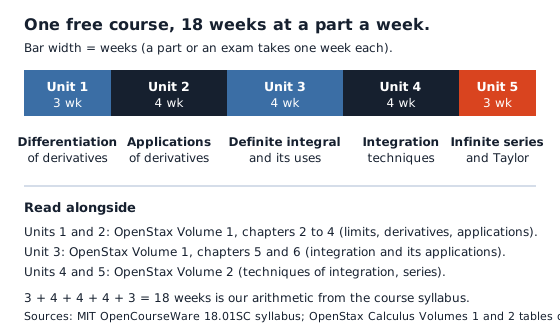
The syllabus of 18.01SC lists 5 units, 13 parts and 5 exams, counting the final1. Giving each part and each exam one week is a calendar you can start tonight.
Worked example (our arithmetic): weeks and hours for the MIT course1
| Unit | Parts | Exams | Weeks |
|---|---|---|---|
| 1. Differentiation | 2 (A and B) | Exam 1 | 2 + 1 = 31 |
| 2. Applications of Differentiation | 3 (A, B and C) | Exam 2 | 3 + 1 = 41 |
| 3. The Definite Integral and its Applications | 3 (A, B and C) | Exam 3 | 3 + 1 = 41 |
| 4. Techniques of Integration | 3 (A, B and C) | Exam 4 | 3 + 1 = 41 |
| 5. Exploring the Infinite | 2 (A and B) | Final Exam | 2 + 1 = 31 |
| Total | 2 + 3 + 3 + 3 + 2 = 13 parts | 5 exams | 13 + 5 = 18 weeks1 |
The UC Davis math department advises two to four hours on each homework assignment5. If each of the 13 parts counts as one assignment, that is 13 × 2 = 26 to 13 × 4 = 52 hours of homework over the 18 weeks, or about 1.4 to 2.9 hours a week on average (our arithmetic)5. Add lecture time on top of that. The point of the sum is the shape: calculus is a habit measured in months, not an evening.
Read the OpenStax chapters beside the units, as the diagram shows: chapters 2 to 4 for derivatives, chapters 5 and 6 for integrals, and Volume 2 for the techniques and series2.
What is the best source to learn calculus?
No single free source wins every learner, so choose by how you learn. If you want a schedule with exams, take the MIT course1. If you want to read at your own speed with checkpoint questions, take OpenStax2. If you prefer to try problems before reading, take Active Calculus3. If you are stuck on one topic, take the matching section of Paul’s Online Notes and its practice problems4. Use the course as the main road and the others as side roads, which is also how MIT frames its own path: read the material for a unit, do the recommended problems, take a sample test7.
Can I teach myself calculus?
Yes, and a path for it has been online for decades. The MIT World Web Math path was written to study calculus in a self paced fashion7. It splits the subject into 10 units, from limits and continuity to infinite series7. The page was last modified July 28, 1998, so use it as a map of the topics and not as a modern course7. Each unit repeats the same loop: read, do as many problems as you need to feel comfortable, take a sample test7.
Three habits from the UC Davis tips page fit self-study well5. Work on calculus every day, because daily practice makes concepts, definitions and theorems familiar5. Memorize definitions, formulas and theorems as they appear, because waiting slows down your homework and gets in the way of deeper understanding5. When a problem stumps you, give it time, because being stumped is a chance for growth even if you never solve it alone5. Preparing for a test with new problems works better than rereading ones you have solved5.
If you study alone, the “study partner” advice still helps: UC Davis suggests finding one or two others to do homework and prepare for exams with5. An online forum or a friend who reads along does the same job.
Is a high IQ required to learn calculus?
The best evidence points to effort, not IQ. A study followed 3,520 students in grades 5 to 10 over six annual waves of data6. Intelligence was linked to math achievement only in the initial development of competence6. Students who felt competent, were intrinsically motivated and used strategies such as summarizing, explaining and connecting ideas grew more, and intelligence had no relation to that growth6. The study measured school students and not adults learning calculus, so read it as evidence about how math skill grows and not as a promise about any one person6.
Where to go next
Soon the ideas get easier to spot in daily life. Read what a derivative is for the core idea, keep the derivative rules cheat sheet open while you practice, and see why math education struggles for the data on how students learn math. More ways to study live in the Learning section. Open MIT OpenCourseWare, OpenStax or Paul’s Online Notes and begin this week.
Common questions
Is a high IQ required to learn calculus?
The best evidence points the other way. A study followed 3,520 students in grades 5 to 10 over six annual waves of data6. Intelligence was linked to math achievement only in the early development of competence, while motivation and study skills mattered more for later growth6. It measured school students, not adults taking calculus6.
Can I self teach myself calculus?
Yes. MIT OpenCourseWare built its calculus course for independent study1, and a separate MIT path was written so that anyone with a web browser and a text book can use it7. The loop is read a unit, work problems until you are comfortable, take a sample test, then repeat7.
Read next
What Is a Derivative in Calculus? Simple Explanation
A derivative is the instantaneous rate of change of a function: the slope of its tangent line. Plain meaning, worked examples, notation and when it fails.
Core ideasDerivative rules cheat sheet
Derivative rules of a first calculus course on one page: all six trig functions, a^x, logs, inverse trig, with examples.
Learning mathWhy American Students Struggle With Math: The Data
U.S. math scores plateaued in 2013 and fell after 2019. See the NAEP, PISA and adult-skills numbers, what builds the gaps, and how math anxiety fits in.
Sources
- Single Variable Calculus (18.01SC) · MIT OpenCourseWare · ocw.mit.edu · checked October 22, 2026
- Calculus Volume 1, Preface · OpenStax, Rice University · openstax.org · checked October 22, 2026
- Active Calculus · Active Calculus project · activecalculus.org · checked October 22, 2026
- Paul's Online Notes: Calculus I · Lamar University · tutorial.math.lamar.edu · checked October 22, 2026
- Tips on Doing Well in Calculus · University of California, Davis, Department of Mathematics · math.ucdavis.edu · checked October 22, 2026
- Motivation, Study Habits, Not IQ, Determine Growth in Math Achievement · Society for Research in Child Development · srcd.org · checked October 22, 2026
- Calculus Independent Study Path · MIT World Web Math · web.mit.edu · checked October 22, 2026
- Highlights of Calculus · MIT OpenCourseWare · ocw.mit.edu · checked October 22, 2026
- Calculus - Math Resources & Test Study Guides · California State University, Sacramento Library · csus.libguides.com · checked October 22, 2026
Published . Every source shows the day it was read. Diagrams: original, by the editors. How we check facts · Report an error.