How it works · Math in daily life
Integrals in Real Life: Examples With Worked Math
Where integrals show up in real life: fuel burned, distance from speed, a race decided by area, net versus total travel. Each one worked out.
Checked against 6 sources (5 textbook, course or government) · By Ambient Math editors
The short answer. An integral adds up a changing rate to give a total: the fuel a boat burns from its fuel-flow rate, the distance an iceboat covers from its speed, the area under a curve15. A motorboat burning 5 − 0.1t³ gallons an hour uses 9.6 gallons in its first 2 hours1.
- The idea
- An integral is the continuous analog of a sum5
- Fuel
- Rate 5 − 0.1t³ gal/hr gives 9.6 gal in 2 hours1
- Race
- Skater speeds integrate to 50 ft versus about 50.6 ft in 5 sec4
Multiply a speed by a time and you get a distance. That works only when the speed holds still. Real speeds, fuel flows and water flows change as you go, and the multiplication has to become a sum of many tiny pieces. That sum is an integral. An integral is the continuous analog of a sum, used to calculate areas, volumes and their generalizations5. Below are three real-life examples from OpenStax and MIT OpenCourseWare, each worked out in full, plus the one trap that catches people. The companion page on derivatives in real life covers the opposite direction, and the daily life section has more.
What an integral does: adding up a rate
Think of a rate as a height and time as a width. Rate times time is then an area, and an integral is the area under the rate curve. Integration was first used for exactly this, finding the area under a curve or determining displacement from velocity5. A definite integral computes the signed area of the region bounded by the graph of a function between two points5.
How do you add up a curved area? The method goes back to Archimedes, who filled irregular shapes with pieces of known area2. By using smaller and smaller rectangles, we get closer and closer approximations to the area2. Taking a limit allows us to calculate the exact area under the curve2.
The shortcut is the Fundamental Theorem of Calculus. Before it, the only tools for a definite integral were geometric area formulas and limits of Riemann sums, and both approaches are extremely cumbersome4. By the theorem, if we can find an antiderivative for the integrand, we can evaluate the definite integral by evaluating the antiderivative at the endpoints of the interval and subtracting4. Differentiation and integration are inverse operations5. A definite integral is a number, while an indefinite integral is a family of functions3.
Example 1: fuel burned
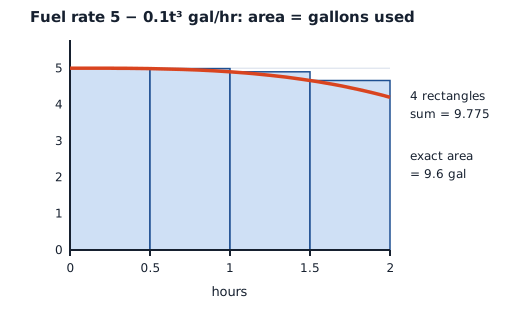
An OpenStax problem starts a motorboat motor at t = 0 and has the boat consume gasoline at 5 − 0.1t³ gallons an hour. How much is used in the first 2 hours1? The net change theorem applies to the flow and consumption of fluids1. The method is to express the problem as a definite integral, integrate, and evaluate using the Fundamental Theorem of Calculus1. The textbook answer is that the motorboat uses 9.6 gal of gas in 2 hours1.
Worked example (our arithmetic): fuel used in 2 hours, exact and by rectangles1
| Step | Calculation | Result |
|---|---|---|
| Antiderivative of 5 − 0.1t³ | 5t − 0.1t⁴ / 4 | 1 |
| Value at t = 2 | 5 × 2 − 0.1 × 16 / 4 = 10 − 0.4 | 9.61 |
| Value at t = 0 | 0 | 01 |
| Exact total | 9.6 − 0 | 9.6 gal1 |
| Four left rectangles, width 0.5 hour | 0.5 × (5 + 4.9875 + 4.9 + 4.6625) | 9.775 gal2 |
| Four right rectangles | 0.5 × (4.9875 + 4.9 + 4.6625 + 4.2) | 9.375 gal2 |
The rate falls from 5 to 4.2, so the left rectangles overshoot and the right ones undershoot. The exact answer, 9.6, sits between them, and more rectangles would squeeze the two estimates toward it2. That squeeze is what the diagram shows.
Example 2: distance from a changing speed
The same OpenStax section has an iceboater, Andrew, whose boat goes at twice the wind speed1. For his first half hour the wind speed increases as v(t) = 20t + 5, and for the second half hour it stays steady at 15 mph1. To find how far he has gone, we integrate his velocity, which is twice the wind speed1. The answer is that Andrew is 25 mi from his starting point after 1 hour1.
Worked example (our arithmetic): the iceboat1
| Piece | Boat speed | Integral | Distance |
|---|---|---|---|
| First half hour, 0 to 0.5 | 2(20t + 5) = 40t + 10 | 20t² + 10t at 0.5, minus 0 | 5 + 5 = 10 mi1 |
| Second half hour, 0.5 to 1 | 2 × 15 = 30 | 30t from 0.5 to 1 | 30 − 15 = 15 mi1 |
| Whole hour | 10 + 15 | 25 mi1 |
Notice the shape of the method. A rate that changes formula halfway is handled by splitting the interval and adding the pieces. The same speedometer idea runs in MIT’s lecture: the integral of speed over time is how far x(t) went, the difference between two odometer readings6. The left side of that equation represents speedometer readings6.
Example 3: a race decided by area
The textbook’s roller-skating race has two skaters on a long straight track, and whoever has gone the farthest after 5 sec wins a prize4. James skates at 5 + 2t feet per second, and Kathy at 10 + cos(πt/2) feet per second4. We need to integrate both functions over the interval from 0 to 5 and see which value is bigger4. James has skated 50 ft after 5 sec4. Kathy has skated approximately 50.6 ft, so she wins, but not by much4.
Worked example (our arithmetic): the race4
| Skater | Antiderivative | Evaluate from 0 to 5 | Distance |
|---|---|---|---|
| James, 5 + 2t | 5t + t² | 25 + 25 | 50 ft4 |
| Kathy, 10 + cos(πt/2) | 10t + (2/π) sin(πt/2) | 50 + 0.6366 × sin(2.5π) | about 50.64 ft4 |
The two nearly tie. At the start James goes 5 ft/s and Kathy 10, at 2 seconds both go 9 ft/s, and at the end James goes 15 and Kathy 104. Kathy is faster early and James late, and only the integral, the accumulated area, tells you who is ahead at the finish.
Net total versus total travelled
An integral tracks signed area. A definite integral is the area above the axis minus the area below it, called the net signed area, and it can be positive, negative or zero3. If the areas above and below the axis are equal, the net signed area is zero3.
That matters for real trips. MIT’s lecture warns that the odometer interpretation fails if velocity changes sign: on a round trip the positive and negative velocities cancel, whereas an odometer would measure the total distance, not the net distance traveled6. The same lecture shows an integral of sin x over 0 to 2π that comes out to 0, because the areas above and below the axis cancel6. The matching rule for odd functions over symmetric limits is in the OpenStax section on net change1.
Worked example (our arithmetic): a round trip6
| Leg | Velocity | Time | Net displacement | Distance on the odometer |
|---|---|---|---|---|
| Out | +40 mph | 1 hour | +40 miles | 40 miles6 |
| Back | −40 mph | 1 hour | −40 miles | 40 miles6 |
| Whole trip | 2 hours | 0 miles | 80 miles6 |
The speeds in this table are our assumptions, chosen to match the lecture’s round-trip case6. Integrate velocity and you get the net change of 0. Integrate the speed, the magnitude of velocity, and you get the 80 miles the odometer shows.
Integrals for dummies: the four steps
- Name the rate. Fuel in gallons per hour, speed in feet per second, flow in liters per minute1.
- Pick the interval. The time span you care about, such as 0 to 2 hours1.
- Find an antiderivative. A function whose derivative is the rate. Any antiderivative works4.
- Evaluate and subtract. Antiderivative at the end minus antiderivative at the start4.
The tools for step 34 are on the derivative rules cheat sheet read backwards, and the page on what an integral is develops the idea from rectangles. For rates that follow a cooling law, see how fast coffee cools.
Mistakes with integral examples
- Mixing units. Gallons per hour times hours gives gallons1. Mix minutes with hours and the total is off by a unit-conversion factor.
- Forgetting that area can be negative. The net signed area can be negative or zero3.
- Confusing net with total. The odometer measures total distance, the integral of velocity gives net displacement6.
- Skipping the limits. An indefinite integral is a family of functions, and only the definite integral is a number3.
- Trusting one rectangle sum. Left and right sums bracket a falling or rising rate, and the exact value needs the limit2.
Common questions
What are some real-life applications of integrals?
Integration was first used for the area under a curve and for displacement from velocity5. It also handles the flow and consumption of fluids, such as fuel used over time1.
Read next
Calculus in everyday life, one morning
Follow one ordinary day and watch calculus run under a cooling coffee, a speedometer, a fenced garden, a bacteria count and a filling tub, with the math shown.
Math in daily lifeDerivatives in Real Life: Examples With Worked Math
Where derivatives show up in real life: speed, population, money, best sizes and linked rates. Each example comes with its numbers worked out.
Math in daily lifeMath in Everyday Life: 7 Examples From One Normal Day
Follow one ordinary day through sleep, GPS, groceries, a forecast, a recipe and savings, and see the arithmetic hiding in each, with the numbers sourced.
Sources
- 5.4 Integration Formulas and the Net Change Theorem, Calculus Volume 1 · OpenStax (Rice University) · openstax.org · checked October 21, 2026
- 5.1 Approximating Areas, Calculus Volume 1 · OpenStax (Rice University) · openstax.org · checked October 21, 2026
- 5.2 The Definite Integral, Calculus Volume 1 · OpenStax (Rice University) · openstax.org · checked October 21, 2026
- 5.3 The Fundamental Theorem of Calculus, Calculus Volume 1 · OpenStax (Rice University) · openstax.org · checked October 21, 2026
- Integral · Wikipedia · en.wikipedia.org · checked October 21, 2026
- 18.01 Single Variable Calculus, Lecture 19: First Fundamental Theorem of Calculus (Fall 2006) · MIT OpenCourseWare · ocw.mit.edu · checked October 21, 2026
Published . Every source shows the day it was read. Diagrams: original, by the editors. How we check facts · Report an error.